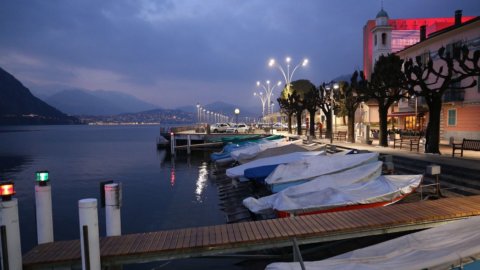
Campione d'Italia is a small town of about 2000 inhabitants, of whom almost five hundred are foreigners (one third are Russians) which overlooks Lake Lugano. Today it is a strip of land, an Italian enclave, in Swiss territory which was originally born as a fief attributed to the Milanese basilica of Sant'Ambrogio and remained as such until the Treaty of Campoformido in 1797, when Napoleon decided to annex it, before to the Cisalpine Republic and then to the Kingdom of Italy.
After Waterloo it became part of the Austrian Lombardo Veneto and in 1861 it definitively passed to the Kingdom of Italy. Also in 1861, the ongoing dispute between Italy and the Swiss Confederation was definitively closed, to which another small enclave of Italian territory on Lake Lugano opposite Campione was ceded.
During the years of Fascism the Municipality, which in the meantime had become "of Italy", was rewarded by the Duce with the concession of the gaming house which until recently constituted a thriving company with 500 employees whose average individual annual cost was 100.000 EUR.
After all, the cost of living in Campione does not differ from the Swiss one and this explains at least in part the high nominal wages. A true gold mine, unfortunately depleted as a result of political and managerial choices that sank first the Casino and then the Municipality.
The management could have been stable in balance but over time the Municipality has demanded more and more from the Casino, arriving in 2014 to collect 37% of the revenues (17% was paid in Venice). Suffice it to say that compared to a "normal" workforce of 13 employees, the Municipality of Campione has hired 102 people with a labor cost in line with that of Switzerland.
To tell the truth, the unions, aware of the abyss that was being created, signed an agreement with the Municipality to reduce employee wages but the "provisional" intervention of a magistrate declared it illegitimate, making it unenforceable.
With the bankruptcy of the Casino declared on 27 July, preceded by the declaration of financial instability of the Municipality of Campione itself and the consequent appointment of the extraordinary liquidation commissioner of the Municipality signed by Sergio Mattarella on 12 July, a dramatic period began for workers and citizens.
In fact, the resumption of activity of the casino is not simple, while in the meantime the regular visitors of the gaming house can easily become customers of other casinos, especially Swiss, but also Italian. Even more difficult is the outplacement of the employees of the Municipality, who already have a few months of salaries in arrears, who will enter the mobility lists receiving 80% of the salary for two years, after which the public employment relationship will be terminated without not even the certainty, at present, of receiving NASPI (unemployment benefits).
In any case, even if public institutions are found, outside the Municipality of Campione, willing to hire their employees, the salaries of the subjects concerned will go from 4-5000 euros per month to 1400-1500. The prospects of impoverishment of an entire community are realistic and, in this case, the specter hovers over Campione, if not of a "ghost town", at least of an oasis of relative poverty surrounded by the well-being of the neighboring Swiss territories. In this scenario, the proposal made to the Government of Bern by the national councilor Marco Romano, Swiss deputy of the Popular Democratic Party, to start negotiations with the Italian Government to transfer sovereignty over the territory (and inhabitants) of Campione to the Swiss Confederation seems almost natural .
It would be a form of annexation which, however, would have nothing to do with distant vicissitudes of territorial disputes in Italian history such as Nice, the hills of Briga and Tenda, least of all Fiume and Dalmatia or Tunisia which, despite being considered a land of emigration Italian, was invaded by France in 1881, pushing our country into the arms of the central empires for more than thirty years.
For what it's worth, it can be added that Switzerland, through the Canton of Ticino, boasts a significant claim against the Municipality of Campione. Moving to Bern would make life easier for the inhabitants of Campione in the future, whose opinion should in any case have a binding value, and would apparently not pose any problems of a political, economic or institutional-patriotic nature to the Italian State.
Has the solution been found for the “Campione case”? It is not said at all, so much so that at the moment there have been no significant responses from the Italian political authorities. The story could instead be presented as a "hostile takeover" and become an interminable via crucis with a multiplication of assistance and patronage recipes to save an island of "Italianness" in a foreign land or the terrain of dispute between experts of international law and constitutionalists, without excluding the intervention of the ordinary judiciary.
Furthermore, it must be taken into account that someone would be alarmed by a precedent useful for soliciting far more important secessionist pushes than the Municipality of Campione. As the Swiss foreign minister himself says, the proposal indicates "an imaginable process", but whether it is feasible in the land of the scammers remains to be demonstrated. For the moment we are going ahead with assistance to the unemployed and with the tiring bankruptcy and commissioner procedures of the Casino and the Municipality, starting with the attempt, so far in vain, to reopen the casino.