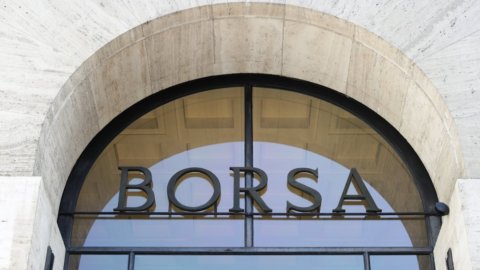
The alarm on public debt launched by Paris slows down the European stock markets today, which close a weak session, after the gains of last week, while a A feeling of uncertainty is creeping into Wall Street In the American morning. Hopes of a US rate cut in September, ignited on Friday by Fed Chairman Jerome Powell, are leaving room for some doubt as we begin a week that must weather two challenging events: Nvidia's quarterly results (Wednesday) and the US PCE inflation data (Friday).
All this in a heated geopolitical context that shows no signs of cooling down. Piazza Affari limits the damage at -0,19% thanks to the banking risk and the umpteenth rebound of Leonardo (+2,32%), which in recent weeks had lost 10% in a single session on the hypothesis of peace talks between Moscow and Kiev.
A much more significant decline hit Paris (-1,59%), alarmed by French Prime Minister Francois Bayrou, who defined the country as over-indebted. The Prime Minister also asked a vote of confidence in Parliament on September 8The spread between OATs and Bunds thus soared, rising to 74 basis points (+5,81%) on the 3,5-year bond, with the French bond yield at 0,52%. This development worsened already weak sentiment on markets across the continent: Frankfurt ultimately fell 1,02%, Madrid 0,2%, Amsterdam XNUMX%, while London was closed for holidays.
Another blow for European stocks was theOrsted's historic lows (-16,35%) on the Copenhagen Stock Exchange after U.S. authorities ordered a halt to work on the $1,5 billion Revolution Wind project off the coast of Rhode Island, which is already 80% complete, with 45 of the planned 65 wind turbines installed. The halt also jeopardizes the success of the 60 billion kroner capital increase announced on August 11 by the Danish company specifically to address the challenges posed by the U.S. decisions.
Wall Street is waiting for Nvidia and is looking at American-style "state capitalism."
The trend is uncertain on Wall Street, where the main indices are currently mixed, with the Nasdaq (+0,1%), but the DJ (-0,41%) and the S&P 500 (-0,16%) are slightly down.
Among the stocks, Nvidia is gaining ground again, after some sessions of losses, plagued by the doubt that the massive investments by the tech world in artificial intelligence will bring adequate returns. The chip giant's quarterly earnings must compete with its numbers, and the bar is increasingly high, which is why stock price fluctuations are estimated to range from plus to minus 6%. There will also be considerable interest in understanding exactly how the deal proposed by US President Donald Trump will work, under which Nvidia will pay the US government 15% of its profits on certain chips sold to China in exchange for export permits.
"Details are scarce, and analysts aren't even sure it's constitutional, but this is state capitalism with American characteristics," Reuters notes today. Regarding Trump's interventionism in the economy, Intel appreciates 2,68% after the U.S. government confirmed it had acquired a 10% stake in the chipmaker.
And this will not remain an isolated case: the US administration could in fact continue to acquire shares in American companies with agreements similar to the one reached with Intel, as White House economic adviser Kevin Hassett said in an interview with CNBC, explaining how the stake in Intel is part of a broader strategy to create a sovereign wealth fund that could also include other companies.
Among the declining stocks Keurig Dr Pepper fell 7,7% after announcing that the company would acquire rival JDE Peet's for approximately $18 billion.
Dollar slightly recovers
The odds of a rate cut in September have risen to around 85%. after Powell's words, but that does not prevent the dollar from rising today. recover some lost ground on Friday, pushing the euro back below 1,17 (1,1688).
The wait for the inflation data in the United States is in fact creating a certain nervousness (growth of 2,9% is estimated in July), since Powell spoke of a temporary price increase due to tariffsThe rate cut is therefore tied to the desire to support the economy and prevent rising unemployment. This combination is not entirely convincing, especially in a week dominated by a massive sell-off of Treasury securities.
On the energy front oil prices are rising todayThe November Brent crude contract is at $68,11 a barrel (+1,32%), while the October futures contract for Texas crude oil is at $64,71 a barrel (+1,65%).
Piazza Affari, MPS and Mediobanca doing well
In Piazza Affari, the focus remains on the banking risk and in particular on the current offer of Ps (+0,9%) up Mediobanca (+0,19%), while Unicredit (-0,39%) strengthens in Commerzbank (-1,15% in Frankfurt), as the largest shareholder, bringing its stake to 26%, including voting rights. "The remaining synthetic position will be converted into physical shares in due course," the bank wrote in a statement, "bringing the total shareholding to approximately 29%." The German government, however, reiterates that it considers the Italian bank's activism towards the German bank hostile.
Good today Popular of Sondrio, +1,02%, after Bper, -0,17%, (which controls the Valtellina bank with over 80%) submitted three lists of 15 candidates for the September 15th meeting to renew its board of directors. Andrea Casini has been appointed chairman, and candidates for the new board include Elvio Sonnino, deputy general manager and chief operating officer of Bper, and Giuseppe Recchi, former president of TIM.
Outside the banking sector and net of Leonardo, Saipem +1,12%, Amplifon +0,71 and Nexi +0,75% rise. The list of the biggest declines among the blue chips opens with cucinelli -1,29%, followed by Prysmian -1,24%, Campari -0,93%, Pirelli -0,88%. Many utilities are also weak.
Spreads up
The seat is in red on the secondary, where the spread between BTPs and Bunds, both with a 86-year maturity, rises to 3,61 basis points. Rates are set at 2,76% and 89%, respectively. On the macro front, German business confidence is improving today, with the Ifo index rising to 88,6 points in August (from XNUMX in July).