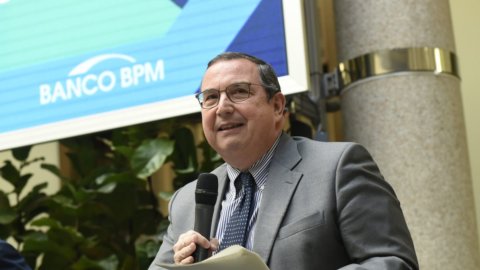
Unlocking potential, building a shared future and investing in people. This is the title of the four-year strategic plan (expiring in 2023) presented in Milan - in a web conference, due to the coronavirus - by the managing director Giuseppe Castagna, who had already made it clear that the near future of the Lombard-Veneto institute will be stand alone : “We will go ahead alone. We made a stand alone plan, we're fresh off a major merger, and we're going forward on our way“, Castagna had already said, excluding a possible involvement in the Intesa-Ubi match or in a consequent banking risk (there was talk of a possible aggregation with Mps).
The first cornerstone of the strategy is substantial remuneration for the shareholders: between the valorisation of the bank and the distribution of dividends, the creation of wealth of two billion is envisaged, of which over 800 million in dividends over the period of the plan, with an average payout of 40% or more. The plan - Castagna specified - "has been extended by a year to have time to achieve all the objectives" and will be guaranteed even in the event of a negative scenario for 2020, as indeed probable given the moonlight of a slowdown of the international economy also and above all due to the effects of the worldwide spread of the coronavirus.
Another aspect, common to all banks and to which even Banco Bpm does not escape, is that of business transformation: the bank will invest more than 600 million euros in technology and digitalisation in the period (+40% compared to the average of the three-year period 2017-2019), "to ensure sustainability and profitability in the future". At the same time, the enhancement of human resources through greater "engagement" is envisaged, but personnel costs will drop from 1,7 to 1,66 billion with 1.100 early retirements and 200 branches closed. Customers will be offered an increasingly multi-channel and digital service, with the adoption of an approach "Mobile first", taking advantage of the Webank experience, and launching the “Relational Branches” (from the current 72% to 80% in the target distribution network), focused on consultancy services and with a complete range of products and services.
Banco Bpm thus aims to relaunch commercial activity, above all through the specialization in services for private and corporate customers (in coordination with Banca Aletti and Banca Akros), and in particular to unlock the still unexpressed potential in the Wealth Management and Family Banking sector. Net fees and commissions in the Wealth Management sector will grow at a CAGR of +6,5% in the period 2019-2023, mainly thanks to a higher ratio between Asset Management/Direct Deposits (which will add 69% in 2023 from 54% in 2019) and to a considerable boost on the front of the placement of investment products.
Another important chapter concerns credit quality and risk reduction. After an excellent track record in derisking in recent years, both in terms of the disposal of non-performing loan portfolios and in terms of workouts, the plan presented by CEO Castagna aims to achieve a further improvement in credit quality, with a target gross NPE ratio of 5,9% (compared to 9,1% at the end of 2019) and a net NPE ratio of 3,0%15 (compared to 5,2% at the end of 2019). A high level of NPL coverage will be maintained throughout the plan horizon and the cost of risk is expected to fall to 51 bps in 2023 (against 73 bps in 2019).
To reduce the risk, monitoring strategies and a new approach in the management of UTPs are envisaged, separating core portfolio (focus on maximizing the return on performing) and non-core. The credit policy is also changing, in support of SMEs but with greater specialization, focus on the risk-return perspective and - another novelty, in the name of sustainability - greater support for ESG initiatives (attention to the reduction of CO2 emissions and energy saving projects).
Finally, the plan will aim at strengthening the balance sheet, to achieve the following financial objectives by 2023: CET1 ratio expected to exceed 12%; the Cost/Income ratio will progressively decrease until it reaches 59%; the revenues they will grow with a CAGR of +0,6% (from 4,3 billion in 2019 to 4,4 billion in 2023), driven by the growth of net commissions (CAGR of +5,1% in the same period); the net profit will grow to around 770 million at the end of the plan (CAGR of +4,3% between 2019 and 2023), corresponding to a RoTE of 7,2%.