International auctions are increasingly rich in vintage cars, where collectors of old and new take part, all in search of the legendary car and to own a part of their history.
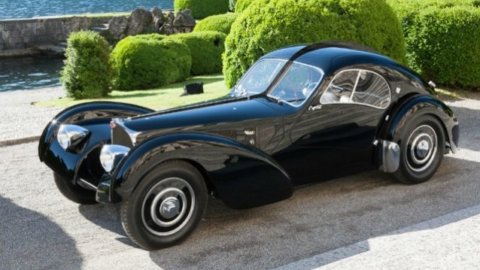
In the spring of 1982, an auction was in full swing in the main courtyard of the Palace of Fontainebleau. The struggle between the wealthy collectors was bitter: "600 francs...650...one, two, sold for 750 francs" as the auctioneer exalted. The object awarded for that amount, one Bugatti, decidedly record-breaking, was an anonymous collector from Paris and it wasn't a diamond or an impressionist painting, it was a Bugatti racing car, put up for sale by the actor Jacques Dufilho. Light blue bodywork, long bonnet, black leather seats and chromed steel dashboard, in short, a four-wheeled masterpiece with 37 spokes.
It was not the most expensive model, there were types 55 and 59 to compete more together with the “Voyage Sedans” type 41, which belonged to the same Bugatti family. And so it was that on 27 June 1985 it was awarded in an auction in Nevada by the collector Jerry Moore for 9 billion lire at the time.
If we think that it was only at the end of the 40s that a second-hand Bugatti could be bought for a trifle. At the time, Francis Mortarini, owner of a repair shop in Neuilly-sur-Seine, bought about two hundred examples from car graveyards. In the early 50s, the American collector Briggs Cunningham bought two Royales, the most luxurious model, directly from the Bugatti family, in exchange for two refrigerators and a few thousand dollars.
Ettore Bugatti, the creator of these jewels, was born in Milan in 1881 into a family that loved art and technology. He built his first car at the age of twenty, an open single-seater with chain drive, with which he won a prize at the Milan World Fair. In the same year he too began to drive racing cars and win several prizes.
In 1904 Bugatti partnered with Emile Mathis, a French manufacturer, but they separated very soon. In 1909 Ettore took over an abandoned dye works in Molsheim in Alsace, and he began again alone to design and build new examples.
With the advent of World War I, he escaped to Paris where he developed an airplane engine for which the United States acquired the patent upon entering the war.
After the conflict, the manufacturer received the nomination of officer of the Legion of Honor for the contribution made to French industry during the First World War and from there its growing success.
In 1930 Bugatti took the first six places at the Monaco Grand Prix, in front of Mercedes, Alfa Romeo and Maserati. While Bugatti blue became the official color of France in international racing.
The first Bugattis were nicknamed the "Purosangue”, fast, snappy and with a pure line, like a racing horse. Perhaps this is why Ettore personally designed the famous horseshoe-shaped radiator plate.
Bugatti only produced 7500 cars in 37 years of activity, but as his biographer Pierre Dumont writes "These cars are the purest and highest expression of the art applied to automobiles".
As well as a defender of the merits of craftsmanship, Bugatti was also an innovator. He invented special wheels and brakes, designed and produced the first automobile used by the French national railways. He obtained about 300 patents, and other inventions such as new types of fishing rods and a ship designed to cross the Atlantic in 8 hours.
On 10 August 1939 a tragedy hit his family, his son Jean, already at the helm of his father's company, died in a car test. Shortly thereafter the Second World War broke out and the Germans occupied the Molsheim works. Hence the move to Bordeaux to produce airplane parts. He returned to Molsheim at the end of the war demanding the return of the factories. With the death of his son and the loss of his best pilots, who died in Nazi concentration camps, his determination was also lacking, tired of a hard life, he died on August 21, 1947. The last of his cars was built in 1955.
In fact, most vintage Bugattis still work beautifully today. The 38 Model 1927 can reach 130 kilometers per hour with three people on board.
Some men have gone bankrupt for the love of Bugatti, as in the case of Henri and Fritz Schlumpf, Swiss textile manufacturers, who bought hundreds of classic cars, including 123 Bugattis.
This somewhat expensive passion is a true treasure hunt for a model that is now unobtainable, to the point that for those who cannot get close to certain figures, they have begun to access model making, a market that is also growing sharply.