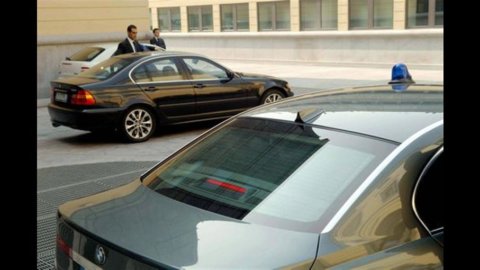
Means of transport most hated by Italians and a privilege that the gotha of the public administration is not resigned to letting go. Symbol par excellence of caste, in recent times it costs less, but the cut - this time - does not proceed as quickly as it should. The blue cars resist. Between 2009 and 2011, spending on state cars fell by 16% and the annual savings amounted to 280 million euros. It is a pity that 44% of the administrations are still late with the cost reduction programme. The Minister of Public Administration, Filippo Patroni Griffi, therefore admitted that on the reduction of expenses for blue cars "the public administration can and must do more".
The numbers were published today in the monitoring carried out by the Department of Public Administration through Formez (Research and Training Center for Public Administration).
In addition to the money spent, the survey also took into consideration the average distance traveled and the number of drivers employed between 10 May and 30 June 2012. The picture that emerges reveals that the overall expenditure incurred in 2011 for the management of the car amounts to one billion and 220 million euros (excluding special plates, police bodies and the armed forces), of which over 73% concerns personnel costs.
Compared to 2009, spending decreased by 15,9%: -11,9% in the central public administration and -16,8% in the local one. In absolute terms, compared to 2009, the reduction in expenditure is more than 200 million euros per year and rises to 280 million euros per year for 2012, on the basis of the further decrease in cars which took place in the first half-year and recorded by the permanent census again managed by Formez on behalf of the Department of Public Administration.
The administrations that have made savings, also considering personnel expenses, are 81,6%, of which, however, only 31,4% have reached or exceeded the savings quota set by law (20% less than costs compared to 2009). On the other hand, 18,4% of the institutions actually increased spending, 6,1 by more than 20%.
If personnel are not considered, also due to the substantial increases in the cost of fuel, only 55,4% of the total achieved savings, while 44,6% show uncertainty or even significantly increased outgoings compared to 2009.