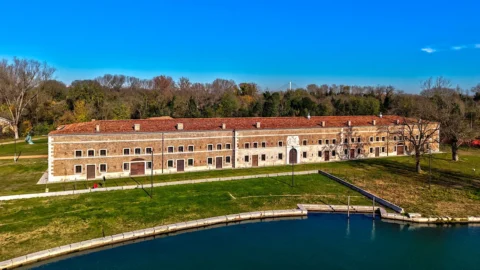
Two twin 19th-century buildings overlooking the Forte Marghera dock, on Ridotto Island, nestled between land and lagoon—one of the most evocative spaces of the fortified complex—have been restored and returned to the public. For the first time in their long history, the public will be able to access the Casermetta Est of Forte Marghera, also known as the Napoleonic Casermetta. This monumental structure, designed under French rule, is the subject of a comprehensive conservation project carried out by the City of Venice and entrusted to the Fondazione Musei Civici di Venezia. The result is a new gathering place, dedicated to contemporary culture and with a particular focus on promoting young artists.
A new cultural hub for young artists and authors
With the reopening of the Casermetta, the Fondazione Musei Civici di Venezia begins a new chapter in promoting research into contemporary artistic languages, with a particular focus on emerging artists. The project expands its network dedicated to contemporary art, closely connected to the activities MUVE conducts in the museums of Modern and Contemporary Art in Venice and, above all, to the artistic production in the heart of Mestre, at the Emeroteca dell'Arte. The new space in Forte Marghera will host the post-residency group exhibitions of the artists who, for the second consecutive year, live and work in the center dedicated to creation and creativity, reopened in 2024. It will also host the annual exhibitions of the competition. Creators of our Time, which brings together works by young creatives selected through an international call promoted by the City of Venice. The Casermetta thus confirms its position as a hub for the emerging Venetian art scene: an open, dynamic, and accessible space designed to host exhibitions, meetings, workshops, and opportunities for artists, the public, and the community to engage.
A new place for the city
Overlooking the bay of Forte Marghera, the Casermetta Est (East Barracks) has regained its public and cultural function, contributing to the rebirth of one of the city's most significant historical complexes. Thanks to the restoration and management of the Fondazione Musei Civici (Civic Museums Foundation), this 19th-century building has become a place where tradition and modernity meet, offering residents and visitors new spaces for culture, creativity, and participation.
A war structure reborn in the name of art
Originally designed by the French as a bomb-proof military structure, the Casermetta Est (East Barracks), along with its twin building, represents the most emblematic element of Forte Marghera's 19th-century monumental heritage. For this reason, it has been the subject of in-depth studies and preliminary investigations, which have allowed for a close analysis of both the buildings and the original Napoleonic design. The project is part of a broader redevelopment program for Forte Marghera, which in recent years has affected numerous historic buildings in the complex. The two Napoleonic Barracks offer over 2.500 square meters of total space for cultural activities and exhibitions. The Casermetta Est has undergone a meticulous restoration, with an investment of €4,7 million. The project was overseen by architect Riccardo Cianchetti, with engineer Andrea Ruggero as project manager, in coordination with the Public Works Department of the City of Venice and the management of MUVE.
GRANDA. The artists of the 2024–2025 Ateliers
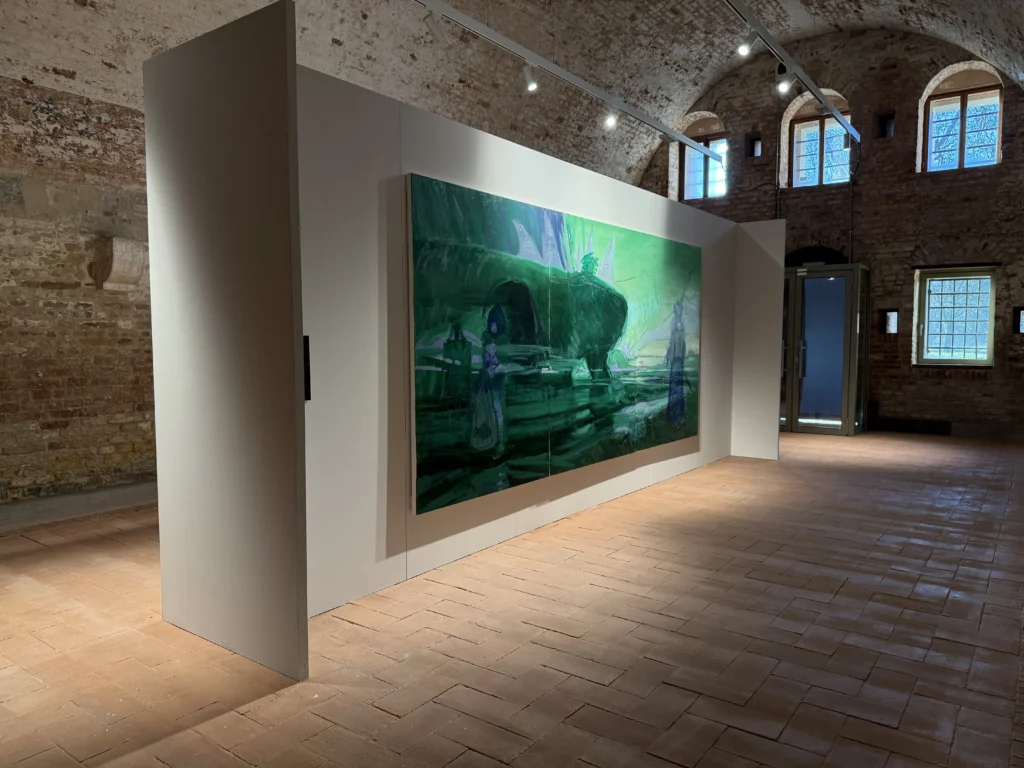
The exhibition BIG arrives in the new exhibition space of the Casermette in Forte Marghera with a renovated installation, designed to welcome and showcase all 27 artists from the Bevilacqua La Masa and MUVE Foundation residencies for 2024–2025. United by the regenerative vision of spaces returned to the community, the artists present a wide-ranging group exhibition that explores the plurality of contemporary art languages, spanning diverse practices, generations, and sensibilities. The exhibition also offers an opportunity to present to the public the research developed in the fifteen historic Venetian ateliers and the thirteen studios of the Emeroteca dell'Arte in Mestre. Accompanying the works, the exhibition catalog features images from the first installation in Venice, held between the Galleria di San Marco and the Palazzetto Tito, along with critical texts and in-depth materials. Photographs by Giacomo Bianco and Nico Covre, complemented by graphic design by the Venice-based Studio Bruno, create a volume that reflects the residency's visual identity.