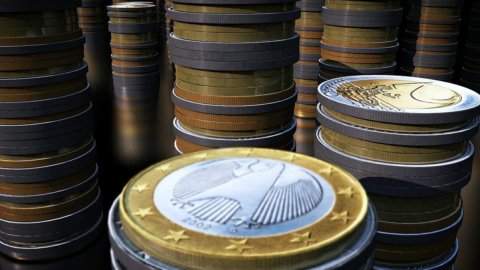
After a long gestation, exactly 23 ago the euro was officially born, the single European currency, used today by 19 countries of the European Union, ie all except Denmark, Sweden, the Czech Republic, Hungary, Poland, Bulgaria, Romania and Croatia. The total number of people who use the euro today across the continent, obviously including Italy, exceeds 337 million. Net of the long preliminary phase and the preparatory agreements for monetary union (Schengen in 1985 already established the free movement of people, money and goods, then above all Maastricht in 1992 and the January 1, 1994 when the European Monetary Institute was established), the final signature came on 3 May 1998 shortly after midnight, when the European Council decided that 11 of the then 15 Member States of the European Union (Austria, Belgium, Germany, Finland, France, Ireland, Italy, Luxembourg, Netherlands, Portugal e Spain) met the economic (high degree of price stability, sound public finances, stable exchange rate, low long-term interest rates) and legal (independence of the national central bank) convergence criteria set by the EC Treaty for the purposes of the entry into the single currency.
In reality, the Council was held on May 2, but the decisive signature of Jacques Chirac and Helmut Kohl, French president and German chancellor at the time, arrived just after midnight, at 00:08 to be precise. From that moment the path went downhill, and within a few years it was completed with the effective entry into force of the euro. A few weeks after that Council, in fact, the European Central Bank took office (June 1, 1998), whose first president was the Dutch Wim Duisenberg, then succeeded by the French Jean-Claude Trichet and from 2011 to 2019 by our Mario Draghi, now Italian premier. In the first three years after its establishment, the euro played the role of scriptural currency: cash was introduced January 1, 2002 in the 11 States mentioned above, to which Greece was added in the meantime. The old currencies were left with a transition period before making them disappear completely from circulation: the Italian lira, which changed at 1936,27 with the euro, definitively ceased to exist on 1 March 2002.
Subsequently, they entered the euro area Slovenia, from 1 January 2007, Cyprus e Malta from 1 January 2008, the Slovakia from 1 January 2009, theEstonia from 1 January 2011, the Latvia from 1 January 2014, the Lithuania from 1 January 2015.