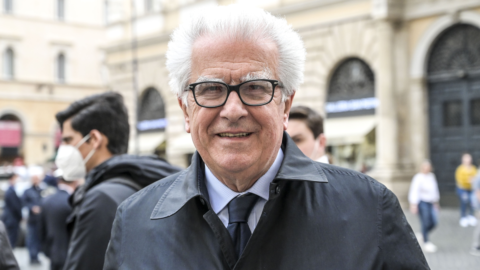
Among the supporters of the No to Meloni-Nordio Justice Reform in the next referendum, the vote of Louis Zanda – a parliamentarian for over twenty years, first for the Margherita party and then for the Democratic Party, where he was President of the Senate – is one of the least predictable. Because Zanda, a lawyer first and then a man of the institutions, doesn't follow party orders but is accustomed to thinking for himself. And in fact, when the Schlein secretariat was still considered an untouchable totem, Zanda was among the first to express doubts and to state bluntly that the Democratic Party and the broad camp, if they don't first clarify their foreign policy and beyond, risk never reaching Palazzo Chigi. But in view of the referendum, his will be a clear No, while acknowledging that "the justice reform it does not affect the independence and autonomy of magistrates“. So why not? “For reasons of merit and for political reasons,” explains Luigi Zanda in this interview with FIRST onlineLet's hear it.
President Zanda, perfect or not, can the justice reform that will be submitted to the referendum be the starting point for shaking up a judiciary that isn't particularly popular with citizens and that has often accustomed us to political encroachments?
This question contains perhaps the most important motivation for the promoters of career separation. When the Tangentopoli scandal broke out in the 1990s, the Mani Pulite team was criticized not so much for the content of the investigations as for the casualness of the investigative methods: on the basis of the old rule that dog doesn't eat dogMany thought that the magistrates tasked with passing judgment on the prosecutor's office's activities were very lenient because they all belonged to the same career path. Today, in reality, the situation has changed significantly, and, honestly, we must say that the spirit of collaboration that was so worrying in the 1990s is much less evident. This is demonstrated by the numerous cases in which judges disavow the actions of public prosecutors, even sensational cases such as – in Milan – the Eni-Nigeria trial and the investigation into urban planning.
So a shock isn't necessary?
"You don't change the Constitution to shake things up. When necessary, the Constitution is changed to adapt to changing times, and if possible, it is changed together, by the majority and the opposition—a principle that the center-left has violated in the past, and which the right is now violating."
She will vote No. But is this reform completely worth throwing away or is there something that can be salvaged?
I will vote No, but first I want to say that the reform does not affect the independence and autonomy of judges or investigating magistrates. Nor does it undermine the rule of law because it was approved pursuant to the Constitution and will be submitted to a referendum, also pursuant to the Constitution. Nor does it undermine the separation of powers because it confirms, precisely, their autonomy and independence.
So, why are you against it?
“For reasons of merit and for political reasons.”
For example?
The main reason for this is that separating careers and, consequently, establishing a CSM to administer the careers of public prosecutors will inevitably lead to a corporation. Today, given that there is a single career, prosecutors are administered by a Higher Council comprising prosecutors and, in the natural proportion, also judges. Tomorrow, however, we will have a corporation that, through its own CSM, will self-assign roles and assignments. This is a very high-risk operation because, under the Constitution, public prosecutors have absolute discretion in choosing which investigations to conduct, with powers that impact the freedom and integrity of citizens.
Is the draw also among the objections of merit?
"Having written the drawing of lots into the Constitution is extremely serious. Constitutionalizing the drawing of lots as a method for selecting highly sensitive public offices is an abomination."
Couldn't it be useful – as those who defend the draw and support the reform argue – to contain the anomaly of the currents?
"Political spirit is in people's minds. And everyone, elected or drawn, is the bearer of their own political opinion. The difference is that with the drawing of lots, these opinions will manifest themselves randomly; that is, chance will determine the orientations of those designated. Random positions will emerge in the CSM. I would have preferred to see work done on the electoral system: a good electoral system can make it very difficult for factions to influence it."
And what are the political reasons instead?
The first political reason is that the politicization of this referendum was desired by the government, because the bill belongs to the government, not Parliament. During the parliamentary deliberations, the opposition was not involved at all; the text remained unchanged as presented. And then it was the government that demanded the referendum, having the majority parliamentarians request it, almost as if to solicit a vote of confidence. At this point, the opposition has no choice but to vote against it, for precisely political reasons.
And then what?
Another political reason is that the founding fathers, who were certainly not naive, wanted a single career path. Let's ask ourselves why. Perhaps also to prevent prosecutors from slipping into a police-like situation. And then because they believed that coming from the same competitive exam, having the same career path, could create a shared culture. Over these 80 years, the single career path has had moments when it has shown significant limitations, but undermining this balance by creating another opposite one seems very risky to me.
A risk that, in your opinion, the Keeper of the Seals Nordio has not calculated?
I know Nordio, who is a cultured and thoughtful person, and I don't understand what led him to appreciate Licio Gelli's theses. I also believe that if he presented this reform bill, he did so because he thought it was perfect. Otherwise, from what I know him, he wouldn't have presented it. But he was wrong and guilty of naivety and unawareness of the risks Italy faces, creating a corporation of public prosecutors that will produce results opposite to those imagined. In short, instead of cutting the prosecutors' claws, they are sharpening them. And then there is also a certain unawareness of the difficulties that will arise in implementing the constitutional provision. It will be a more complex operation than has been estimated. The merit of the Cartabia law lies not only in having produced excellent results, essentially preventing the transition from the investigating magistracy to the judiciary and vice versa, but also in having done so using ordinary law. The risk that Nordio failed to calculate is, in my opinion, the depth and irreversibility of wanting to impose a change to the Constitution".
But is yours a merely constitutional objection or also a political one?
"Look, there's a political connection between the Nordio-Meloni reform, which targeted magistrates and constitutional culture, and the virulent controversy against Quirinale Councilor Francesco Saverio Garofani. In both cases, there was a lack of the respect and prudence that are always necessary in institutional relations in a democracy: when they're lacking, the state ceases to function in an orderly manner."
What then do you answer to those who insist on the need for a fair trial?
Today, they want to separate careers to destroy contiguity, in the belief that this will complete the constitutional reform on due process, which places prosecution and defense on equal footing with respect to the third-party judge: this is the main argument of those who support the separation. I repeat, the good laws of the last twenty years have already achieved this goal by making the transitions essentially impossible, and they have done so without undermining the Constitution or inventing draws. The need for due process is very serious, and it seems to me that it has already been satisfied. Moreover, I see that in the Nordio reform, both investigators and judges continue to be called magistrates.
Even among the No supporters, there are those who warn that it would be a mistake to follow the ANM's position in the referendum. But does the fact that the No Committee is represented everywhere by Judge Gratteri seem like an appropriate choice to you?
“I respect Gratteri but I am not influenced one way or another by his opinions.”
The referendum will inevitably have a strong political impact: will the vote be on the content of the reform or on Prime Minister Meloni?
"Giorgia Meloni, by presenting the government's constitutional proposal, rejecting amendments to the text, and having her parliamentarians call for a referendum, will lead many to vote on the government rather than the reform. This is especially true because the referendum vote will fall not far from the general election, and it's possible that whoever wins the referendum will also win the general election immediately afterward."
Will whoever loses the referendum – whether it's Giorgia Meloni or Elly Schlein – have to resign?
"We have precedents that suggest one or the other solution. Both Meloni and Schlein seem sufficiently attached to their positions and I don't think they will resign."
But if the referendum passes, what effects would it have on the Democratic Party's stability?
“It would certainly be another serious failure and they won't be toasting with happiness.”
READ MORE Justice Referendum: An Interview with Attorney Caiazza di M. Scacchioli