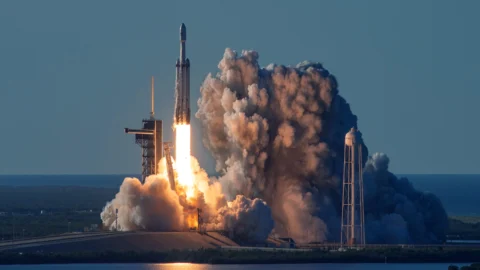
The big day has arrived. SpaceX goes public and points to rewriting the history of IPOs, with a debut that could become the largest ever on global markets. Elon Musk's company, active in rockets, satellites and artificial intelligence, is expected today at Nasdaq and on the Nasdaq Texas under the symbol SPCX, accompanied by record demand and extremely high expectations.
The offer is set at $135 per share, with 555,6 million shares on sale. SpaceX will thus raise approximately 75 billion dollars and will present itself to the market with a valuation close to $1.800 trillionA size that brings the operation well beyond the previous record of Saudi Aramco, which raised $29,4 billion in 2019.
The launch comes at a challenging time for Wall Street, weighed down by geopolitical tensions, rising oil prices, and concerns about the resilience of technology stocks after months of rallying. But SpaceX's IPO is on a different track. Investor interest has been overwhelming and turns the listing into a market test not only for Musk, but for the entire artificial intelligence sector and for large private companies ready to compete on the stock exchange.
SpaceX and the charge of small investors
The most obvious push came from the retail investorsThe orders of individual savers according to Bloomberg have exceeded 70 billion dollars, a level that makes a strong selection in the assignments inevitable. Retail customers should be given at least 20% of the available shares, although the hypothesis of a share of up to 30% had previously been circulated. individual application, based on the overall size of the offering, will remain largely unsatisfiedThis could put further pressure on the stock once trading opens, as many investors who missed out on the IPO may try to enter the market directly.
Tesla's legacy weighs heavily on the background. Over the years, Musk has built a very large and loyal retail base, capable of accompanying the automaker's stock growth and influencing market sentiment. SpaceX is now attempting to tap into the same enthusiasm, but on an even more ambitious scale, with an industrial narrative that combines space launches, satellite networking, computing infrastructure, and artificial intelligence.
The interest is not limited to small investors. SpaceX has rreceived orders from around a thousand institutional investors as wellSome reports indicate total demand exceeds $250 billion, representing a 3,5- to 4-times oversubscribed offering. Less than 10% of the shares are expected to be allocated to international orders, while the quota reserved for Japan has been increased to $2,5 billion from the initial $2 billion.
SpaceX: A $1.800 trillion giant with Starlink and artificial intelligence
SpaceX isn't going public like a typical aerospace company. The group has built its industrial clout on commercial launches and the Starlink satellite network, but the valuation reflects a much broader bet. The market is eyeing the possibility of the company becoming a global technology platform, capable of combining connectivity, space infrastructure and artificial intelligence.
Starlink remains the most concrete heart of the businessThe satellite internet network generated a significant portion of the group's revenue, profits, and growth in the last fiscal year. In the three months ended March 31, SpaceX's revenue rose to $4,69 billion from $4,07 billion in the same period the previous year. However, its loss per share widened to $1,27 from 18 cents previously. In 2025, the company swung from a profit of $791 million to a net loss of $4,94 billion.
The market is therefore also pricing in a significant portion of the future. SpaceX's valuation includes ambitions related to orbital data centers, artificial intelligence infrastructure in space, missions to Mars and integration with xAI, Musk's startup that develops the Grok model. At the beginning of the year SpaceX merged with xAI in a deal that valued the aerospace company at $1.000 trillion and the chatbot developer at $250 billion.
The structure of the IPO confirms the will of raise capital without loosening controlThe offering is expected to be entirely primary, with proceeds going to the company and no share sales by current shareholders. Musk will also be required to hold his SpaceX shares for 366 days after the listing. Governance, through a dual-class share structure, will retain voting power in the hands of the founder and a select group of executives.
The market divided between dreams and valuations
SpaceX's IPO has sparked one of the divisions clearer among market observers. On the one hand, there are those who see the title as a bet on the next global technological infrastructure and on the other hand there are those who consider the already very tight evaluation, especially in light of still volatile economic results and industrial plans that depend on markets that are largely yet to be built.
Among the most optimistic voices, New Street Research has indicated a target of $165 per share, approximately 22% above the IPO price. Such a valuation would bring the company's market capitalization to around $2.300 trillion. The bullish scenario is based on very aggressive growth assumptions, with estimated revenues of $195 billion and operating income of $65 billion by 2030. more cautious assessments, instead, the price already incorporates a very high share of future promises. Morningstar It indicated a fair value of $63 per share, significantly lower than the offering price. The gap between the two readings captures the crux of the debut: SpaceX can be considered a new strategic infrastructure for the digital economy, or an exceptional company trading at multiples that leave little room for error.
The test will only come with the first trading sessions, when the pre-market euphoria will have to be measured against the actual market price.
Also debuts on Piazza Affari
The listing of SpaceX will also have repercussions for Italian investors. Borsa Italiana announced that from today the shares of Space Exploration Technologies are admitted to trading on Euronext GEM, the market dedicated to companies listed in Europe and the United States. The ISIN code will be US84615Q1031.
Traders will be able to place, modify, and cancel orders starting at 7:30 a.m. Italian time, but trades will only be concluded after the first trading price on the Nasdaq has been determined. Also starting today, SpaceX shares will also be available for After Hours Trading.
The day will therefore be marked by two distinct phases. First, there's the IPO price, set at $135. Then, there's the first trading price on the market, which could deviate significantly from the offering price if the demand left over from the allocation spills over into the stock.
For Musk it's a new test. For Wall Street it's a test on the hunger for great tech stories after years of slow IPO market.