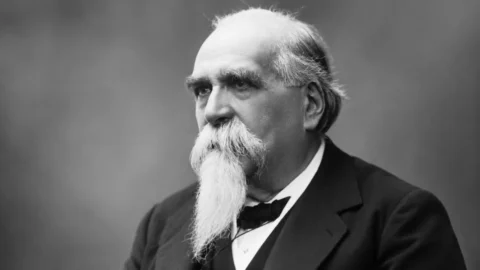
Today we're talking about access to credit, support for small businesses, and the relationship between banks and local communities. These are timely topics, but they Luigi Luzzatti had already placed it at the centre of his thinking in the second half of the nineteenth century.
An economist, jurist, university professor, minister, and Prime Minister of the Kingdom of Italy, Luzzatti was, above all, the man who envisioned a different kind of bank: closer to communities, founded on participation and the ability of local savings to translate into growth for the local area. From that vision came the Italian Popular Banks, destined to change the history of cooperative credit in our country.
Almost a hundred years after his death, his idea of finance linked to community development returns to the centre of the debate thanks to the volume “Luigi Luzzatti seen up close", published by theNational Association of Popular Banks On the occasion of the 150th anniversary of its founding, this book not only retraces Luzzatti's life, but also brings together contributions from economists, bankers, and key figures in Italian institutions to reinterpret the legacy of one of the great reformers of liberal Italy.
Who was Luigi Luzzatti: from economics to leading the Italian government?
Born in Venice on March 1, 1841, and died in Rome on March 29, 1927, Luigi Luzzatti was a jurist, economist, university professor, banker, and politician. After graduating in law from the University of Padua, he began to study political economy, attracting the attention of the Austrian authorities for his liberal ideas in the period preceding the unification of Italy.
His public career was long and intense. He was a member of parliament for almost fifty years, treasury minister in different governments, Minister of Finance, senator of the Kingdom and President of the Council of Ministers From March 31, 1910, to March 29, 1911, during the reign of Victor Emmanuel III. He was also one of the three presidents of the Council of Italian Jews from the time of Italian unification, along with Alessandro Fortis and Sidney Sonnino. His government coincided with the fiftieth anniversary of national unification, celebrated in 1911 with large demonstrations throughout the country.
But his deepest legacy comes not from the halls of politics, but from his ideas on credit.
Luigi Luzzatti and the birth of the People's Banks: credit as a social instrument
In 1863, at the age of just twenty-two, Luzzatti published “The diffusion of credit and popular banks”, a text destined to leave a profound mark on Italian economic history.
The inspiration came from the German's experience Franz Hermann Schulze-Delitzsch, promoter of cooperative banks in Germany. But Luzzatti didn't simply import a foreign model: he adapted it to the Italian reality, envisioning institutions capable of meeting the needs of a still young society, made up of small producers, merchants, and artisans who were often excluded from the traditional banking system.
For Luzzatti, credit also had a social function. It wasn't just a question of money, but of opportunity: enabling capable people to transform a project into a business.
From theory to reality: the first Italian cooperative banks are born
Luzzatti's intuition quickly became reality. In 1864 he contributed to the foundation of the Banca Popolare di Lodi together with Tiziano Zalli. In 1865 he founded the Banca Popolare di Milano, of which he was president in the early years and subsequently honorary president until his death. The Popular Banks model introduced a new principle: a form of finance built around communities, with broader participation and a direct relationship with the local communities. It was not just a new form of banking, but a different concept of economic development: locally raised savings were to be used to support local growth.
The phenomenon had an extraordinary growth. In 1876, year of birth of the National Association of Popular Banks, there were already 118 institutions. On the eve of the First World War they had become 848, with around half a million members and a significant role in the national credit system.
For Luzzatti, however, success wasn't measured solely in numbers. The real challenge was to get credit where it was still lacking. In 1881, he wrote to the members of the Banca Popolare di Milano asking for support in the development of popular banks in the South, because – in his vision – the unity of the country also had to pass through access to economic opportunities.
Not just banks: Luzzatti, the builder of institutions
Luzzatti was not only the father of the People's Banks. His idea of progress was much broader: to build institutions capable of accompanying the economical progress with that socialHe was among the protagonists of the birth of theCa 'Foscari University of Venice, founded in 1868 together with Edoardo Deodati and Francesco Ferrara, the first Italian university dedicated to economic studies. From professor of constitutional law toUniversity of Padua and as a scholar, he continued to support a precise belief: knowledge, like credit, had to be accessible and become a lever for collective growth.
The same approach guided his commitment to social policiesIn 1903 he promoted the law that led to the creation of the Autonomous Institutes for Public Housing, while during his government the Daneo-Credaro law of 1911 was approved, which strengthened the role of the state in elementary education in the poorest municipalities.
In every field, the same idea emerged: to build institutions capable of expanding people's possibilities.
An economist with an international vision
His gaze did not stop at the Italian borders. He participated in the great debates on international monetary cooperation in the age of bimetallism and he foresaw a problem that would mark the twentieth century: an increasingly connected economy would need shared rules and institutions capable of guaranteeing stability. His proposal for a greater collaboration between central banks anticipated themes that would become central again decades later, up until the major international financial agreements of the post-war period.
Here too, the same common thread emerges: for Luzzatti, the economy could not be left solely to market dynamics, but required responsibility, balance, and cooperation.
From Federico Caffè to Guido Carli: A book chronicling Luzzatti's legacy
The volume Luigi Luzzatti seen from close up collects contributions from some of the most authoritative figures in Italian economic and institutional culture.
Federico Coffee analyzes Luzzatti as a key figure in Italian economic development and a proponent of credit capable of generating social progress. Guido Carli elaborates on his vision of international monetary cooperation. William Meat cutter focuses on the relationship between economy and social growth. Franco Bonelli reconstructs the relationship with the Bank of Italy, while Oddone Fantini, Ezio Nepi, Carlo Marzano e Stefano Silent They address issues such as banking cooperation, the protection of savings, the role of the State, and the transparency of public finances.
What emerges is the portrait of a man who never separated economics, institutions and social responsibility.
Why Luigi Luzzatti and the Popular Banks are still relevant today
Nearly a century after his death, many of the questions Luzzatti's questions remain open: how can we guarantee credit to small businesses? How can we maintain a strong relationship between banks and local communities? How can we transform savings into growth?
In a profoundly changed banking system, marked by the concentration of the institutes and from digital transformationRemembering Luzzatti doesn't mean looking back nostalgically, but questioning the role finance can still play in community development. This is why the important lesson left by the founder of the People's Banks remains relevant today: a bank's value is not only for the capital it safeguards, but for the future it helps build around it.