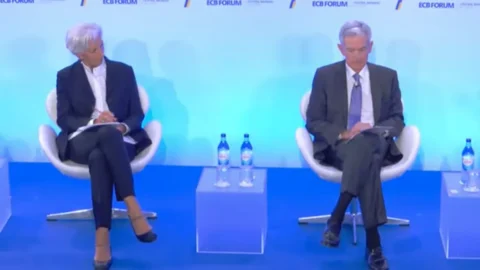
Jerome Powell, head of the US Fed, e Christine Lagarde, at the helm of the ECB, reiterated their positions without shaking the markets. From Sintra, Portugal, where the Central Bank forum European, both leaders reiterated a now familiar message: there is no rush to reduce interest rates.
In the aftermath of Lagarde's inaugural speech on the first day of the Sintra forum, the president of the ECB highlighted that the euro zone is "very advanced" on the disinflation path, but also underlined the existence of "uncertainties" regarding the prospects of economic growth. Powell, for his part, reiterated the Fed's cautious policy: “We need further data on inflation” before considering easing monetary restrictions.
Both leaders agreed on the need to carefully evaluate the risks of premature or late action on interest rate policy, ensuring prudent management of inflation and economic growth in the respective economic blocs. In short, if there was a disconnect on monetary policy decisions in June, there could now be a realignment.
Lagarde: “Good drop in inflation in June but still a bumpy road”
In June there was a decline compared to the previous month, a positive sign for Lagarde, but she underlined that thecore inflation which "remains high", especially in the service sector. He described the path to “the return of inflation to the 2% target as bumpy until the end of 2024”, expecting the target to be reached only “by the end of 2025”, and made it clear that any decision on monetary policy will be based on available economic data and changes in the global economic landscape. He described the disinflation process as "non-linear" and "not predetermined", but rather a path that requires continuous evaluation, especially in a context of uncertainty and ambiguity about the future. Especially in relation to the dynamics "between profits, wages and productivity, and the possibility of new supply shocks in the economy".
“We are in that slow recovery that occurred in the first quarter and which we hope will persist, but all of this is (full) of uncertainty and big question marks about the future.” Answering questions about a possible return to interest rate policy close to zero in the absence of a crisis, Lagarde considered this scenario very unlikely, preferring to focus on the positive signs of economic stability that such a discussion could imply, but clarified that this is not the context in which they currently exist.
On external influences, Lagarde emphasized the importance of making autonomous decisions based on the economic reality of the euro area. And he calmed the markets on French elections: “I do not comment on the political situation of any of the member states, especially during elections. But the European Central Bank has to do what it has to do. Our mandate is price stability that is based on financial stability." And he concluded: “We monitor and are attentive to this because it is part of our job and we will continue to do so.”
Powell: “Before cutting rates we need more data on falling inflation”
For his part, the president of the United States Federal Reserve reiterated the solidity of the US economy despite global uncertainties. Powell highlighted “significant progress” towards reaching the 2% inflation target, but emphasized the need to confirm that inflation continues to move towards this target before considering easing restrictive monetary policy. To the possibility of a cut in September, Powell slows down again, as Lagarde did yesterday, saying that she did not want to "set a precise date", underlining the Fed's desire to acquire "greater confidence". He also reiterated the resilience of American economic fundamentals despite pessimistic recession forecasts. Therefore, he emphasized the importance of maintaining a restrictive monetary policy, citing the “strong labor market and growth” as key pillars.
Regarding inflation in services, Powell described a complex situation, noting an improved balance in the labor market with sustainable wages, but also signaling a moderation in wage increases. He highlighted a gradual decline in inflation, especially in sectors such as insurance and real estate, where rent increases pose a challenge. The Fed's number one projected that inflation may not reach 2% by 2024, perhaps aiming more at 2026 for that goal.
Finally, Powell also defended the independence of the Fed, reiterating that decisions will not be influenced by external political considerations (such as the possible presidency of Donald Trump in the USA in case of victory).