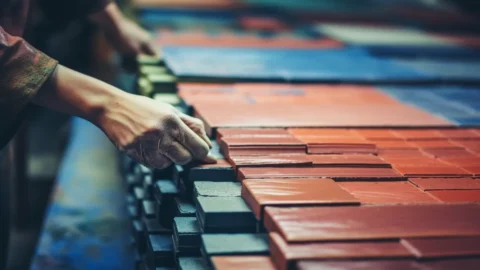
In 2024, the Italian industry ceramic tiles prepares to close the year with a light growth: in fact, a increase in sales, which will reach 376 million square meters, with a +1,9% compared to 2023. Despite a decline in the construction market, the sector appears resilient, even if 2025 could bring some more difficulties. exports are the beating heart of this growth, with 291 million square meters sold abroad (+2,4%), while the domestic market remained fairly stable, with approximately 85 million square meters sold (+0,3%). This is what emerged from the press conference of the end of the year Confindustria Ceramica, who presented the preliminary budget drawn up by Promethea. Despite the increase in sales, production is expected to fall by 2%, a sign that, despite selling more tiles, the production machine is slowing down. Demand on foreign markets has been a bit of a rollercoaster ride: some highs, some lows, but with a significant recovery in North America e Asia, while the 'Europe has seen stagnant growth. If we look at pre-pandemic numbers, the sector is down 7,5%, a figure that makes it even more important to decisively address future challenges.
Ciarrocchi (Confindustria Ceramica): “Abandon ideological approach in environmental regulations”
“The competitive context in which our companies are called to operate will be determined by decisions of extraordinary importance that Europe will take in the coming months, for which we ask for the support and backing of all national and European institutions”, declared the president of Confindustria Ceramica, Augusto Ciarrocchi. “We are in favor of a pragmatic decarbonization – he continued –, which occurs in times appropriate to the technologies actually available, while avoiding continuing to penalize our industry which, thanks to the significant investments made over the years, has already started paths with reductions in emissions that have no equal in the international context. It is essential that in the definition of environmental regulations we abandon the ideological approach followed up to now – which defines the goal and the times a priori -, without considering what are the possible paths to take to reach the result”.
The president did not just talk about decarbonization. He also stressed the need for review the ETS system, which, according to him, transforms the obligation to purchase CO2 quotas into a real tax on production, penalising the most efficient technologies such as cogeneration. Ceramic Bref, the new regulations that will establish the best available techniques, has been defined as a set of limits that are technically impossible to respect and lacking a concrete economic evaluation, in open contrast with the European Directive on Industrial Emissions 2.0.
Energy and international competition: the challenges for ceramics
Speaking of energy, the cost of bills is another painful issue. In Italy, gas and electricity prices are much higher than those of our European neighbors and other countries. A disparity that must be resolved by completing the single energy market, to prevent Italian companies from always being the most penalized.
Il international trade, then, it brings with it other challenges. Europe is in fact seeing an increase in imports of low-cost ceramics fromIndia, coming from factories that certainly do not shine for their standards of protection of workers and the environment. For this reason, it is urgent to strengthen trade defense policies, raising the anti-dumping duties on Indian pottery and Chinese tableware. The President also highlighted the importance of aMandatory origin labelling, which would give a boost to the protection of Made in Italy, countering the distortions of “Made in” and recovering significant revenues for Italian productions.
Challenges for exports: possible new US tariffs and duties
Fears of a possible rise in tariffs in the United States are strong, considering that the American market is one of the main export markets for Italian ceramics. concern grows further if we consider that, if the US market were to close, other exporting countries could direct their overproduction precisely towards Europe, increasing competition. However, the President is confident: "With the support of our institutions, we are ready to face any discussion and negotiation, certain of the quality of our products and our sales prices, which are on average double those of the competition present on the US market".
Infrastructure: the secret of competitiveness
We cannot talk about competitiveness without talking about infrastructure. The Campogalliano-Sassuolo link road, one of the main arteries for the Emilian ceramic district, is waiting for an upgrade that will be fundamental for the future. If all goes according to plan, the first months of 2024 will see the approval of a modernization project that will concern the entire A22 del Brennero, the Cispadana and, of course, the Bretella. A fundamental step to keep the competitiveness in the sector.
In short, the Italian ceramic industry, despite signs of growth, faces a 2024 full of challenges related to political, energy and commercial decisions that will determine its competitiveness in the medium and long term.