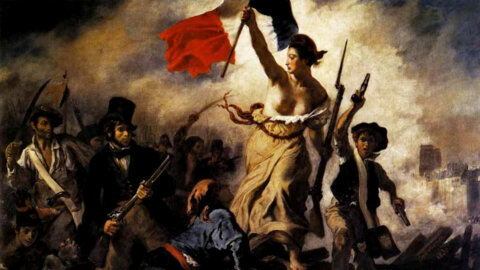
History and art always help us understand the social and political changes of a country. In these French moments we cannot help but remember Delacroix and his work that made him famous Liberty Leading the People (Freedom leading the people) oil painting (1830) by the French artist Eugène Delacroix which commemorates the July Revolution in Paris who removed Charles X, the restored Bourbon king, from the throne. The heroic rebellion scene was initially met with mixed reviews, but became one of Delacroix's most popular paintings, an emblem of the July Revolution and justified revolt.
The painting "Liberty Leading the People"

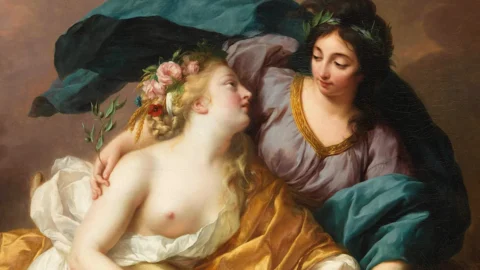
The Three Glories
Delacroix began painting after witnessing the escalation of protests against a series of restrictive ordinances issued by Charles les Trois Glorieuses (27-29 July), citizens of working and middle class they erected barricades in the streets of Paris and they fought the royal army. Unable to contain the insurrection, Charles X soon abdicated. Louis Philippe, the so-called Citizen King, ascended the throne and created a constitutional monarchy. Delacroix finished the painting in three months and it was exhibited along with 23 other revolutionary-inspired works at the 1831 Salon, an annual exhibition of French art held at the Louvre. A semi-naked female figure dominates the monumental painting (3,25 metres) as she charges forward, followed by a crowd of revolutionaries. She is a personification of freedom, a classic symbol used throughout the history of art. Indeed, her yellow dress swirls around her body, tied loosely with red rope and falling from her shoulders in a manner reminiscent of heroic Greek sculptures, such as the Winged Victory of Samothrace (190 BC about). Yet she is also current, wearing a red Phrygian cap reminiscent of the cap worn by the working class and popularized during the French Revolution (1787–99) as the “cap of liberty,” but which hails from antiquity. Her modernity is accentuated by the Tricolor that she hoists above her head and by the musket with bayonet that she holds in her other hand. Some critics, however, felt that her dirty skin and alleged armpit hair were too human for a personified ideal. In 1874 it was finally transferred to the Louvre and over time it became one of Delacroix's most popular works. In 2013 it was vandalized but then restored and today it is back in its place.
Eugène Delacroix and the 30s between Paris and Morocco
Eugène Delacroix (1798 – 1863) was one of the greatest French Romantic painters, whose use of color influenced the development of both impressionism and post-impressionism. His inspiration came mainly from historical or contemporary events or literature, and a visit to Morocco in 1832 provided him with further subject matter. And it was in 1830 that Delacroix painted Liberty Leading the People to commemorate the July Revolution which had just brought Louis Philippe to the throne of France. From January to July 1832 Delacroix visited Algeria, Spain and Morocco with the Count of Mornay, King Louis Philippe's diplomatic representative to the sultan. Morocco proved to be a revelation for Delacroix, who found in its people and their lifestyle the nobility and Homeric beauty that he had never seen in French academic neoclassicism itself.