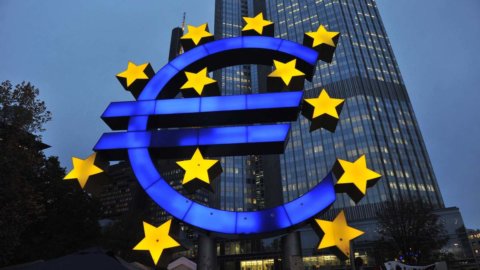
For the European Central Bank there “an option” for raise rates of interest in its next meeting of end of April, if the war in Middle East should lead to a surge ininflation in the Eurozone. He said this in an interview with Reuters Joachim Nagel, member of the Monetary Policy Committee of the ECB, as well as President of the Bundesbank, the German central bank.
The ECB has started to think about the possibility of rate increases, abruptly reversing the trajectory of its monetary policy, after the conflict in Iran has pushed the Energy prices rise, with traders now speculating on the possibility that the first move be made to April or at the next meeting of June.
Nail he said that, on the occasion of the meeting of April 29-30, he and his colleagues will have at their disposal sufficient information, both on war both on his impact on the economy, to decide on a potential rate increase of interest. “It's certainly an option"But that's just one option," he said in an interview regarding a possible rate hike in April. "I think we'll have enough data by April to determine whether we need to take action or whether we can wait and see. But we shouldn't back away now just because we think it's too early," he added.
Lagarde had already said she was ready to act. The ECB outlined three inflation scenarios.
This week Christine Lagarde, president of the ECB, said that the central bank of the 21 countries that share the euro is ready to act at any meeting to keep inflation at its 2% target. And again yesterday he reiterated: one can "look beyond" a "small and one-off" shock, but "if the deviation from our inflation target becomes larger and more persistent, the need to act becomes more compelling," he said. last week's meeting The ECB had left interest rates unchanged, but had already warned of an imminent price hike, as had also been done by the other central banks of the world. Now monetary policy makers are discussing what the conditions would be which could force them to increase financing costs to prevent rapid price growth from consolidating, without however slowing down the already difficult economic growth.
in most optimistic “baseline” scenario According to the ECB, inflation will average 2,6% this year, up from around 2% last year. adverse scenario, inflation will peak above 4% in the second half of this year, but will return to target by mid-2027, while in worst-case scenario, inflation will peak above 6% early next year and will not return to target for many years to come.
The ECB has been criticized for acting too late during the inflationary surge of 2021-2022The bank believed the spike was transitory and did not raise interest rates until inflation reached about 8%, four times its target.
The new surge of the oil and gas prices represents a severe blow to the Eurozone, a major energy importer. Furthermore, the closure of the Strait of Hormuz has blocked thesupplying of some chemicals, such as fertilizers. However, the energy shock is so far of minor magnitude, especially in the case of natural gas, the labor market is not as tight, there is no pent-up post-pandemic demand, fiscal policies are more restrictive, and the central bank's interest rate is higher, the ECB said.
The key is to pick up on inflation signals that go beyond energy.
Nail He further said that he and his colleagues would try signals of price increases beyond the energy sector and wage increases, which would suggest that higher inflation is taking root in the eurozone. “This is certainly a situation where every passing day contributes to increasing inflationary risks, especially regarding what interests us most from a monetary policy point of view: how inflation expectations will evolve in the medium term", he has declared.
Market participants expect two or three increases in the ECB's key interest rate by the end of the year, bringing it to 2,50% or 2,75%.