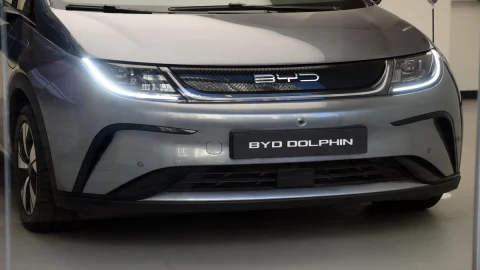
The European Union increases duties on the import of electric cars from China. The decision to increase duties comes after months of investigations by the European Commission, which detected practices of unfair competition by Chinese manufacturers. This last benefit from public subsidies which allow them to sell vehicles at lower prices compared to production costs, thus damaging European producers.
“The European Commission has communicated to interested parties the level of provisional countervailing duties it intends to impose on imports of electric cars from China,” the EU executive said.
The new duties on Chinese electric cars
Currently, cars imported from China into Europe have a 10% tariff, while European cars imported into China are taxed at 15%. THE new European duties, according to the Commission's intentions, will be added to the 10% already in force and will be able to reach up to 38% on Chinese vehicles, thus reaching an overall maximum of 48,1%. The increase will be differentiated by manufacturer.
Those who will be most affected will be Byd, subject to an additional duty of 17,4%, Geely by 20% e Saic by 38,1%. For the other Chinese manufacturers who cooperated in the investigation, a average duty weighted by 21% while it will be 38,1% for those who did not cooperate.
The new additional tariffs they will also affect some Western companies that produce models in China, such as BMW with the iX3 and the Mini, Mercedes with the new Smart models, Renault with the electric Dacia Spring and Tesla which ships the Model 3 from Shanghai to Europe.
Germany and Hungary against, France and Spain in favor
The decision to impose tariffs has divided EU member countries. There Germany, the Sweden andHungary have opposite to this extent, fearing commercial retaliation by China and potential damage to their economic relations with Beijing. In contrast, France and Spain supported the introduction of higher tariffs to protect the European automotive industry.
Analysts predict that the China will respond to these tariffs with similar measures, raising tariffs on European car imports from 15% to 25% and imposing new tariffs on other goods. These European duties will be temporary, but retroactive, coming into force in July and lasting five years, subject to ratification by member states by November 2nd.
“We have achieved a key step in our investigation of Chinese battery electric vehicles by making public the provisional tariffs we intend to impose. Our goal is not to close the European market to Chinese electric vehicles, but to ensure that competition is fair,” the vice president of the European Commission declared on Valdis Dombrovskis.
China doesn't agree: "opposing protectionism"
Beijing's response was not long in coming. The spokesperson of the Chinese Foreign Ministry, Lin Jian, stated that the EU is harming its interests with these tariffs. “We urge the EU to respect its commitment to support free trade, to oppose the protectionism and collaborate with China to safeguard overall bilateral economic and trade cooperation.”
The European decision follows the imposition of 100% tariffs on Chinese electric cars gives part of the United States. An attempt to stop Chinese manufacturers who are flooding Western markets with cheap, good-quality cars, complicating efforts by Europe and the United States to develop their own supply chains to meet ambitious climate goals.