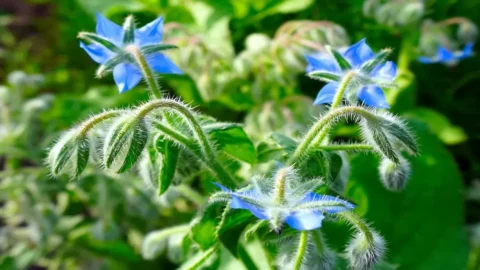
In Spring it appears almost everywhere in the woods, on the edges of country roads, in abandoned gardens, along embankments. Its leaves are characteristic because they have a "hairy" appearance. From March it blooms continuously, with beautiful starry flowers with five petals of a blue-violet colour. The old people in the countryside stocked up on it, being careful not to confuse it with the very dangerous Mandragora, both to cook it and to draw medicinal remedies for the body. Borage is known since ancient times for its many beneficial properties. But one, above all, made it very widespread among the ancient Romans. He explains why Pliny the Elder, writer, naturalist philosopher, author of a monumental Naturalis Historia consisting of 37 books, dealing with astronomy, physics and earth sciences, geography, biology, fauna and flora, which dedicated ample space to medicinal remedies. And speaking of Borage he certified that a decoction of this precious herb "removes sadness and gives joy of living". And for this reason his fame spread at the time of the Crusades when it was administered to soldiers before battles to give them serenity of spirit and enhance their tests of courage.
For Pliny the old man took away sadness and gave joy to life
In reality, Borage was also used to reduce fever, calm dry coughs as a diuretic and emollient. The oil obtained from its seeds was used in the treatment of eczema and other skin conditions. E The infusion of leaves and seeds has been used in traditional medicines to increase milk production in breastfeeding women.
A concentrate of beneficial properties and very versatile in the kitchen
From then to today, borage has found wide use in medicine, aesthetics and cooking. From the Humanitas website we learn that this herb is rich in vitamins and minerals: 100 grams of its leaves contain, for example, 0,70 g of lipids, including 0,170 g of saturated fatty acids, 0,211 g of monounsaturated fatty acids, 0,109 g of polyunsaturated fatty acids, which have a beneficial effect by affecting the presence of cholesterol in the blood and, consequently, on the health of the cardiovascular system 4.200 IU of vitamin A, a powerful antioxidant 35,0 mg of vitamin C, a nutrient with an antioxidant effect capable of promoting the proper functioning of the immune system 0,900 mg of niacin, 0,150 mg of riboflavin, 0,084 mg of vitamin B6 which promotes good metabolism and then potassium which protects the heart and is important for the production of red blood cells, iron calcium sodium phosphorus magnesium iron manganese zinc and copper which promote healthy bones and teeth.
It can be a starting point for beautiful walks in the woods, but be careful not to confuse it with Mandragora, a poisonous herb.
Nothing of borage is thrown away: leaves, flowers and stem are widely used in various recipes. Excellent for enriching minestrone soups (also to be enjoyed warm), for giving flavor to ravioli and pansotti fillings, for risottos - the risotto with borage and gorgonzola has a very delicate taste - savory pies, for filling meatloaves, and omelettes. But it is also excellent alone in a pan used like Neapolitan escarole with garlic, oil, desalted anchovies, raisins and wild fennel. Among the many tasty recipes we can mention potato gnocchi with salmon and borage, borage rolls with mozzarella and anchovies, borage and potato cream soup. Sautéed in a pan, like chicory, it goes well with pork sausages or Venetian liver but also with stewed cuttlefish. It is also excellent in timbales and flans.
In short, you are spoiled for choice. Bearing in mind that your body will always thank you for the benefits it will derive from it in the future if you include borage in your shopping menus or, better yet, if you treat yourself to a day of healthy relaxation by picking it up during a picnic out of town. But be careful: study the difference with the mandrake carefully first to avoid unpleasant surprises.