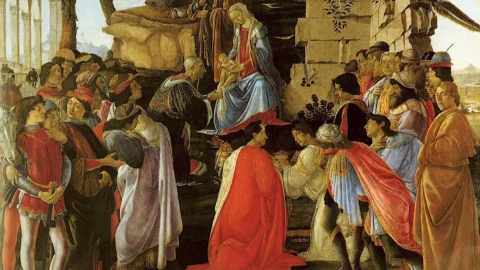
The “Adoration of the Magi” by Sandro Botticelli, built around the 1475, is a work that uses a traditional and religious subject to respond to deeply personal needs. historical, political and social. More than a scene of devotion, the painting is configured as a visual construction of the memory and identity of fifteenth-century Florence, dominated by the Medici family. Religious narrative becomes a shared language, functional to represent the order of power and the role of the city's elite.
Florence in the second half of the fifteenth century: art and power
In the late 15th century, Florence was a leading economic and financial center in Europe. The city formally maintained a republican system, but real power was exercised by the Medici family, who governed through a network of alliances, popular consensus, and institutional control. In this context, art took on a strategic function: it was not merely decoration or spiritual expression, but a political tool capable of legitimizing authority without resorting to overtly monarchical symbols. Artistic patronage allowed the Medici to present themselves as guarantors of order, stability, and the historical continuity of the city. The works commissioned or supported by the family thus became vehicles of sophisticated propaganda, in which cultural prestige replaced coercive force.
Botticelli and the culture of public image
Sandro Botticelli He operates fully within this system. His painting, often described as elegant and idealistic, is actually deeply rooted in the historical present. Botticelli demonstrates a remarkable ability to translate the demands of his patrons into complex images, in which the official narrative is intertwined with the observation of social reality. In the "Adoration of the Magi," the artist uses a traditional iconographic scheme to construct a collective portrait of the Florentine ruling class, transforming the Gospel episode into a scene of public recognition and self-representation.
Painting as a construction of political memory
The most significant element of the work is the presence of numerous identifiable portraitsThe Magi take on the appearance of Cosimo the Elder, Peter the Gouty e Giovanni de' Medici, key figures in the construction of family power. Around them appear other members of the dynasty, including Lorenzo the Magnificent e Giuliano de' Medici, inserted into a composition that suggests continuity, order, and political centrality. This choice is no coincidence: Botticelli transforms the scene into a sort of secular pantheon, in which the Medici family is presented as the cornerstone of the city's history. The dynasty's past, present, and future coexist in the same pictorial space, creating a visual narrative of the legitimacy of power. The artist's self-representation, looking directly at the viewer, reinforces the work's self-conscious and modern character: the painting does not conceal its historical function, but openly declares it, inviting the viewer to recognize the protagonists of the time.
The setting also contributes to this historical reading
Le classical ruins in the background, typical of Renaissance iconography, should not be understood only in a symbolic way, but as a direct reference to Florentine humanist culture. They recall the idea of Florence as the heir of Roman civilization, a modern city that bases its authority on the recovery of the ancient and on rationality. The space is not mystical or indefinite, but constructed according to principles of order and clarity, a visual reflection of the Medici political ideal: a hierarchical, harmonious, and recognizable society.
« Botticelli's "Adoration of the Magi" can be read as an extraordinarily powerful historical document, in which painting becomes a tool for representing power and constructing collective memory. The religious subject is reduced to a narrative structure, while the true center of the work is fifteenth-century Florence, with its political balances, cultural ambitions, and ruling class. In this sense, the painting demonstrates how Renaissance art was not merely an aesthetic expression, but a sophisticated form of political communication. »