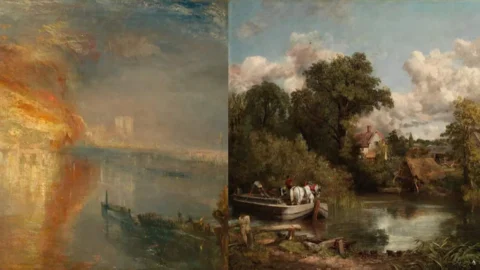
Although radically different in both style and personality, Turner and Constable shared the same ambition: to revolutionize the landscape genre, transforming it into an art form of great breadth and emotional depth.
The exhibition, which celebrates the 250th anniversary of their births, traces their careers in parallel, highlighting the successes, criticisms and continuous comparison that fueled their creativity. With over 190 works including paintings and drawings, the exhibition includes masterpieces rarely seen in Great Britain, such as the monumental The Burning of the Houses of Lords and Commons (1835) by Turner, from the Cleveland Museum of Art, and The White Horse (1819) by Constable, one of his most iconic works, last exhibited in London two decades ago.
Born one year apart
Turner (1775) in bustling London and Constable (1776) in the quiet village of East Bergholt, their very different youthful experiences profoundly influenced their art. Turner, precociously talented and commercially minded, exhibited for the first time at the Royal Academy at just 15 years old and produced ambitious paintings such as The Rising Squall, Hot Wells, from St. Vincent's Rock, Bristol, before the age of 18. Constable, largely self-taught, traveled long distances to produce early watercolours such as Bow Fell, Cumberland (1807), perfecting methods and techniques, exhibiting at the Royal Academy only in 1802. Both emerged at the height of the explosion in popularity of landscape, sharing a determination to transform it.
The exhibition explores how both artists developed distinct identities
Constable on the Suffolk countryside, drawing from life between Dedham Vale and the River Stour, with an obsessive attention to sky and light, as evidenced by his cloud studies and late works such as Hampstead Heath with a Rainbow (1836). Turner, instead, traveled throughout Britain and Europe, filling notebooks with rapid sketches that inspired both sublime scenes and The Passage of Mount St Gothard from the Center of Teufels Broch (1804), both commercial reproductions of his watercolors. His experiments with color and light capture the power and dynamism of nature, as evidenced by late works including Ancient Italy – Ovid Banished from Rome (1838), unseen in London for the last 50 years.
In the 1830s Turner and Constable were recognized as landscape innovators
The differences between their works sparked lively debate among critics, who presented them as rivals. In 1831, Constable himself exhibited his paintings alongside Turner's at the Royal Academy, prompting immediate comparisons: the fiery light of Turner's Italian scenes contrasted with the humid, foggy atmosphere of Constable's Britain. Today, displayed side by side at the Tate Britain, their most striking paintings demonstrate how both elevated landscapes to a genre worthy of large canvases and artistic prestige.
The exhibition concludes with a film featuring contemporary artists, including Frank Bowling, Bridget Riley, George Shaw, and Emma Stibbon, reflecting on the legacy of Turner and Constable, underscoring the vitality and enduring influence of the two masters. Turner and Constable not only changed the face of British landscape painting, but continued to inspire generations of artists, reminding us that landscape is a limitless genre, capable of conveying emotion, history, and memory through light, color, and form.
Cover image: Left to right: JMW Turner, The Burning of the Houses of Lords and Commons, October 16, 1834, 1835. Cleveland Museum of Art. Leaves of John L. Severance 1942.647; John Constable, The White Horse, 1819. © The Frick Collection, New York. Photo: Joseph Coscia Jr.