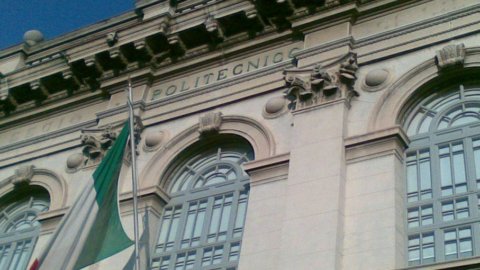
Without English you go nowhere. It is increasingly appropriate to say, after the epochal turning point of the Milan Polytechnic, that starting from the 2014-2015 academic year, it will offer the entire master's degree program (specialist two-year courses and doctorates) exclusively in English.
In short, after the three-year degree, the green light to internationalisation. “Italian kids have to learn it in high school – the rector Giovanni Azzone cut short – thinking about doing it at the university is too late. Universities cannot be asked to teach a profession and, in the meantime, also provide skills of this kind. If they had to go to high school too, both things would hurt ”.
The choice, that it will cost an investment of 3,2 million euros to attract teachers from abroad, is the latest step in a process that began some time ago and which has allowed the Milanese university to see foreign students out of the total number of students enrolled go from 1,9% in 2004 to 17,8% in 2011, while the Italian average it dropped to 3,6%, far from 10% in industrialized countries and 20% in the United Kingdom.
"Foreign students – Azzone explained again – are an added value for our country. Italy has a strong cultural attraction, but also a barrier, limited knowledge of the language: by teaching in English we attract all those people interested in Italian culture. Our boys, on the other hand, in addition to more scientific skills, also have an international cultural openness. Because a young person entering the world of work must get used to working in international contexts”.
A very clear message, and in line with what has already been partially done by other universities such as Bocconi of Milan, the Polytechnic of Turin and the Luiss of Rome, but not shared by all. “It may be a reasonable route for a private university, but not for a public one. Another thing, however, if certain subjects are taught in English and only in some courses”, is the objection of the linguist Tullio De Mauro.
However, it is now clear that this step is fundamental, especially given the low propensity, according to a recent survey by the Makno institute, of Italian students to multiculturalism. But in a labor market devastated by the crisis, the need to know languages in order to open up opportunities abroad is becoming more and more evident.