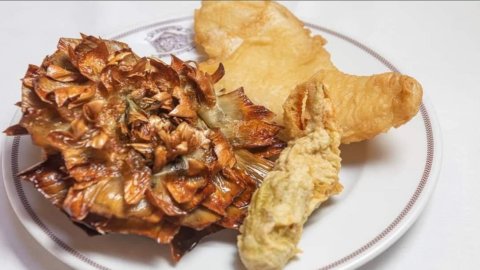
Protagonists of the Christmas period lunches in the capital, the tasty artichokes alla giudia belong to the tradition of Judeo-Roman cuisine from the XNUMXth century, as attested by cookbooks and memoirs dealing with the gastronomy of the Jewish ghetto of Rome.
With the bull "Cum nimis absurdum" in 1555 Pope Paul IV, who held the pontificate with a hard fist, raising the Inquisition to the governing body of the Church and having the cardinals arrested who, in the conclave that had elected him Pope, had represented alternative candidates, implemented a policy of intransigence and limitation towards the Jews residing in Rome, such as the imposition of wearing a yellow badge, the ban on owning real estate and for Jewish doctors to treat Christians, and above all it limited their movements by confining them within specific areas. The ghetto of Rome it was the largest and most important to the point that even the Jews expelled from Spain by Isabella of Castile converged there.
Born in the ghetto to celebrate the end of fasting for Kippur
The name of artichokes alla giudia derives from tradition of Jewish families to feast on fried artichokes at the end of the observance of Yom Kippur, which imposes the observance of fasting as well as abstention from work and fatigue, for 24 hours.
To prepare this easy but very tasty and crunchy dish it is essential the use of violets, the cimaroli artichokes of the “Romanesco” variety grown in Lazio between Ladispoli and Civitavecchia. Mammola and cimarolo are two synonyms, in both cases these words identify the artichoke that grows at the apex of the plants, usually the earliest, voluminous and tasty artichoke. The Romanesco probably acquired the name of mammola and cimarolo due to their size, which is on average larger than that of any other variety of artichoke. The reason why the violet artichokes fried alla giudia quickly conquered everyone's palate is easy to say: round and without thorns, they are soft and delicate and can be eaten whole and without waste
The recipe, small tricks for a result of guaranteed goodness
The recipe (in the photo the classic artichoke alla giudia together with fried cod proposed by the restaurant “Da Giggetto al Portico d'Ottavia) is prepared in a few simple steps: after having kept them immersed in water and lemon for a quarter of an hour to soften them and prevent them from turning black, they are pressed on the board so as to open the leaves well, then plunged into boiling oil for about ten minutes with the head down, squeezing them to give them the open shape of a rose; then a second passage is made in boiling oil to allow the open leaves to open completely and become crunchy. Among other things, while the slightly toasted leaves remain crunchy, the heart of the artichoke remains tender and very tasty. After capture, it rests on absorbent paper to eliminate excess oil. At this point, all that remains is to add salt and eat them very hot.
An easy and tasty recipe, therefore, which soon conquered the palate of even the gods Romans who got into the habit of going to eat them in the ghetto even beyond the time of Yom Kippur.
Poor dish but reached the high tables of the nobles. In fact, a legend tells that Caterina de' Medici liked them so much that she devoured many of them, until she felt ill.
In the film “Eat, Pray, Love” Julia Roberts devours them with relish
And artichokes alla giudia have also made an appearance in the cinema, particularly in the 2010 film "Eat, pray, love" by Ryan Murphy, where names such as Julia Roberts, Javier Bardem, James Franco, and Luca Argentero appear in the cast. Based on the autobiographical book by Elizabeth Gilbert, the film sees Julia Roberts fleeing New York in search of herself through three experiences: the culinary one in the Roman and Neapolitan stays, the spiritual one in India, the amorous one in Indonesia. AND in the Italian stage he delights in the flavor of artichokes alla giudia
Finally, it is worth mentioning that the great Pablo Neruda, 1971 Nobel Prize for Literature, who knew Rome well and was an excellent gourmet, dedicated one of his famous Ode to the artichoke, in this case not alla giudia but cooked for a tasty pasta dish.
Pablo Neruda: Ode to the artichoke from "Elementary Odes" (1954)
The tender hearted artichoke dressed as a warrior,
bristly built a small dome,
kept dry under his scales,
near him the maddened vegetables curled,
they became tendrils,
inflorescences touching rhizomes;
underground slept the red-whiskered carrot,
the vine dried up its branches from which the wine rises,
the cabbage began to try on skirts,
oregano to perfume the world,
and the sweet artichoke there in the garden dressed as a warrior,
burnished like a hand grenade,
proud,
and one fine day,
in close ranks,
in large wicker baskets,
marched to the market to fulfill his dream:
the militia.
In the rows he was never so martial as in the market,
the men in the midst of legumes with white dusters were the generals of the artichokes,
compact files,
command voices and the detonation of a falling cassette,
but then Maria arrives with her basket,
choose an artichoke,
don't fear it,
examines it,
he observes it against the light as if it were an egg,
buy it,
confuses it in her purse with a pair of shoes,
with a cabbage and a bottle of vinegar until,
entering the kitchen,
he plunges it into the pot.
Thus the career of the armed vegetable called artichoke ends in peace,
then scale by scale we undress the delight and eat the peaceful pasta
of its green heart.