
REAL INDICATORS
Recession or no recession, here's the question. Without bothering Hamlet, there are three good reasons to dwell on the distressing disaster for consumers, businesses and investors, as well as governments and central bankers. With a premise.
A year ago these days there was (or almost) no economist who did not foresee the arrival of a contraction of the economic systems, with supply and demand squeezed between the anvil of the energy and food crisis and the hammer of interest rates raised by central banks to bring down inflation. Autumn and winter have passed without the cataclysm happening. All right, then? No, because many still fear that the prediction was just wrong in timing and which will take place one year late. So the question remains burningly topical, also in the light of the following three reasons.
The first reason arises from reading current data on the state of the global economy. Where is there a mighty tug of war between the manufacturing sector, which is already shrinking, and the “recession yes-recession no” affects the investment decisions real (companies) and financial (savers) and makes them more prudent, reducing the probability of avoiding the downturn in the cycle.
So, help understand what is happening and outlining what could happen can have a saving effect for the immediate fate of workers, entrepreneurs and savings managers. Let's try to unravel the skein of the three reasons in search of the most probable scenario, a sort of Holy Grail.
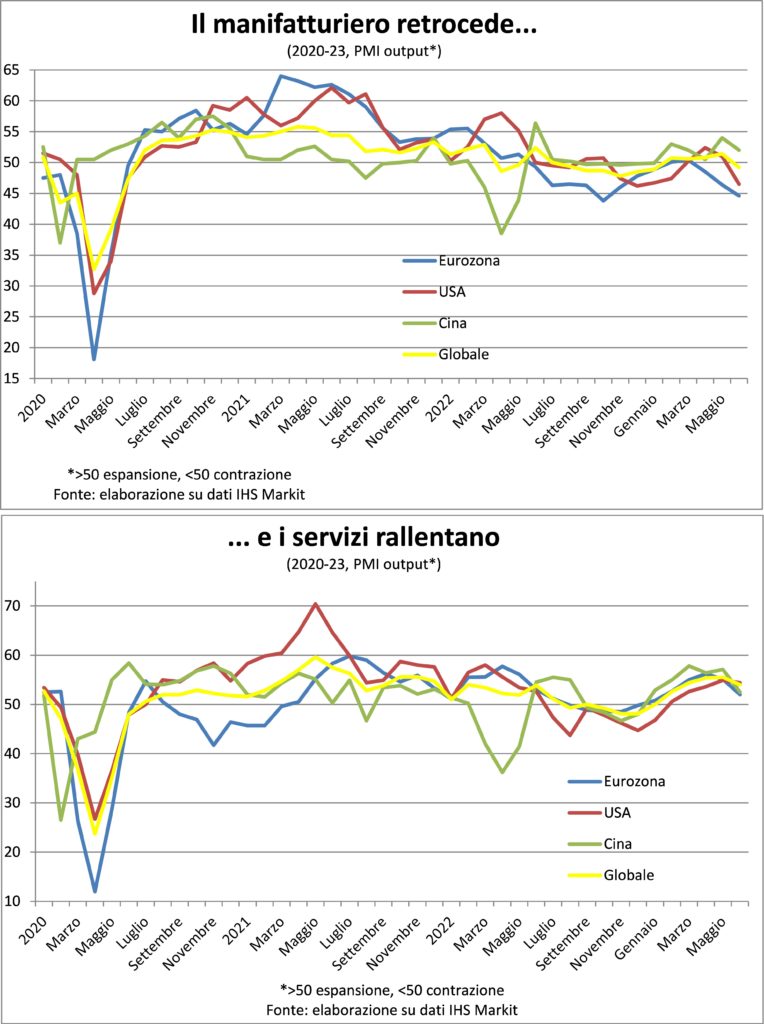
To answer the question of who will win the tug of war between the tertiary sector and industry, let us consider two aspects. The first is that manufacturing is not only the «engine room» of growth, because it produces innovation which is then incorporated into goods, spreads throughout the system and therefore feeds the increase in general productivity, but it is also the cyclical sector par excellence. In fact, it cranks out those durable and investment goods whose demand is discretionary and sensitive to financial conditions, purchasing power and expectations. Therefore, although it directly weighs little in the economic system (one tenth in the USA, one sixth in the Euro area, even more in China), it determines its fate in the long as well as in the short term. So, apparently, manufacturing should win.
But here the second aspect intervenes: in current times the bias in demand generated by the pandemic. In fact, the 2020 recession was led by the services sector (usually anti-cyclical), due to restrictions on movement and social life, and the recovery was driven by manufacturing, as companies made up for the time lost in satisfying the accumulated orders and why new question he added.
New question of people who, not being able to spend on services, turned to buying durable goods for the home. Demand for companies, which have adapted the organization to the new way of working, to health security measures, to global supply chain disruptions, to green and digital transitions and to government industrial policy incentives. Public demand to support the economy but also to better equip society with infrastructure. This great initial impetus in manufacturing could not last, at least for the part linked to contingent factors. And being in part an anticipation of future spending (it doesn't make sense to replace brand new refrigerators because they just changed...), it sowed the next phase of sluggishness.
In addition to this inevitable and natural decrease in requests, with the reopening consumers have turned demand towards travel, get-togethers, social activities, entertainment… In other words, services. How they should make up for lost time. And this is normal behavioral flip make the producers of material goods suffer, allocating resources to immaterial goods. Therefore, to understand the true state of health of the economic cycle, the analysis of the economic situation should be purified of these factors that do not originate from the health of the economic system. But there is no statistical filter or data purification system that allows it.
Just as it is natural that manufactured goods, often purchased in installments or leased because they involve high outlays for family and business budgets, are affected by theincrease in the cost of money. The latter aggravates the downturn in industry, because it makes it less convenient to finance those purchases. Furthermore, the increase in interest rates, by increasing debt service (as those who have taken out variable-rate mortgages, which are the norm in many countries, well know), reduces spending power and sooner or later will also make itself felt on consumption of services.
However, all this does not necessarily lead to a recession, but certainly to behavior normalization and the distribution of expenditure between sectors. It doesn't necessarily lead to recession because today's spending means more jobs and more income which translates into more spending tomorrow. For another ride on the cheap carousel. Therefore, between normalization and higher income-expenditure, in the autumn we could observe a new impetus for manufactured goods and a weakening of the tertiary sector.
The bifurcated trend of industry and services is also reflected in the confidenceand is its reflection. In fact, in America and Europe i consumers, who continue to 'consume' the 'treasure' set aside when it was not possible to leave the house and who benefit from the excellent conditions of the labor market, confirm the optimism, while the companies, especially manufacturing, are pessimistic.
All of this can be observed, with greater or lesser intensity, in almost all the major economies. Which, however, are not at all in the same conditions of form. In particular, in Usa il nowcasting Q2 gives another 4,2% and more annualized increase in GDP. And in the first quarter without the destocking it would have increased by +XNUMX%. Since at a certain point the decumulation ends and the accumulation starts again… Thanks also to the copious amount of data, in the United States it is possible to observe live the functioning of the mechanism described above of expenditure-employment-income-expenditure: the creation of jobs work continues, so much so that jobless claims are down again, and the real wage bill it has returned to increase at a good pace, providing fuel for other spending.
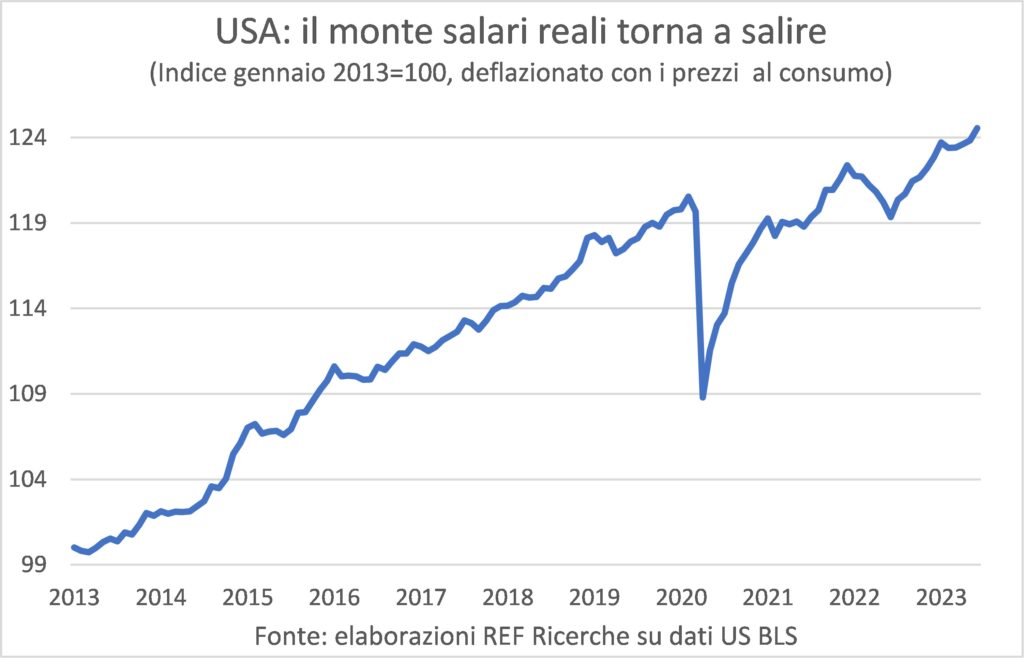
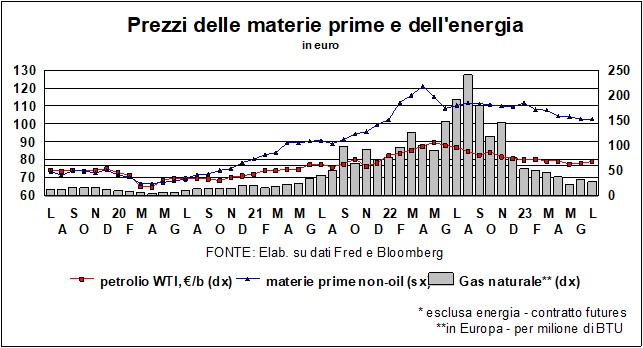
On the contrary, theEurozone appears more difficult. The contraction in industrial activity is greater and so is the slowdown in the tertiary sector. This appears to be consistent with the extent of the impact of the energy and food shock, which for the USA has translated into an improvement in the terms of trade (they are net exporters of hydrocarbons and agricultural commodities) while for the EU+UK the bill was very high. It is true that the cost of many raw materials has returned, but not to pre-war levels.
Again, the China it already appears to be trudging just a few months after the free-all from the rigid zero-Covid policy. However, it has the driest economic policy dust: The 2023 budget balance (% of GDP) is estimated at 5,4% in the USA, 3,4% in the Eurozone, and 3% in China. Furthermore, it can afford to implement monetary easing, thanks to non-existent inflation, and with direct intervention by banks and other-directed large companies.
Finally, theItaly confirms that it holds, thanks to investments, employment and exports. It is true that the confidence indices report, as elsewhere, bad weather for businesses (but with sectorial distinctions) and good weather for consumers. And that the PMI output component indicates a sharp contraction in manufacturing and stagnation in the tertiary sector, but businesses are even accelerating investments (Bank of Italy survey). We don't call it a miracle, but it is something new compared to what we used to observe until shortly before the pandemic.
INFLATION
"Matilde, there is no more inflation, it's gone», the financial markets hum happily after the bingo of the change in American consumer prices in June. Unaware emulators of a famous television advertisement of almost sixty years ago brilliantly conceived by Armando Testa.
Is there really no more inflation? There drop in price temperatures, to production and consumption, is unequivocal and incontestable. Again, it follows the manufacturing vs services dichotomy mentioned above. And again there are marked differences between economic systems.
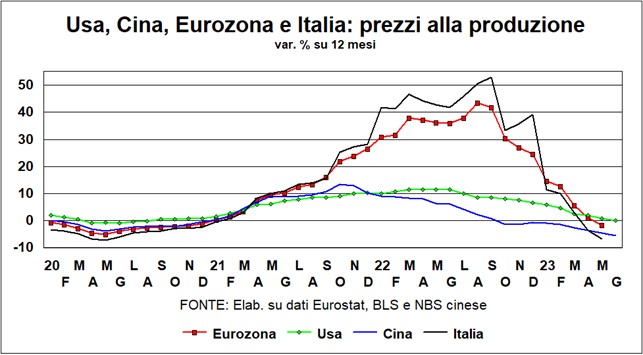
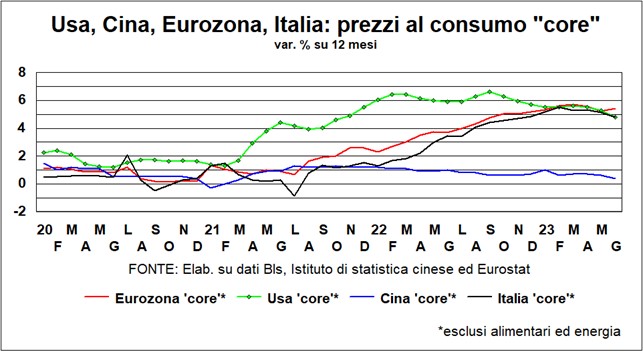
For the sectors, the difference can be explained by various factors: the manufacturing Incorporates more raw materials while I services are more intensive than work, and raw materials fell as labor costs continued to rise; the interruption of value chains it has hit manufacturing with a scarcity of semi-finished products and their increases and higher transport costs, and now that the tensions have ended, the opposite is happening; the increase in rates and the lower demand has prompted manufacturing companies to dispose of warehouses (which services do not have) and promote sales with discounts, while the high use of production capacity in the tertiary sector prevents promotions; the decline of international trading further relieves transportation costs.
All of this can be seen clearly in the price component of the PMI: in the tertiary sector the dynamics are still clearly higher than in manufactured goods, both for the costs of the inputs and for the output price lists, and also compared to the pre-pandemic rhythms. There is a return, but slower than in the central part of 2022.
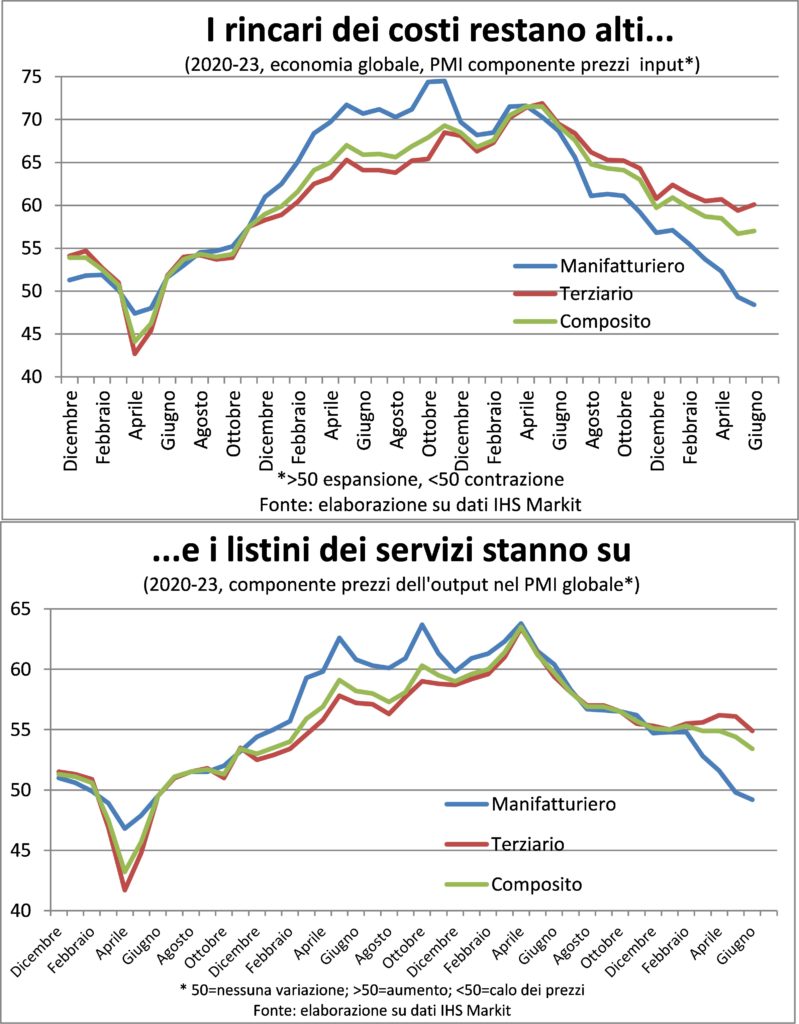
The crucial questions are: now that the downsizing of commodity prices is over and indeed, if the recession is avoided, their increase is likely, where further disinflation will come from? If the most important "raw material" is work and this remains scarce, how wage pressure eases? Questions that sow doubts on the further cooling of prices.
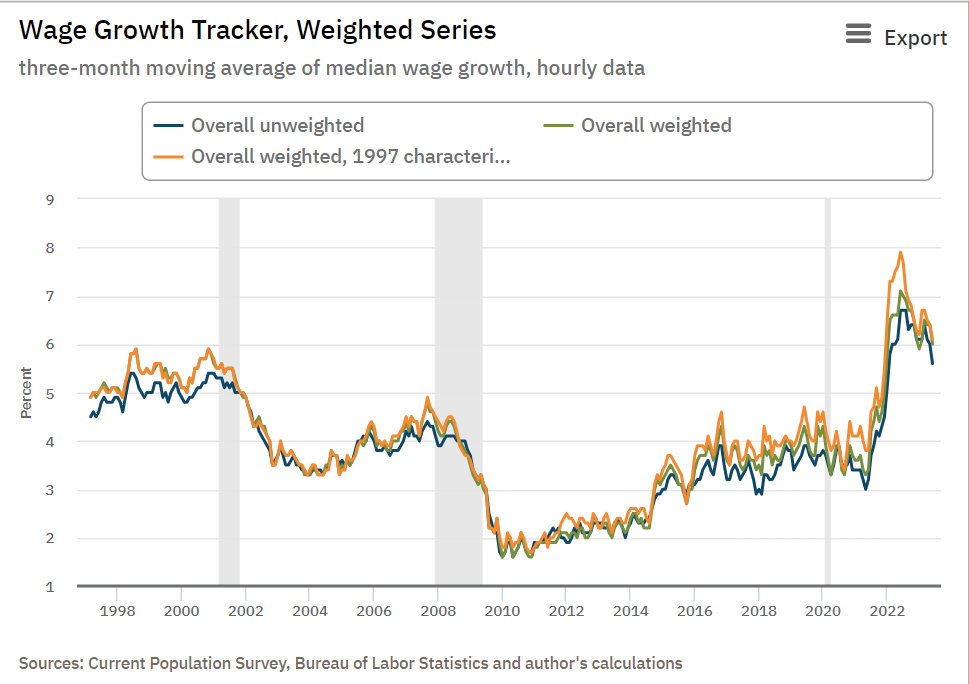
Then there are the strong differences between economic systems. In USA total inflation fell to 3,0% and core inflation to 4,8%. And there are those who estimate the drop to be even more rapid and sharp, placing the annual increase at 2,1% in July (while the nowcasting gives it as a rise at 3,4%). By contrast, the dynamics of hourly wages it accelerated again (4,8% over three months annualized in June, from 3,4% in March) and the trend that considers the effects of the reorganization of the employed travels by a couple of percentage points above the pre-pandemic dynamics.
In 'Eurozone, on the other hand, consumer prices rise to 5,5% per year total and 6,8% per year core. It is not known how much the cost of labor will increase (a little driving with the lights off at night, without calling it "emotions"!), but with the unemployment rate at historic lows and with governments and companies hunting for personnel, wages they can only rise. Finally, the China it is in full deflation.
What is certain is that there will not be a return to the world of impending global deflation and it is indeed probable that from now on the cooling of salaries and price lists will be longer and slower.
RATES AND CURRENCIES
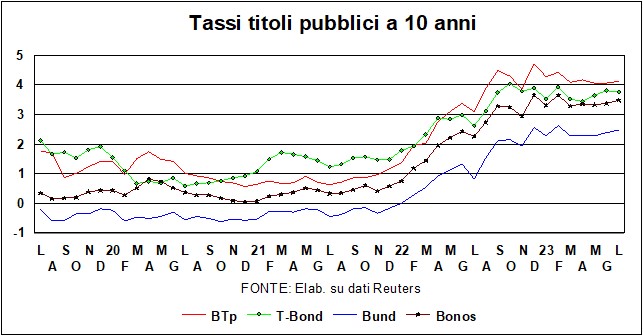
The main rate of the financial markets – the T-Bond at 10 years – had exceeded 4%, before retreating after the good data on US inflation. But in general rates they stay high, which certainly does not please the indebted states (on the podium there is Italy). And there are at least three reasons: on the one hand, the intentions of the central banks (Fed, BoE and ECB) I am still warlike (even if others – Japan, South Korea, Australia, New Zealand – have remained – or are going to remain – firm, and the Chinese one has even lowered the guide rate). On the other side, the world economy holds, and, even if it slows down, it lasts longer than expected to the increase in the cost of money. This second reason is linked to the first, in the sense that the Central banks, who might be dissuaded from further rate hikes if they see a recession in the whites of their eyes, they are comforted by an economy that does not give up and therefore they insist on the restriction (during the Cuban crisis in 1962, while the Russian ship with the missiles was heading towards Havana, Khrushchev said: “I thrust my sword in until I find no resistance…”).
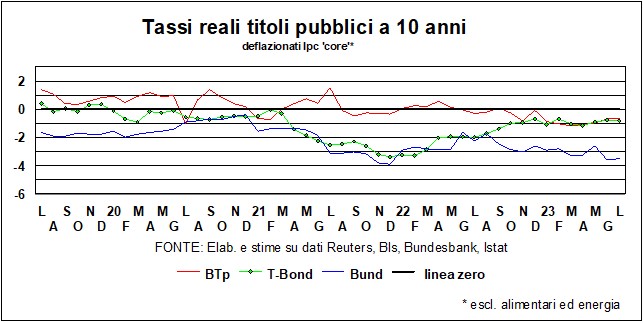
The last reason lies in theinflation which, in the version that excludes food and energy, falls too slowly (US) or does not fall (Eurozone), and is in any case far from the 2% target set by the central banks. Speaking of 2%, there would be serious reasons to raise it a bit. There are dozens of central banks that formulate the target around one fork, with the upper limit exceeding (and often not by a small amount) the 2%, but the Fed and the ECB do not want to touch their 2%: they fear losing credibility if they do so when inflation is well above that 'Sacred Chalice'.
The Fed seems to ignore, in its stubborn anti-inflation crusade, the signals coming from yield curve inversion (see graph). An inversion (yields on 10-year T-bonds, more sensitive to the ECB's guide rate, minus 10-year yields) that has not occurred, in its magnitude, since the times of the savage tightening of Paul Volckerbetween the late seventies and early eighties. This reversal is traditionally seen as the 'canary in the mine' of the recession: the Fed increases the cost of money and this increase causes the recession; markets therefore expect the economy to slow down, which leads to lower demand for long-term funds and thus the short-term rate becomes higher than the long-term rate, reflecting future rates. Which seems reasonable, but perhaps the Fed is right not to fret too much about the reversal. As Nobel laureate Paul Krugman observes, this is not to say that the reversal, in itself, is a causal factor in the recession. The reversal depends on what the markets expect on the path of Fed rates: an increase followed later by a decrease. In this cycle – anomalous for the reasons mentioned above – one cannot rely on the signals of the yield curve: the recession in the USA can still be avoided. All the more so the slowdown in inflation in US data of June suggests that the Fed is now close to the end of the crusade.
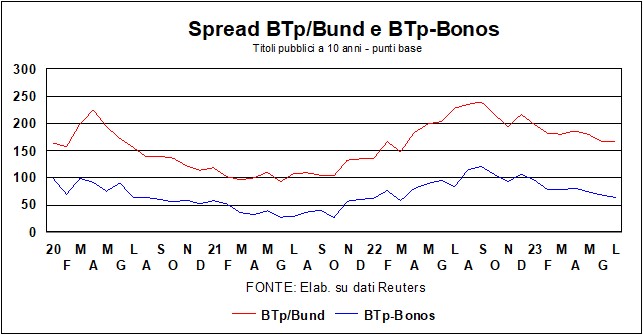
Incidentally, also in Germany the yield curve is inverted, though not as much as in America. In Italy there is no inversion, but only – as we have already said – because the political risk and the fragility of high public debt structurally weigh on the 10-year long rate. But the markets, in any case, do not appear concerned by Italian risks and fragilities: the spread they keep well tempered, both towards Waist than to passes.
The situation in Europe she is different. The slowdown in total inflation is less marked than in the USA, and does not go down - indeed, it goes up - in theindex core (mainly due to the Germany, where is the core has risen by more than one point). There ECB, even under the German prod, will continue (rightly) to drive up the key rate (which, incidentally, is much lower than the American one).
This gap between the two sides of the Atlantic was not foreseen (both the sharp drop in US inflation and the jump in the rate core in Germany they weren't on analysts' radar). Which explains – moving on to the foreign exchange market – the sharp fall of the dollar, connected to the different perspectives of the key rates in the USA and in the Eurozone. Making amends for what we had said in the last Lancette («…after touching 1,10 against the euro, the greenback is stabilizing around 1,07, and there are no big reasons to snatch upwards or downwards »), where will the dollar go, after exceeding 1,12 against euro?
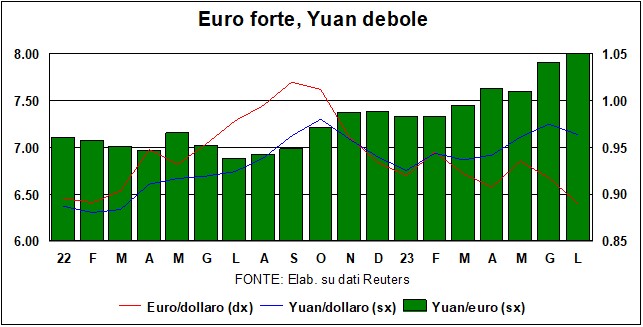
The impression is that the quotas reached (the dollar fell against everyone, not only against the euro) constitute a new normal for the American currency, unless – of course – the usual caveat related to geo-political risks. The chinese coin, which also strengthened against the dollar, however lost against the euro (see graph), a sign that it is not only a question of strong euro but also of weak yuan. A weakness that owes much to difficulties of the Chinese economy.
I stock markets have responded positively to the drop in US inflation, but the underlying doubts remain. Doubts related to to evaluate of US companies, which, as mentioned last month, they have not kept pace with the quotations. The US may well avoid a recession, but it cannot avoid two years (2023 and 2024) of low growth, with pressure on corporate profits, also given the situation on the labor market, which is favorable to wage increases. In the financial sector, in particular, also weighs the regulatory strictness next venture, already mentioned as coming (for the smaller American banks) in the Lancets of last May, but now hoped for also for the bigger ones.