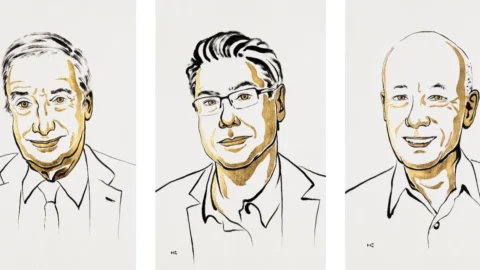
I Nobel Prize winners in Economics 2025 are Joel Mokyr, Philippe Aghion e Peter howitt, three internationally renowned economists who have contributed decisively to explaining the mechanisms of innovation-driven economic growthThe award was made official today, Monday 13 October, in Stockholm by the Nobel Committee for Economics, composed of members of theRoyal Swedish Academy of Sciences. And as per tradition the Nobel season closes.
How the Nobel Prize in Economics is awarded
The Nobel Prize in Economics, officially called Bank of Sweden Prize in Economic Sciences in Memory of Alfred Nobel, takes its name from Alfred Nobel, the inventor of dynamite, who in his will left a large portion of his estate to establish annual prizes for those who render "greatest services to humanity." Economics, however, was not included among the five original prizes: physics, chemistry, medicine, literature, and peace. In 1969, on the occasion of the 300th anniversary of the Bank of Sweden, a special fund was created that gave rise to the economics prize, awarded along with the other Nobel Prizes and managed by the Nobel Foundation.
The process of selection The process begins about a year before the award ceremony: the Royal Swedish Academy of Sciences invites experts, Academy members, and former laureates to nominate worthy candidates. The nominations, which can exceed 300, are evaluated by a committee of five to eight members who draft a final report to the Academy. Winners, at most three, are chosen at the beginning of October and announced immediately after. ceremony The handover takes place every December in Stockholm, while information about the process remains confidential for 50 years.
La equipment Economic Sustainability, similar to that of the other Nobel Prizes, is financed by the Bank of Sweden and varies according to investments; in 2018 it amounted to approximately 9 million Swedish kronor (about 900 thousand euros).
The 2025 Nobel Prize in Economics Winners: The Motivations
The prize, of the value of 11 million Swedish kronor (about 1,2 million dollars), was divided into two parts. The half was awarded to the American-Israeli Joel Mokyr, of Northwestern University in Evanston, Illinois, “for identifying the prerequisites for sustainable growth through technological progress.” The other half it was shared by the French Philippe Aghion and from the Canadian Peter howitt “for the theory of sustained growth through creative destruction.”
According to the Royal Swedish Academy of Sciences, "Over the past two centuries, for the first time in history, the world has experienced sustained economic growth. This has lifted large numbers of people out of poverty and laid the foundation for our prosperity. This year's laureates in economics, Joel Mokyr, Philippe Aghion, and Peter Howitt, explain how innovation provides the impetus for further progress. The laureates have taught us that sustained growth cannot be taken for granted. Economic stagnation, not growth, has been the norm for much of human history. Their work demonstrates that we must be aware of and counter threats to continued growth."
Economics: Who are the three new Nobel Prize winners?
Joel MokyrBorn in Leiden on July 26, 1946, Mokyr is a Dutch-American-Israeli economist and economic historian. He teaches at Northwestern University and Tel Aviv University. Raised in Haifa after the war, Mokyr earned a PhD from Yale University in 1974, focusing his research on the mechanisms that made the Industrial Revolution and Western technological progress possible. Author of seminal works such as The Lever of Riches (1990) The Gifts of Athena (2002) and A Culture of Growth (2016), Mokyr argues that economic development depends not only on institutions and material resources, but also on shared ideas, culture, and values. For him, modern European growth was possible thanks to a culture of scientific curiosity and experimentation, fueled by networks of intellectual exchange and freedom of thought.
Philippe AghionBorn in Paris on August 17, 1956, he is a leading expert on economic growth and innovation. After studying at the École Normale Supérieure and earning a doctorate from Harvard, he taught at the Collège de France, the London School of Economics, and INSEAD, as well as at Harvard, Oxford, and University College London. Together with Peter Howitt, he developed endogenous growth models, demonstrating how economic dynamism emerges from the interaction between entrepreneurship, competition, and research-friendly public policies. His best-known works include Endogenous Growth Theory, The Power of Creative Destruction e Leçons de croissanceAghion combines theoretical rigor and civic engagement, promoting an optimistic vision according to which sustainable growth arises from a balance between creativity, regulation, and faith in change.
Peter HowitzerBorn in Toronto in 1946, Howitt is known for his contributions to endogenous growth theory and innovation. A graduate of the University of British Columbia and a PhD from Northwestern University in 1973, he taught at several Canadian universities before joining Brown University, where he is professor emeritus. In the Aghion-Howitt model (1992), the growth process is described as continuous: each new technology replaces the previous one, improving productivity but also generating complex transitions. With his work, Howitt has redefined the understanding of modern capitalism, emphasizing the importance of entrepreneurs, knowledge, and public policies as drivers of economic transformation.
Nobel Prize winners in economics in recent years
In recent years, the Nobel Prize in Economics has awarded internationally renowned scholars:
- 2024: Daron Acemoglu, Simon Johnson e James A. Robinson, for studies on the inequality of wealth among nations
- 2023: Claudia Goldin, for “improving our understanding of women's labor market outcomes”
- 2022: Ben S. Bernanke, Douglas W. Diamond and Philip H. Dybvig, for research on banks and financial crises
- 2021: David Card, Joshua D. Angrist e Guido W. Imbens, for contributions to labor economics and causal analysis
- 2020: Paul milgrom e Robert Wilson, for studies on auction theory and innovations in auction formats