Many things have changed since the XNUMXs: North Korea and South Korea declared war on each other while now negotiating the demilitarization of the border, women are not relegated to the domestic hearth, the mass media, evolving continuously, have managed to conquer an ever greater place in people's lives and even in electoral campaigns: Twitter, Facebook, promotional videos, creativity. They are all buzzwords.
“From Eisenhower to Trump: this would be enough to make this collection unmissable, to stimulate curiosity, to prompt us to reflect on the role of communication and marketing with respect to politics and the choices of voters. Over time the means of information and communication have changed, from television commercials to social networks, what has not changed is the need for narration. The need to fix in a few minutes a positioning capable of creating identification, loyalty, involvement", these are the statements of the President of the Senate, Elisabetta Alberti Casellati, at the opening of the review "The Living Room Candidate", a collection of all the commercials elections of the American presidential elections from 1952 to today, an initiative part of the Videocittà project, promoted by Francesco Rutelli.
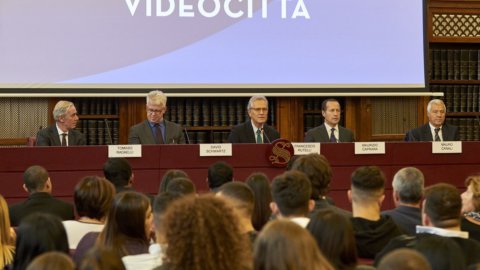
The preview of "The living room candidate" was presented yesterday morning in the Sala Koch of the Senate of the Republic, attended by Maurizio Caprara, columnist for Corriere della Sera, David Schwartz, curator of the Museum of Moving Image in New York City who made the collection of images of the commercials available to Videocittà and who specified how expensive American electoral campaigns are and how great the impact of social networks is on them, historic Mauro Canali and Tomaso Radaelli, president of MondoMostre, who remember how much an electoral spot can now be considered a film with direction, costumes, it's a real production with extraordinary budgets.
After the preview in the Senate, the electoral commercials will be screened as part of Videocittà's overall 114 events program at the Ex Dogana headquarters from 21.00 to 23.00 in three different appointments divided into screenings and debates.
It starts on October 24 with the first evening dedicated to American electoral commercials from the Museum Of Moving Image in New York covering the period from 1952 to 1964, from Eisenhower - who was the first to resort to electoral commercials - to the Lindon Johnson years. Reconstruction after the Second World War, the wind of change, John Fitzgerald Kennedy, the specter of communism and the war in Vietnam. After the screenings, a debate will be held with Antonio Di Bella, director of Rainews 24, the historian Mauro Canali, Edoardo Novelli, associate professor of political communication at Uniroma3, and Clara Tosi Pamphili, head of the Videocittà Fashion Project.
The second evening, October 25, will cover the period from 1968 to 1984, from Nixon to Reagan's second victory. The world was changing, students were on the march, protests against the old system and the Vietnam War raised ever more powerful voices, the desire for freedom and peace shouted on the Cold War field. After the screenings, a debate will be held with: Mario Calabresi, director of La Repubblica, Clara Tosi Pamphili, head of Videocittà's Fashion Project.
The October 26 appointment will describe the electoral campaigns from 1988 to 2016, from Bush senior to Donald Trump. The Cold War is coming to an end, giving way to the longest period of peace and growth during the Clinton presidency, but the world is constantly changing, the advent of terrorism, the tragedy of 11/2008. George W. Bush junior, the war, the fall and the new hope with the victory of Barack Obama. With the economic crisis of XNUMX, the Western world is in the balance, poverty is growing dangerously and terrorism is always a threat. Donald Trump's campaign and his victory. Afterwards, after the screenings, a debate will be held with Fernando Masullo, journalist Maurizio Caprara, editorialist for Corriere della Sera, Clara Tosi Pamphili, head of Videocittà's Fashion Project.
The focus on the United States does not prevent a parallel with the electoral campaign of the Italian elections of last March 4, 2018, when Matteo Salvini made his League achieve the best result in history. Furthermore, Salvini never lowered the curtain on the electoral campaign, continuing to tweet, go to the square and always knowing how to dictate the agenda and intercept the needs of citizens. The 5 Star Movement is confirmed as the leading party in these elections as well, exceeding 30% of the votes. The democratic party is considered not to have arrived during the electoral period, so much so that it brings home the worst result in history. Silvio Berlusconi pulls the brakes on the boat in the last weeks of the electoral campaign and sees his historic party, Forza Italia, surprisingly surpassed by the League.
In his conclusions, Maurizio Caprara notes a series of differences in the contents of the American and Italian electoral campaigns: "if a candidate for the presidency of the United States of America had served his country in war, even though it had been the dirtiest war of all, that of Vietnam, his electoral commercial would have reminded him, while in Italy, despite the fact that generals such as Di Lorenzo, Franco Angioni, Luigi Ramponi could boast, the feeling of having fought for the country occupies only a small part of the life of the individual, unless it wasn't a question of having resisted. Another important issue is that of the public debt which in America is a central theme, it affects the future of the children, it is reiterated in every electoral commercial, while here only Emma Bonino spoke about it. The objective of the commercials is to capture the feelings of the electorate and take them wherever you want”. But not everyone succeeds.