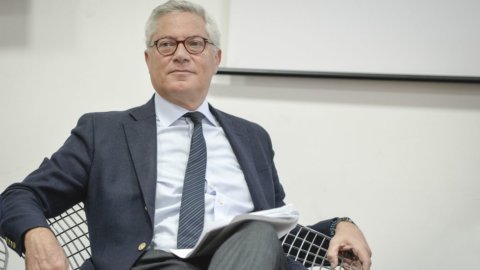
It's not easy to be a "watchdog" and he knows something about it Giovanni Pitruzzella, president of the Antitrust, the authority that supervises competition and unfair commercial practices in Italy. But in the age of the digital economy it is an even more complex profession because the market is increasingly dynamic and constantly evolving. Christmas is no exception, indeed it is precisely in this period that purchases and transactions on the World Wide Web intensify: according to data from the eCommerce Observatory of the Milan Polytechnic, 4,5 billion were spent on online purchases between November and December, with a growth of 18% on 2015. The vast Internet prairie is expanding, opportunities but also pitfalls are growing: the latest Antitrust investigations have all been dedicated to digital in a crescendo that has led the Authority, from 1 January 2015 as of October 26, 2016, to exceed the 517 million fines, a large part of which are dedicated precisely to the variegated world of the Internet. The escalation does not spare the "big brothers" of the Web such as Google, Amazon, Facebook whose scale is planetary, but there is no shortage of national or international groups and companies: in chronological order, the most recent to have come under control are theAci fined with 3 million for the extra costs charged on online payments with cards or debit cards; the State Railways (the investigation is underway) for online ticketing; Ticketone (also still in progress) for scalping on the Internet.
Aggressive groups, innovative techniques, the level and type of disputes has changed. “Before we met with Vanna Marchi – it is a joke that circulates in the competition building – now with WhatsApp” which, in fact, ran into a double investigation which is still being defined. An ongoing challenge for the men of the Antitrust who have two weapons at their disposal: fines, up to a maximum of 5 million for unfair business practices or up to 10% of turnover in case of violations of the competition; or the commitments and judgments on their compliance or otherwise. The Antitrust is self-financing (it is the companies that pay the costs), the result of the fines instead ends up in a budget chapter of the Ministry of Economic Development. The Italian guarantor will soon be the first in Europe to be present on the three social channels: Facebook, Twitter and YouTube. New means to communicate activities and objectives: "We aim at the overall well-being of the consumer and the overall efficiency of the market", summarizes Pitruzzella.
Sites perfectly similar to those of big brands such as Nike, Gucci, Hogan, Moncler but which instead sell fake products; telecommunications and energy scourged by non-transparent clauses, privateer teleselling; unforeseen or hidden costs. President Pitruzzella, what is happening on the Internet: is it no longer the happy island we expected?
“Let's start from this fact: the XNUMXst century economy is the digital economy. We are living through the fourth industrial revolution and this changes not only the economic mechanisms but also social relations and politics. Let's look on the bright side: the digital economy brings with it increased opportunities for consumers; e-commerce allows us a panorama of choices that we didn't have before. However, all of this brings with it new risks: we must prevent the formation of new monopolies and counter the new pitfalls for consumers who, faced with such a rapid technological process and the change in consumption patterns, find themselves more naive than if they went in a traditional shop where they are able to better master the purchasing dynamics”.
The problem arises on several levels, including transnational ones in the case of over-the-top giants. An absolutely dominant position that was unimaginable ten years ago. The European Antitrust has taken the field but the repercussions are also national… It was you who spoke of “destructive innovation”.
“Innovation is very rapid and competition changes appearance, the new innovator eliminates the old monopolist and takes its place. Once the comparison was with Ibm or Microsoft, today it is with Google, Facebook, Amazon. It is therefore necessary to ensure that the process continues and to prevent the new position conquered by the neo-monopolist from being used to prevent new operators from entering the market. International cooperation is fundamental: we have used it, for example, by collaborating with the authorities of France and Sweden in relation to Booking.com, the hotel booking platform which, through a specific clause imposed on merchants, blocked the competitive capacity of other platforms".
The Antitrust asks for changes to incorrect behavior, but then what happens, do they adapt?
“In most cases yes, otherwise they risk heavy penalties, of varying intensity depending on the case. However, compliance with our requests is monitored; if needed, even for years”.
It is a bit like the multi-headed Hydra of Lerna. The game is never over.
“The market has its excesses and left to itself it ends up overflowing. This constant tension is structural and what counts is that there is an Antitrust Authority that brings companies back to the physiological level. It's not easy: in an economy where technology is a basic element, it is also necessary to pursue business innovation. You intervene in one sector, another emerges. We are dealing with an extremely dynamic reality, but what matters is to spread awareness among companies that there are competition rules to respect, there is no escaping. It is a delicate issue in a country like ours, accustomed to protecting privileges and positional income”.
Yet the recurrences, if you can call them that, are constant. Let's take telecommunications: the marketing logic seems to digest without too much difficulty sanctions and appeals from the Antitrust, from Telecom Italia to the other operators, without exception.
“Telecommunications are the backbone of the digital economy which develops precisely on these networks. It is a sector in which we have decided to intervene strongly: against Telecom Italy with a fine of 100 million euros because it did not allow equal access to its competitors on the broadband network. A non-compliance procedure is open on this matter, the decision of which is now imminent. We also fined the main mobile telephone operators – Tim, Vodafone, Wind and H3G – for a total of 1,7 million as they had not set up suitable safeguard mechanisms to prevent customers from being charged for premium services by downloading Apps presented as free ”.
In practice the managers were held responsible for Apps, not them, but which they had not sufficiently controlled. This recalls the problem of content published on social networks. A few days ago, the family members of the victims of the Orlando massacre filed an appeal who denounced Twitter, Facebook and YouTube for having provided "material support" to ISIS.
“It is an epochal theme. We made a decision against Amazon because it didn't make it clear how liable it was for products sold by others on its platform. But the theme is broader and involves the concept of hosting provider: does it limit itself to hosting content without having editorial responsibilities or not? The question also extends to information and to the many containers, such as Google News, which offer news elaborated by others. Many wonder if we shouldn't move towards greater responsibility for them. It is a problem of the future but it is a central issue, information is the fulcrum of democracy”.
To conclude this overview of the year that is about to end: the sharing economy cannot exist without the internet. Fair or unfair competition? And what do you think of the work done by the European Antitrust on the selective distribution channels adopted by luxury brands, the real ones: do they limit competition or protect quality?
“The sharing economy cannot be stopped, it expands the choice of consumers but, in the case of Uber or Airbnb, involves costs for other categories: hotels and taxis. We need to create an equal playing field but it is wrong to think of extending the old rules, including fiscal ones, to new sectors. The Lazio Region has tried with a regulation with so many bureaucratic obligations to block new activities in the bud. This is why we challenged it before the Tar which declared it illegitimate. As for Made in Italy, the Authority blocked 174 sites that sold counterfeit products. However, there is another issue that concerns the big luxury brands, the real ones, and their selective distribution channels on the Internet: they generally try to avoid having their products sold on websites and prefer to use distributors with certain standards but this can create competition problems and reduce price comparisons. We're working on it. The EU investigation will be a useful starting point, we'll talk about it once the investigation is over”.