
In Europe – even Trump recalled it in his strategic document – the aging of the population which proceeds inexorably and accompanied by the declining birth rate poses problems in the labor market on the supply side and, adding to the rising trend in life expectancy, destabilizes pension systems, Think of the time of industrial society, which, like a dead star, continues to project flashes of light in the service society. All this in a context of stagnant productivity, compared to trends in other parts of the world.
Pensions and Italian difficulties
For pensions Italy is somewhat of a leader in a long transition phase in which generations of workers belonging to different backgrounds have arrived, are arriving and will arrive again to the appointment with retirement and therefore to collect their pension. large classes (in 1964 1,1 million children were born in Italy), who entered the labour market early and, due to the characteristics of the economy, had long, stable work histories and continuous enough to allow access to the early retirement of legions of elderly/young people and to remain there for a long period of time dependent (the financing of the pay-as-you-go system being) generations already undermined by the declining birth rate according to a progressively worsening trend (fewer than 370 thousand children were born in 2024) and with employment typologies characterised by late entry and discontinuity in employment.
In a recent essay (which enriches a lepidus libellus by a young scholar, Damiano Perrons) entitled, ''Pensions, the original sin'' the demographer and former president of Istat Gian Carlo Blangiardo has calculated – from the examination of the prospective load index, which also incorporates the significant change that has occurred in survival levels and consequently in the lengthening of life (in old age) – that for every ten years of work contributions, eight of pension income, moving from the reality of a "today", in which each (hypothetical) pensioner is on average supported by three (hypothetical) workers, to the prospective vision of a "tomorrow" already written in today's data, in which the time spent working would almost be coincide with that experienced in retirement.
It appears evident the economic, financial and social unsustainability of such an arrangement From many perspectives. Therefore, Blangiardo calls into question the inability, but also the unwillingness, of the country's system to retain all those who, despite being beyond the conventional threshold of working life, would like to continue offering their wealth of skills and experience to the community.
Pensions and adjustment to life expectancy
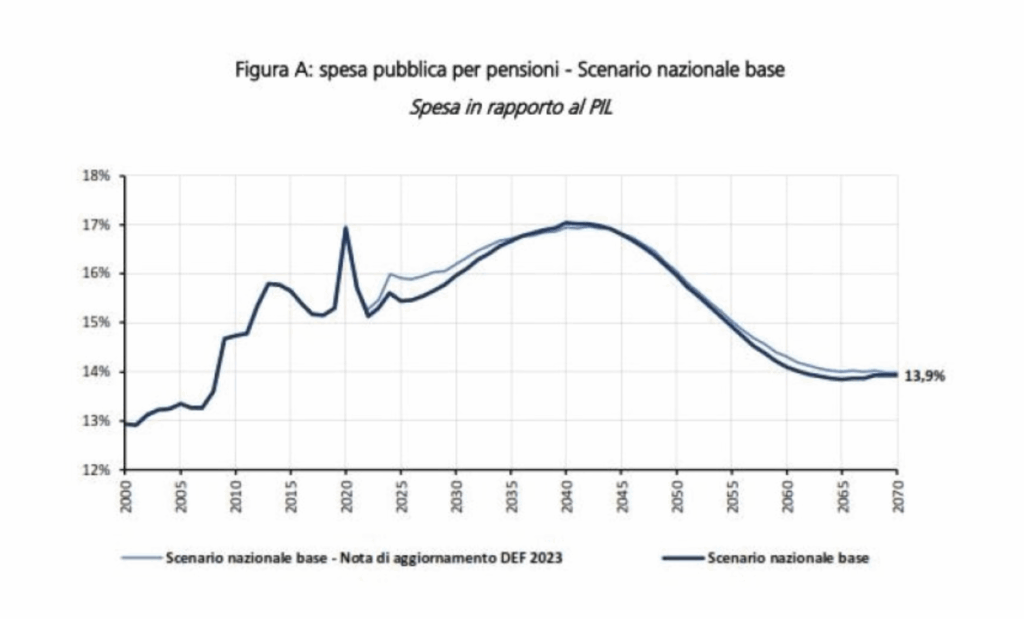
In Italy there is a Piave line: a measure reintroduced earlier by the current government than in the years in which the yellow-red executive had blocked it: the automatic periodic adjustment (now biennial) of age and contribution requirements to increase life expectancy. The law is now under joint attack from the Salvini/Landini alliance. And the government is hesitatingFor now, a pathetic gradual increase of three months has been hypothesized in the two-year period 2027-2028, with a wasted burden of additional outlays of 0,5 billion in 2026, 1,8 in 2027 and 1,0 in 2028. The importance of this mechanism has been reconfirmed in all venues. We recall, for its clarity, what the Bank of Italy wrote on the subject, in the Memorandum submitted to the hearing on the budget of the joint Budget Committees: "The mechanism of indexing the retirement age to longevity was introduced for rebalance between generations The ratio between working time and retirement; this will help limit the growth in pension expenditure in the coming years, driven by population aging. According to European Commission forecasts, the current legislation would halt the growth in the ratio of expenditure to GDP in 2036, when it would peak at 17,3 percent, before declining and stabilizing at around 13,7 percent in 2070.
In recent days theOECD has published "Pensions at the Glance" 2025, the biennial report containing a comparative analysis of the pension situation of all 38 member countries. As regards Italy, the requirement has not changed subsequently and is also clearly stated in the 2025 edition of Pensions at a Glance, the usual indication to prolong active life: This measure is deemed necessary if we want to increase income from work and, in turn, ease the burden of pensions, which will weigh especially heavily on younger generations, who must face the economic challenges of aging, which in the short term will cause a slowdown in their income growth and, in the long term, a potential burden on the entire Italian economy.
To mobilise untapped labour resources and counteract the generally negative impact of population ageing on per capita GDP growth, the OECD indicates three main routes: 1) drastically reduce (by at least two thirds) the gender employment gap; 2) activate healthy older workers; 3) promote regular immigration. In Italy, therefore, the "normal" retirement age, for those who started working in 2024, could be closer to the threshold of 70 years in the next decades, and maybe reach it.
This forecast – in a country like Italy obsessed with retirement age levels – has sparked the usual Greek cry over the fate of poor young people. Il Nidil-Cgil Indeed, it maintains that the only realistic route to retirement for the vast majority of self-employed workers remains retirement at 71, the only age at which no threshold is required, but with a modest pension and far from a dignified standard of living. The CGIL-affiliated workers' organization isn't entirely wrong. Indeed, it is right to point out that the Special Management at INPS is the golden goose for the institution's consolidated budget, boasting colossal assets (€9,6 billion in 2024) due to the trivial fact that it collects contributions but pays out few pensions. It would be important, however, for NIDIL to seek a solution to the contradictions of the pension system, which, in the coming decades, will continue to see cohorts of retirees, with dignified benefits, especially for men on senior pensions, dependent on new entrants.
Germany and the pension vote
Young Italians should take lessons from young Germans. Even the Merz government is struggling with one pension law which is The Bundestag went to the polls on FridayMerz must respect the program agreed with the SPD, which envisages maintaining, at least until 2031, pension amounts at least 48% of the average monthly salary (in Italy the average pension amount is higher than the average salary). The deputies of the Young Union of the CDU fear that this will become a threshold to be maintained even after this date with a additional annual cost between 11 and 15,1 billion euros, which will primarily impact the incomes of younger people. The Young Union has 18 MPs, but its majority only has 12 votes.
There was strong concern that the government would lose its majority in the vote on the law, with all the consequences that entailed. The CDU convened its group—behind closed doors—in recent days, concluding the meeting with a vote binding on all MPs. It became known, however, that disagreements had arisen, and the Chancellor was unsure of the group's unified discipline. In the end, the government was saved by the abstention of Die Linke, the far-left formation. This vote will not be a negligible fact in the German political dialectic. Using the language of Francesca Albanese, one could say that the Youth representatives have sent a "warning" to politicians. Meanwhile, in Germany, as in Italy and elsewhere, the left, both social democratic and extremist, is demonstrating that, when it comes to pensions, its interests are tied to the working class of industrial society, to Cipputi's international.