
In the movie Everybody at home by Luigi Comencini (1960) Lieutenant Alberto Innocenzi, masterfully interpreted by a great Alberto Sordi, in the confusion of September 8, 1943, telephones the Command to warn that the Germans have allied themselves with the Americans. The misunderstanding is soon cleared up. For the Italian pensions, instead, it is always September 8th. And every time, cases of irresponsibility and dishonor are wasted, without starting from there, as in 1943, the path of resistance and redemption.
These days there is talk of a Policy document presented to the Chamber by the broad-based groups, first signed by the Democratic Party president, Clare Braga, with which the left definitively crosses the Rubicon that separated it from the Salvini's League and reaches, in that uncomfortable position, the CGIL, forcing the majority to draft, at forced marches and with some embarrassment, an alternative motion in an attempt to fend off the blow of the League being called into question, on tenterhooks because it saw one of its historic demands, which it had also advocated in the final phase of the budget session, being taken away.
In short, The Braga motion strikes at the heart of the Fornero reform urging the government "to take steps to review, starting with the first available measure, the decision to increase the age requirements for pension access and eliminate the periodic review mechanism." This is the rule (introduced in 2010 by the last Berlusconi government, extended by the Fornero reform, blocked in 2019 by the Conte I government, and reinstated on January 1, 2025 by the Meloni government) that provides for the biennial indexation of the age and contribution requirements for retirement to increases in life expectancy. This is a rule that all institutional observers (Istat, INPS, RGS, UPB, and the Bank of Italy) consider essential to the sustainability of the pension system, attributing its repeal to an increase in the debt-to-GDP ratio of approximately 15 points by 2045 and approximately 30 points by 2070. Isn't that how you kill horses too?
The most astonishing paradox lies in the criticism that the opposition directs towards the majority and the government.: that of having deceived voters, since, "after having promised during the election campaign to repeal the Fornero law and the possibility of accessing a pension at 60 years of age and with 41 years of contributions, the only measures that were structurally adopted consisted in the substantial reduction or, even, elimination of any form of flexibility in pension exit." It is strange that the opposition is demanding the implementation of a program that they criticize and that contains wrong proposals. And, fortunately for the country, they were promptly set aside as part of the policies of attention to public finances that have been—in all the budget laws passed—the defining feature of the Meloni government. The Democratic Party, a new Saturn, continues its plan (it tried in vain with the Jobs Act) to dismantle all the reforms it championed in the past. The Fornero reform was passed by the Democratic Party during Pierluigi Bersani's time as secretary. Revisiting the past requires moderation. The Democratic Party, however, advances... while regressing. Sometimes even returning to the left's Stone Age. This is the case with the Act's treatment of supplementary pensions.
Only primitive, three-nosed politicians, in fact, could write in 2026, after thirty years of experience, that "the public pension system must be protected and strengthened, preventing all initiatives that tend to undermine its financial solidity and social credibility, surreptitiously encouraging the transfer of workers' pension savings to private financial groups." With these few remarks (which made even Maurizio Landini blanch) the Democratic Party liquidates a sector that is made up of 33 negotiating funds, 38 open, 69 Individual Pension Plans (PIPs), 151 pre-existing funds. The total number of members has reached over ten million.
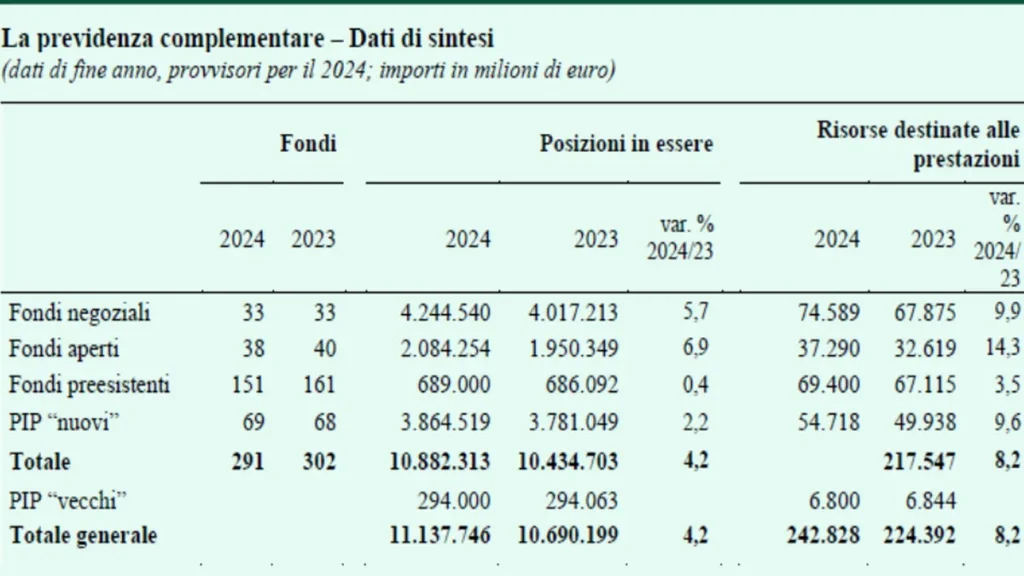
In 2024, there were approximately 4,2 million outstanding positions in occupational pension funds; 2,1 million in open-ended funds; and 4,2 million in PIPs, of which 0,3 million still belonged to the so-called "old" PIPs. There were approximately 700.000 positions in funds that pre-existed the 1993 reform (and subsequent amendments). The resources allocated to the benefits accumulated by supplementary pension schemes at the end of 2024 amounted to 243 billion euros, corresponding to 10,8% of GDP and 4% of Italian households' financial assets. These resources were distributed as follows: approximately €74,6 billion to occupational pension funds; €37,3 billion to open-ended funds; and €69,4 billion to pre-existing funds. PIP resources totaled €61,5 billion, including €6,8 billion attributable to "old" PIPs.
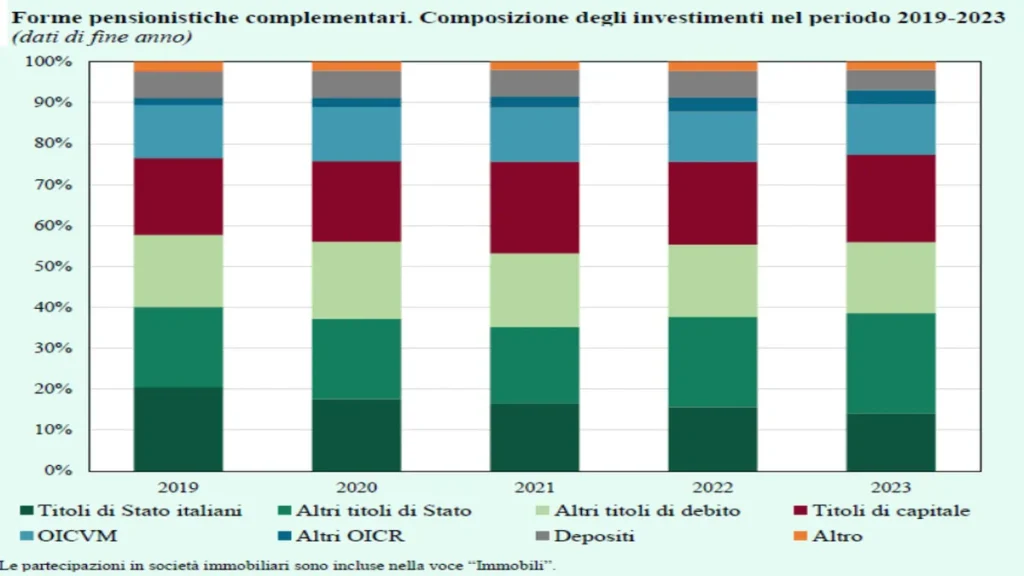
Did these resources go to democratic-plutocratic "private financial groups"? (When will the Jews be added?) The bicameral Commission for the supervision of social security institutions, chaired by the Northern League's Alberto Bagnai, conducted an investigation into the funds' investments and demonstrated that considering the sector as a whole, investments are mainly allocated to government bonds or other debt securities (overall, 56% of the total), in equity securities (21,4%), and in UCITS (12,4%). Total exposure to equities, including that achieved through UCITS, other UCIs, and derivatives, reached 28,8%. Italian government bonds constituted by far the largest item of domestic investments: €26,7 billion.
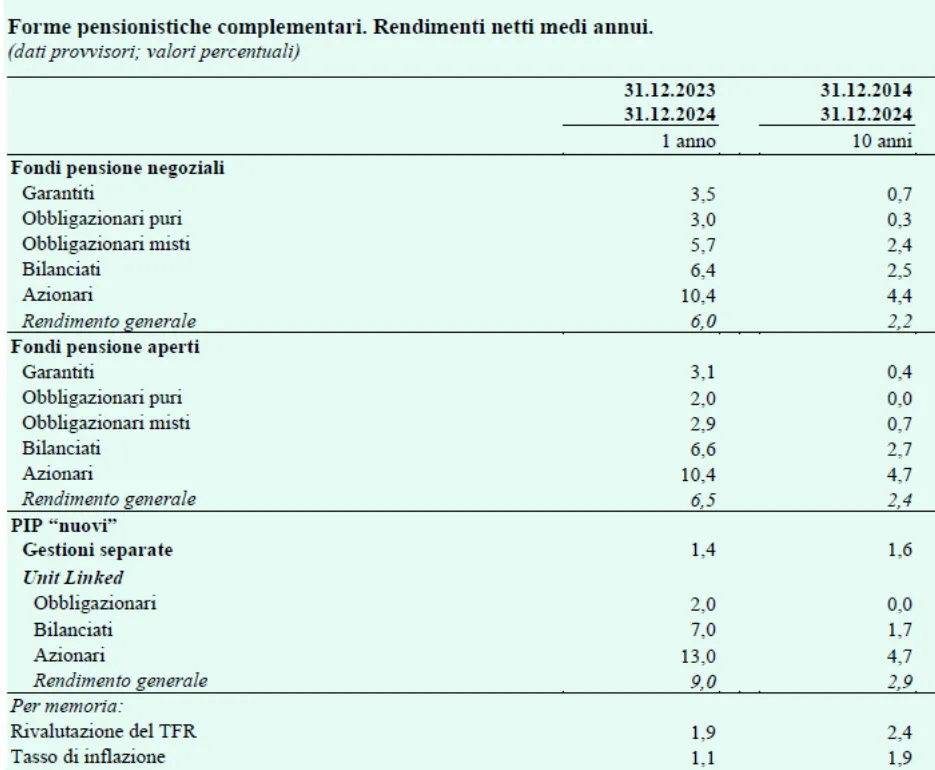
As for the returnsFor the equity segments, average net returns ranged between 10,4 and 13 percent for the various types of investment forms. For balanced lines, average results ranged between 6,4 and 7 percent. Lower, but still positive, average returns were observed for the bond and guaranteed segments. The following table highlights the different types of returns, comparing them with those – by law – of the TFR, which is the main source of financing for supplementary pension provision.
As seen No one defrauds the workers, who freely decide to joinInvestments in securities issued by Italian companies amounted to €2,8 billion for debt securities (bonds) and €1,7 billion for equity securities (shares). In essence, investments in the real economy are practically symbolic.