The origins are ancient: the castle was part of one defensive network to protect Todi in the XIII century, but its origins are much more remote, the presence of a "gens Petreja" on the place that hosts it also tells of its existence already in Ancient Rome, as "Castrum" of the powerful "municipium" of "Tuder".
In a census of 1290 Petroro Castle, positioned along one of the main arteries that unraveled from Via Flaminia, had 60 families and about 300 inhabitants and was the only fortified point of the plebate of Santa Maria di Due Santi, intended to protect the nearby villas. Inserted in a context of artistic-religious importance, due to the large presence of sacred places, with the Romanesque churches of San Epimaco and Gordiano, San Salvatore, Santa Maria, San Martino and Sant'Antimo, Petroro also served as a shelter for pilgrims. Furthermore, the place is located on one of the Jerusalem streets, as evidenced by the presence of the Hospital of the Order of St. John of Jerusalem. Theater of history for better or for worse,
the Petroro Castle in 1499, at the time of Todi of the Guelphs, was the scene of a frightening massacre, when the followers of the Ghibelline Altobello Chiaravalle took refuge there, hunted down by the troops of Cesare Borgia, the Orsini, the Vitelli of Città di Castello and Ludovico degli Proceedings from Todi.
Past stories. Today Castel Petroro, after a restoration that lasted years, hosts a charming country house among the olive groves and the flavors of Umbria that extends over the entire area of the medieval village, of refined and austere beauty
A large millstone on the internal square testifies to the presence of an ancient oil mill next to which stood the public oven, both certified in the 1852 cadastral Brogliardo. Today on that square opens the “Petreya Inn”, a refined restaurant that marks the opening of a new interesting chapter in the intense gastronomic history of Oliver Glowig, already two Michelin stars, German by name but Italian first for the love of a woman who soon became his wife, then for the love of our cuisine and then for elective adoption for 25 years now.
In love with Mediterranean flavors in its landing at the Capri Palace in Anacapri and at the Aldovrandi in Rome, where he won two Michelin stars in just seven months of work, of those of the Lazio hinterland rediscovered during his stay at Poggio Le Volpi in Monte Porzio Catone, now the great chef immerses himself in the flavors and in the Umbrian gastronomic tradition creating emotions between land and sea obviously reworked in a dimension of strong innovation in the game of his inexhaustible imagination.
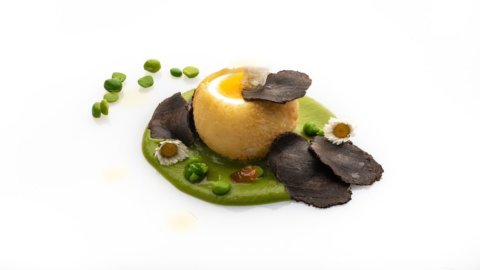
His menus marry the absolute quality of raw materials, treated with wisdom and technique and with a touch of creativity. For the Appetizers, simple land products are used such as "cooked and raw fruit and vegetables", a dish to which the Chef is very attached and which he has been following for at least ten years. We are in the Umbria of truffles and Glowig embellishes the egg which is served in a crunchy breading that gives life to a fun game of textures in the dish "crispy egg with peas, candied kumquat and Norcia truffle".
His passion for the recovery of raw materials unknown to most led him to develop an intriguing first course the "mixed pasta with mussels, roveja, candied tomatoes and fried rosemary". The roveja, an ancient legume typical of Cascia best known as field pea, today a slow food presidium, is exalted for its spicy notes and decisive personality, becoming the protagonist of a dish in which the memory of the Campania influence plays a role in a pasta that offers mussels and legumes together.
Strength of character also manifests itself in the main courses where the intensely flavored meats are all strictly local. The meeting with a "Cinta Senese" breeder and a visit to his farm, the latter's passion for his animals bewitch Chef Glowig who creates an unusual recipe: "Orvieto beltello pork with broken spelled polenta, asparagus, jelly of lemon, lavender and chilli pepper and mustard grain sauce”, here even the less noble parts find their rightful expression when combined with a broken spelled polenta and accompanied by a lemon, lavender and chilli jelly which with acid, fresh and spicy notes breaks and dilutes the fatness of the dish making it only apparent.
Spring is celebrated with "lamb, agretti and radishes", in a succession of apparently simple flavors where the minerality of the agretti decisively balances the characteristic flavor of the lamb. Finally, the Desserts, which are also a reflection and celebration of the territory. The inevitable chocolate comes alive in the "Bacio, semifreddo of milk chocolate and hazelnuts" inspired by the classic chocolate, in shape and flavour, while the famous Umbrian lentils are offered in the unusual guise of "Lentil ice cream with creamy white chocolate acid, rhubarb and strawberries”.
Oliver Glowig's work will be assisted in the dining room the maitre Claudio Carletti, who boasts a 23-year career in haute cuisine, particularly in restaurant management, from La Pergola in Rome alongside Heinz Beck (present in 2015 for the conquest of the third Michelin star) at the Villa Crespi hotel restaurant – 2 stars Michelin – with Antonino Cannavacciuolo
However, Oliver Glowig's projects go beyond the restaurant. In the Country House, as soon as it is permitted by current legislation, cooking classes will be held, dedicated to leavened products and fresh pasta in a particular context around the oven, where in past centuries the castellans baked bread. All under the banner of a philosophy of the new project that aims to enhance and increasingly share the beauty of this land, making its roots admired and its products appreciated.