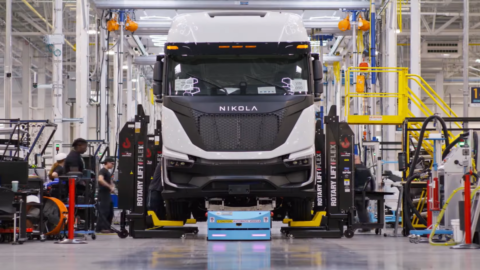
Yet another victim in the electric vehicle sector. Nicholas Corporation, the American startup specialized in electric and hydrogen trucks, has officially filed with the United States Bankruptcy Court for the District of Delaware bankruptcy protection application according to Chapter 11, a section of U.S. bankruptcy law that became famous with the crisis of Chrysler and General Motors in 2009. The news comes after weeks of speculation about the financial state of the company, during which the stock had suffered a precipitous collapse on the Nasdaq.
Nikola, in a statement, stated that have about 47 million in cash of dollars and want to continue to provide a “limited” service and support for trucks on the road, starting a process of selling its assets to maximize their residual value. The bankruptcy filing listed liabilities between $1 billion and $10 billion and set the number of creditors between 1.000 and 5.000.
After the announcement the stock is in free fall on the Nasdaq: -36% to $0,49.
Nikola: From the promise of revolution to the inexorable decline
Founded in 2015 with theambition to become the “Tesla of trucks”, Nikola had also made an important partnership with Iveco for the production of zero-emission heavy commercial vehicles. But already after four years, in 2023, the joint venture had been dissolved by mutual consent, a sign of the operational difficulties the company was facing in Europe and North America.
Phoenix, Arizona-based Nikola was listed on the stock exchange in June 2020 and delivered the first vehicle in December of the following year. Despite initial investments and promises, the company never managed to consolidate a stable position in the market.
The financial crisis and the failure of the recovery plan
“Like other companies in the electric vehicle industry, we have had to address various market and macroeconomic factors that have impacted our ability to operate. Over the past several months, we have taken numerous actions to raise capital, reduce our liabilities, clean up our balance sheet and preserve liquidity to support our operations. Unfortunately, the our efforts were not enough to overcome these significant challenges and the Board has determined that Chapter 11 represents the best possible path forward under the circumstances for the Company and its shareholders,” said CEO and Chairman, Steve Girsky.
Nikola's bankruptcy is the result of years of economic hardship, compounded by a controversial managementThe company has tried unsuccessfully to raise new capital and reduce liabilities, finding itself in a particularly difficult market environment for startups in the sector.
The Broken Dream: From the Wall Street Bubble to the Scandals
In 2020, at its peak, Nikola had reached a Market capitalization of over 30 billion of dollars, even surpassing giants like Ford. Today the market cap is only 40 million. Even General Motors had bet on the company with a multi-billion dollar deal that should have led to the production of the Badger electric pickup, but the agreement never materialized. At the same time, the founder Trevor Milton was engulfed in a financial scandal and convicted of fraud, leaving the company in a credibility crisis from which it has never recovered.
Nikola: a failed production and unsustainable costs
Nikola managed to produce just 600 electric trucks by 2022, many of which have been recalled for technical defects, a fact that highlights the difficulty of competing in a sector dominated by giants such as Tesla and Daimler. low demand for hydrogen trucks and lack of refueling infrastructure further hindered the company's growth.
Furthermore, the production cost per unit remained high, causing losses of hundreds of thousands of dollars for each vehicle sold.
A market hostile to EV startups
Nikola It's not the first electric startup to collapse under the weight of economic difficulties. Before her, even Fisker and Canoo have faced challenges. The once promising electric vehicle market has proven to be extremely competitive and lacking the infrastructure needed for sustainable growth. In addition, rising interest rates have made it harder for emerging companies to attract investment and finance the development of new technologies.
The only Tesla remains an exception, which, thanks to the vision of Elon Musk, is managed to overcome obstacles similar and consolidate itself as the undisputed leader in the sector.
Next steps: asset sale and liquidation
According to court documents, Nikola has assets between $500 million and $XNUMX billion, while liabilities amount between one and ten billion dollars. The company now intends to market and sell part or all of its assets, with the aim of implementing an orderly liquidation of the assets. The end of an era for a company that, between great expectations and just as many disappointments, has failure in an attempt to revolutionize the zero-emission heavy-duty transport sector.