The project is part of a broader program of reflection on the role of contemporary art within historical contexts, offering an experience that combines aesthetics, physical participation, and critical thinking.
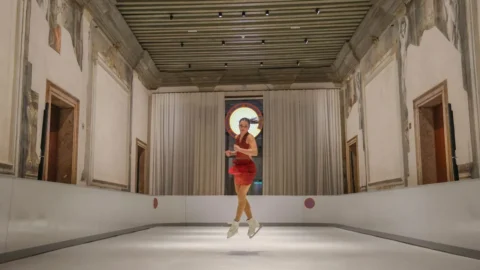
A 100 square meter skating rink
The rink is located in the sumptuous frescoed ballroom on the first floor of the 18th-century Palazzo Diedo. The contrast between the temporary and unstable ice surface and the monumentality of the historic architecture generates an intense dialogue between past and present, between permanence and transience. The simple, everyday act of skating is thus transposed into a museum context, transforming into a conscious and performative act. The installation is accompanied by a original soundtrack composed by the Berlin band To Rococo Rot, a fundamental element of the work. The sound is spread through six speakers Arranged around the rink, they react to visitors' movements, amplifying them and presenting them as an immersive acoustic experience. In this way, the audience's bodies become an integral part of the work: every step, every slide on the ice contributes to generating an ever-changing sound composition.
Originally developed by the artist over twenty years ago, Eisfeld II was rethought and reinterpreted specifically for Palazzo Diedo, adapting to the spatial, historical, and symbolic specificities of the site. This new version of the work reinforces the site-specific nature of the intervention, underscoring the ability of Nicolai's work to renew itself over time and to engage with ever-changing contexts, without losing its conceptual power. Through this initiative, Eisfeld II intends to open a debate on the intended use and contemporary function of historic spaces, inviting the public to imagine the museum not as a static place of conservation, but as a welcoming, dynamic, and participatory environment. The project proposes a vision of the museum as an experiential space, where the visitor is not simply an observer, but an active participant in a shared reflection on art and its role in society.
At the ends of the track are located the two lightbox of the artist, ENJOY/SURVIVE I & II, which introduce a further level of reading of the work. The luminous words, placed in a relationship of tension and complementarity, invite us to reflect on the delicate balance between pleasure and survival, between play and necessity, between freedom and risk. In this way, the experience of skating transforms into a sensory and conceptual meditation, capable of involving the body, the gaze and the thought.
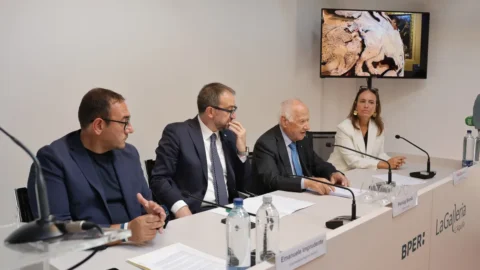
Mario Codognato, Director of Berggruen Arts & Culture, recalls: «I remember seeing Olafin's skating rink and installation in a museum in Zurich about twenty-five years ago. I was struck by its combination of seriousness and humor. The work addresses so many themes and questions of modern art. It's fantastic that it can be represented in an eighteenth-century palace in Venice.».
Born in Halle/Saale in 1962, Olaf Nicolai He is recognized as one of the leading contemporary German artists. His work develops in key cContemporary and interdisciplinary, exploring new possibilities for liberating art from traditional forms of representation and market logic. Nicolai interweaves reflections on economic mechanisms and materialism with investigations of memory, archives, and historical materials, often drawing on elements from everyday life. His works shape artificial landscapes and urban settings, transforming consumer objects into monumental presences, and employing advertising graphics reworked with a disorientating and critical approach. In his projects, Nicolai frequently integrates the results of theoretical and scientific research, creating works that straddle the boundaries between visual art, architecture, music, and performance, inviting audiences to question the cultural and social conditions of the present.
Cover image: Olaf Nicolai, Eisfeld II. Installation view, December 2025, Palazzo Diedo, Berggruen Arts & Culture. Photo