"Milan is experiencing a golden moment, with someone comparing his energy to that of London in the 90s, but with a touch of Dolce Vita" he said it in Financial Time in a long study dedicated to the Italian economic capital which in recent years has seen a profound transformation, thanks also to the tax benefits for repatriation of capital and a Real Estate Market profitable that have opened the doors to the “luxury migrants"And ai private equity funds.
For better or worse, Milan is no longer the city known for its "cast iron" and fog. Milan is now talked about in living rooms of the world's richest people, those who until yesterday had their own place of residence in Antigua, the Bahamas, Barbados, Panama and Cyprus and who now have it moved to Milan: In 2023, there were 1627 new arrivals from the United States, the highest figure since 2003.
Nassef Sawiris, Egypt's richest man and co-owner of Aston Villa, Richard Gnodde, vice-president of Goldman Sachs, e Yoël Zaoui, co-founder of the consultancy boutique Zaoui & Co, are some of the international billionaires who have decided to move to Milan due to the flat tax. But Rolly van Rappard, co-founder of CVC Capital Partners, is also considering the move, while Frédéric Arnault, son of luxury magnate Bernard Arnault, divides his time between Paris and Milan after taking over at Loro Piana. The British newspaper also highlights how in recent years several investment firms such as Hvc, Preservation Capital and Ares have opened and expanded offices in Milan.
The siren song of the flat tax, or the "Ronaldo law"
Certainly, the reason that triggered the multi-billionaires' moves was a fiscal one: anyone who moves their residence to Italy benefits from the so-called "CR7 rule", introduced by the Renzi government, so called because it allowed Cristiano Ronaldo to move to Juventus by paying a “symbolic” and flat tax on all income from abroad: a flat tax of 200 thousand euros on all income from abroad (there were 100 thousand until last year), on interest on bonds, dividends from shareholdings, capital gains from the sale of businesses, for a maximum of 15 years old, with exemption frominheritance tax on non-Italian goods. For the private equity which does not fall within the flat tax, Italy applies a26% capital gains tax rate, significantly lower than the 34% introduced in the UK.
Property prices are skyrocketing, but still lower than those in London
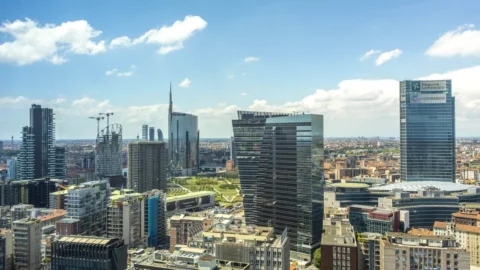
So some international investors have poured no small amount of capital into luxury properties in Milan which in the meantime was developing in many areas, especially vertically. In recent weeks, the focus has been on these operations investigations by the Prosecutor's OfficeReal estate prices, already high in Milan, have skyrocketed further: according to some analysts, house prices have increased by nearly 60% over the past ten years. Luxury apartments and the most sought-after penthouses in the historic center are commanding sky-high prices, with penthouses over 600 square meters with a pool, gym, and concierge now starting at €8 million to €10 million. High-end rents have also risen by over 14% in the past five years, more than double that of Rome (+7%). fashion district they reached almost 40 thousand euros per square meter, a figure eighteen times higher than the average for the rest of the country.
Aside from the peaks of top-end housing, the average house price in Milan is around 5.000 euros per square meter, while in London the average price is 12.000 pounds, or around 14.000 euros per square meter.
Then the love for the Italian “dolce vita” blossomed
But it wasn't just about tax breaks and office transfers: once company executives landed at Malpensa they then began to discover the other side of Milan, appreciating the quality of life in the city: "in two hours you can reach Portofino; in 45 minutes you can have lunch on the terrace of Villa d'Este on Lake Como; and in three hours you can reach St. Moritz" reports the Financial Time.
The downside is for some Milanese
The arrival of great wealth has forced some Milanese to move from the most sought-after neighborhoods to the suburbs. This has given rise to some citizen committees, while to complicate the scenario a new one has arrivedjudicial investigation on an alleged kickback scheme linked to urban redevelopment.
Il Financial Times It also reports the proliferation of private “English-style” clubs, including Cipriani house and the next Soho House, perceived as alien to the "Italian" lifestyle and way of doing business. A banker interviewed by the newspaper emphasizes that these places are frequented almost exclusively by private equity managers and foreign bankers. He also notes how the "London" salaries of newcomers are creating imbalances within the Milanese offices.