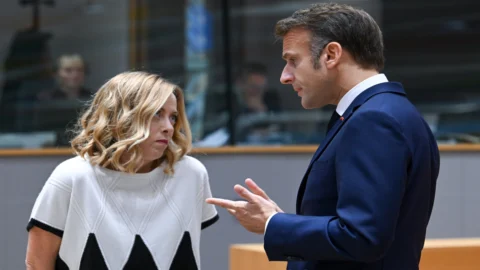
What happened in Tirana was could it be the (final?) break? between Giorgia Meloni and the so-called Coalition of Volunteers. On the sidelines of the summit of the European Political Community, a new restricted meeting was held between Emmanuel Macron (France), Keir Starmer (UK), Friedrich Merz (Germany) e Donald Tusk (Poland). The Ukrainian President also at the table Volodymyr Zelensky and, by telephone, Donald Trump. A group photo that quickly made the rounds of agencies and social media. But among those faces was missing that of the Italian Prime Minister.
A absence that did not go unnoticed, also because Meloni was already in Tirana to participate in the official sessions of the CPE. It was a few meters away, but he chose not to sit with the othersA decision that ended up amplifying, symbolically and politically, the distance between Italy and its main European allies.
Many have interpreted this choice as the reflection of a personal and political friction with Emmanuel Macron. But there's more: the gesture was also interpreted as a sign of growing Euroscepticism by the Italian government. An attitude that risks isolating Italy just as Europe is seeking a common position on the war in Ukraine. This distance is also due to a political choice dictated by internal logic: in order to leave no room for electoral competition from Matteo Salvini, Giorgia Meloni has adopted a ambiguous line towards Europe, as also demonstrated by the failure to ratify the ESM.
Meloni: "No to sending troops, Italy is consistent"
In front of opposition controversies – who spoke of a “worldwide embarrassment” and of “Italy reduced to a walk-on role” – the prime minister responded harshly. In a press briefing in Tirana she clarified the position of the Italian government:
“Italy has long declared that is not available to send troops to Ukraine and it wouldn't make sense to participate in formats that have objectives for which we have not declared our availability" explained Meloni.
The Prime Minister has claimed a line of coherence and transparency: “Are we asked to participate in these formats to send troops to Ukraine or just to take a picture and then say no? You have to be serious, and I am a serious person.”
Meloni has however Italian support for Kiev reaffirmed at all other diplomatic and international levels, but has marked a clear distance from any hypothesis of military escalation.
Macron's response: "No troops, ceasefire being discussed"
But the Italian position was immediately questioned by Emmanuel Macron. The French President, in a press conference in Tirana, denied that during the meeting of the Volunteers there was talk of sending troops:
“There was a misinterpretation. We did not talk about sending troops, the discussion was about the ceasefire in Ukraine. Let's avoid spreading false information: there are already enough of them on the Russian side”.
A denial that had the tone of a reproach, fueling diplomatic tension between Rome and Paris. The implicit message from the French president is clear: Italy misunderstood – or exploited – the contents of the summit to justify its absence.
A new axis with Trump? And the EU relaunches sanctions
At the Tirana summit, a further point also emerged new convergence between the European leaders present and Donald Trump, with whom they had a telephone conversation. Macron spoke about the possibility of an upcoming direct contact between Trump and Vladimir Putin, while the common goal remains to increase pressure on Moscow.
Ursula von der Leyen, who did not attend the restricted summit, announced a new package of sanctions against Russia, developed in coordination with the United States. Among the measures envisaged: a ban on access to Nord Stream 1 and 2, a lower price cap on Russian crude oil, and tougher financial restrictions on Russian banks.
Italy most isolated at European level
Although Meloni reiterated Italy's full support for Ukraine – "We must not throw in the towel, we must insist on peace and security guarantees for Kiev" – her relationship with the "Volenterosi" appears increasingly compromised. Italy, while remaining active in multilateral formats, seems officially outside the group that most directly interacts with Kiev and Washington.
The clash with Macron seems to seal a new fracture in the Franco-Italian axis, just when Europe needs unity and a shared vision. And the photo of Tirana – without Meloni – could become theemblem of an Italy increasingly on the margins of European strategic choices.