The Lockdown pushes restaurateurs to sharpen their ingenuity to develop new inviting proposals for their customers with the aim, if necessary, of attracting new ones.
The initiative launched in Rome by the Osteria dell'Arco is original, a gourmet restaurant run by two women, Nicoletta and Cristina, endowed with a spirit of initiative "lovers of the cuisine of the past, of cooking with long cooking times, of simplicity, but which it never changes into the obvious” in Via Giacomo Pagliari, a stone's throw from the historic Porta Pia.
In fact, the Osteria dell'Arco offers “The curious walks”, interesting itineraries “to discover those details, which we sometimes overlook. Historical anecdotes and curious digressions from a Rome that belongs to us". The initiative is proposed in collaboration with an authorized tourist guide. A route that every Saturday and Sunday starting from Porta Pia unfolds in the Sallustiano district, revealing extraordinary and unusual itineraries.
And it must be said that the Sallustiano district lends itself well to a stratified reading of the history of Rome.
The name refers to the Horti Sallustiani, because here stood the luxurious villa of the historian, politician and influential Roman senator of the republican period Sallustio Crispo, here also stood the temple of Venus Erycina, where the famous Ludovisi throne was found today preserved in the Roman national museum.
From this area, as evidenced by a stone of white marmop fixed in the ground in memory of the ancient Porta Salaria, also started the Via Salaria Nova, one of the oldest Roman consular roads, used - hence the name - for the transport of salt from production sites on the sea inland
The Aurelian walls also pass here, the walls built between 270 and 275 by the emperor Aurelian to defend Rome, the capital of the empire, from possible attacks by the barbarians. Even if two hundred years later they could not prevent the irruption of Alaric's Visigoths who put the city to fire and sword. A curiosity: Alaruico's troops didn't have to tear down the walls, they entered without problems through the Salaria gate, demolished 1400 years later, which they found open. According to legend, a wealthy matron Anicia Faltonia Proba. Taking pity on the terrible conditions of her fellow citizens, convinced that there was no more hope for the city, she would have ordered her servants to open the gates to the barbarians.
The imposing walls hide a curiosity: high up near Piazza Fiume you can still see a sort of swelling of the walls, with a fissure. It is the only example of a latrine for Roman soldiers on guard duty, which poured out, which has survived to us.
A little further on, a marble column recalls the breach that Piedmontese soldiers opened on 20 September 1870 in the city walls of Rome, sanctioning the annexation of the city to the Kingdom of Italy and the end of the Papal State as a historical-political entity.
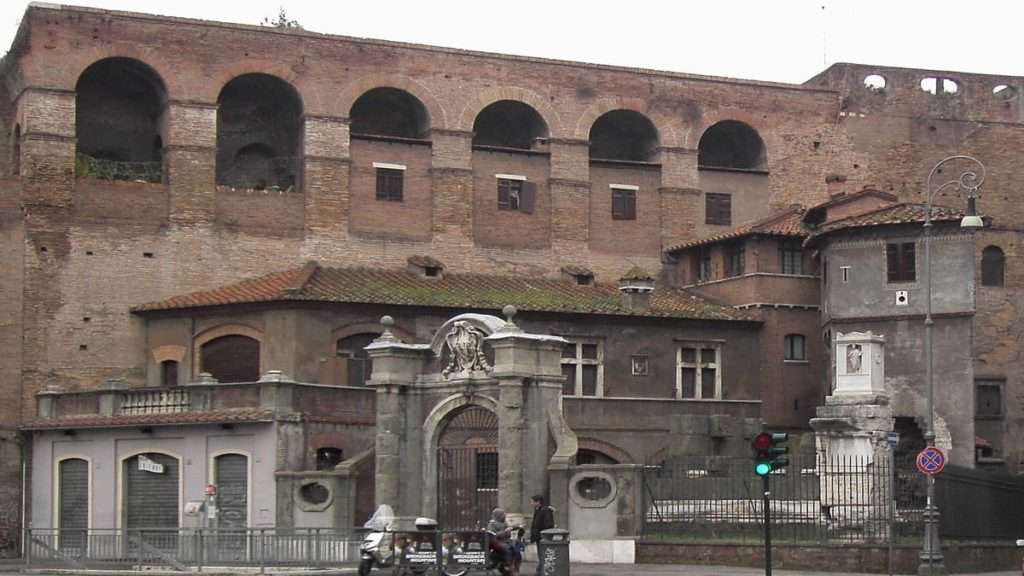
We move two hundred meters and here is the monumental Porta Pia built by Michelangelo Buonarroti for the entrance to the city of the Popes from Via Nomentana. The now octogenarian artist of the Sistine Chapel was summoned by Pope Pius IV. Given the importance of the door, Michelangelo presented three projects. But the thrifty Pope chose the cheapest one. The artist didn't like it and was able to take revenge on him.
On the side of the door you can see a tondo representing the papal paten, the plate used to cover the chalice for the Eucharist. But there are strange symbols inside. To understand this, we need to make a premise. The Pope boasted of Medici ancestry while in truth he would have had a more humble barber among his ancestors.
And so Michelangelo, with his bad temper, made fun of the pontiff by placing inside a stone disc that in reality would have represented the barbers' basin also a block that represents a piece of soap, all surrounded as is the custom by papal stoles, transformed into towels.
This obviously aroused the irony of the populace, which was summarized by a poem by the dialect poet Luigi Zanazzo:
“Since he says that the pope who made it did come from the descendants of the family of a barber, the architect for that knew all of the monno, that done he scurpì that large cunculina, with a drento in the middle piece of soap and 'ntorno a la cunculina er sciutamano co la su' good fringe here and there”.
The Sallustiano district therefore reserves many surprises that sometimes escape even the most attentive.
Therefore, the initiative of the Osteria dell'Arco is commendable, which aims, in times of Lockdown, to strengthen its not only gastronomic but also cultural ties with the neighborhood.
“In 2008, when we opened – recall Nicoletta and Cristina – the neighborhood was teeming with pizzerias and restaurants with “plethoric” menus and quality not in line with what was happening in the city at the time.
We were the first in the area to choose short menus, careful and non-obvious wine selections, cuisine that is both simple and gourmet: with great satisfaction we note that in recent years our area - the neighborhood around Piazza Alessandria - is increasingly distinguishing itself for quality offers and new entries”.
The guided tour ends "with a tasty refreshment stop at the Osteria dell'arco".
You can choose between two possibilities: “the walk from 10:30 to 13:00 includes lunch (a first course of the day, a glass of wine paired with water).
The walk from 14:00 to 16:30 includes a snack (homemade focaccia with 12 hours of leavening with roasted pork loin, salad and chimichurri, glass of wine and water).
Cost of the guide program including 24 euros. Obviously, it is mandatory for everyone to wear a mask and respect interpersonal distance as well as undergo temperature checks.