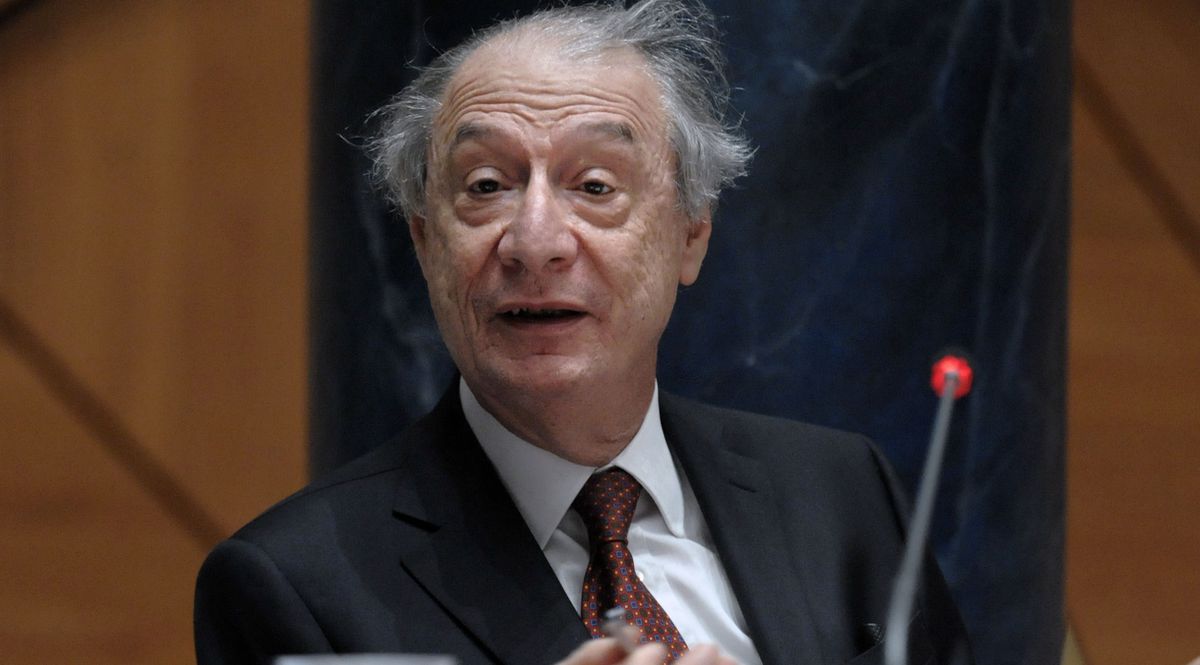
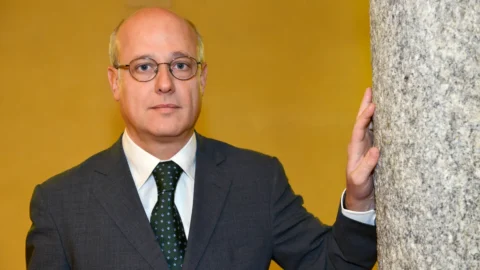
The professor. Bruno Bises, of Roma Tre, organized a conference in honor of Cesare Cosciani 50 years after the publication of the "Status of the works of the Commission for the study of tax reform" (1963). It was held last week; an undoubted success. I was kindly offered to speak at the end of the first day to recall the "Dispute with Bruno Visentini": Cosciani, due to disagreement with the majority that had formed in the Commission, left the presidency to my father, while continuing to assiduously participate in the works, which ended in 1967 with another report by Visentini. It is interesting even today, and it is nice to re-read the reports, due to the solidity of the formulations, which document an analytical and profound work; for the simplicity in the exposition and the care in the style, which testify to the mastery achieved in understanding the problems and the clarity of ideas in the proposals developed. The different natures of the drafters, and the different roles of each one, academic one, professional and politician, the other, do not obscure the full commonality of the institutional ideal of elaborating a project that strengthens the State in its mission at the service of society and the citizen. It is not discussed because it is in the common sentiment of the society of those years.
Today is different. The novelty is precisely on the mission of the institutions. What we improperly call populism, due to the crude way of presenting itself, bears witness to the widespread ideology of extreme individualism, which in its rejection of institutions, in its vocation to the minimal state, borders on anarchy. It is a sentiment that has spread throughout Western culture; seriously discussed by philosophies that reflect movements we encounter elsewhere (eg neocom, tea party, "participatory democracy", the anarchist tradition). In the Italian voter it is a sentiment that is taking root, but mostly caught instinctively, without conscious reflection. We find it as certainly not a secondary component of the ideological minestrone, which Berlusconi has summarized in moderate party: "everything must change", "we must deregulate", "you don't eat with culture", remember the Martelli of the time "who cares about Bobbio". They are words, because the practice was quite different. In the voter, betrayed by the politics of recent years, the sentiment re-emerges, recalled by the net, from the philosophy of grillismo, where it has found clear expression in the radical and unambiguous oratory: to destroy the institutions; disparaging the people who represent them (we have no practice to say if it is sincere oratory; in the management of the movement seems rather insincere). She remains superficial. It does not explain how one can live together in an association articulated by the sole use of the network. Man left to nature is a wolf towards his kind. How to contain instinct if political institutions are destroyed? Private institutions should then also be destroyed in order not to become slaves to them. Perhaps man finds his meek nature in the anarchist society ordered by the network? Is the web the magic to rediscover the egalitarian society, as it was for the communist to overcome capitalism? In the communist elaboration, anarchy was more sophisticated in introducing the dictatorship of the proletariat as a transitory phase, to the point of betraying the invoked utopia in experience. Now utopia has taken hold perhaps precisely because it is confused. Its diffusion, so uncritical, can be explained as a popular reaction to the profound distrust in institutions, unable to represent common interests, as they have become an instrument at the service of the interests of groups that manage to appropriate them from time to time. Institutions have degenerated into corporatism; in fact it is the bodies that reproduce the fight of the wolf against the wolf; the marginalized voter feels its oppression.
After these years of institutional crisis, I don't know if it will be possible to recreate the atmosphere of the common good of Cosciani's time, to resume the discourse on the remaking of institutions, which already at that time, and in that context, he proposed to rethink to face the new. But we are forced to try the institutional path, in order not to fall into irrational populism, which in complex societies like ours always finds those who know how to rationally take advantage of it.