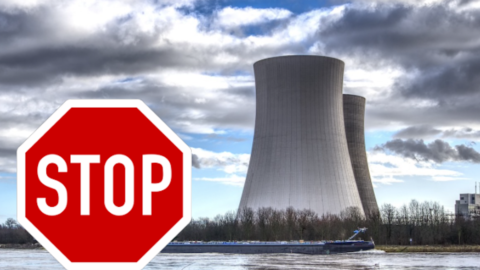
It truly is the end of an era. From midnight on Saturday 15 April the Germany will definitely say goodbye to the production of nuclear energy with the stop of his last ones three reactors. For the country's Green party, this is a dream that has been coming true for some time. Meanwhile, in Asia, nuclear energy is experiencing a renaissance, despite the disastrous Fukushima accident in 2011. Which is why Angela Merkel, the second longest-serving chancellor in the country's history, chose to accelerate the exit from nuclear power.
Although it is a decision that has been announced for some time, the closure of the last three nuclear power plants (Emsland, in the northern state of Lower Saxony, the site of Isar 2 in Bavaria and Neckarwestheim, in the southwest) surprises other countries a lot. Because Berlin, together with other European states, is trying to diversify its sources of supply so as to be able to become totally independent from Russian gas. Germany is historically one of Russia's largest "customers", with gas from Moscow accounting for around 55% of consumption in 2021 alone. Now the percentage has dropped to around 16% but only because Russia has partially closed supplies in following the European sanctions triggered by the invasion of Ukraine.
The nuclear debate has also divided the German government
However, the stop does not seem to concern the debate on the theme that has animated the country in these 62 years, quite the contrary. The energy crisis and the war in Ukraine have even exacerbated it, also dividing the internal forces of the semaphore coalition formed by social democrats, greens and liberals, which governs the country. In their coalition agreement – SPD, Greens and FDP – they agreed to abide by theabandonment of nuclear power in Germany, as a result, the last nuclear power plants were due to close at the end of 2022.
But Russia's invasion of Ukraine changed all that, as supplies of Russian gas to Germany stopped and the government feared an energy shortage. Chancellor Olaf Scholz decided to extend the period of operation of the power plants until April 15, 2023.
Germany, goodbye to nuclear power? But a third of electricity comes from coal
It is also true that nuclear energy, in the first three months of 2023, contributed to 4% of the country's electricity needs against 51% of the renewable such as wind and solar – growing steadily – and 28% of carbon (increasing to compensate for the absence of Russian gas), the most polluting of the fossil fuels: burning coal, with the same unit of energy produced, releases four times as much carbon dioxide into the atmosphere as compared to the use of methane .
However, the federal government intends to accelerate on renewables. The goal is to reach 80 percent by 2030 and compensate for the fluctuating supply of wind and solar power by building about 50 new gas-fired power plants in the 500-megawatt class. We will have to install “four to five wind turbines a day” over the next few years to cover our needs,” warned Chancellor Olaf Scholz. But will he be able to achieve his goal?
Nuclear power in Europe: who shut down the reactors and who wants to turn them on
Compared to Germany, other European countries have been quicker to say goodbye to nuclear energy. There Sweden led the way, ending nuclear power shortly after Chernobyl, as did Italy, which decided to shut down its last two nuclear power plants after the disaster. In Italy, the decision has remained in force even if it has often been reverted to discuss it; in Sweden, the phase-out was reversed in 1996. Today, six nuclear power plants produce about 30% of the country's electricity needs.
Other European countries, such as i Netherlands , Poland, plan to expand their nuclear power systems, while Belgium is postponing its planned phase-out. With 57 reactors, the France it has always been the first European country for nuclear energy and intends to continue to be so.
Overall, 13 of the 27 EU countries intend to use nuclear energy in the coming years, and some of them intend to expand their capacities.
Arguments in favor of nuclear energy
That the atom is an extremely divisive issue is nothing new. Europe has found itself split in two over the authorization of the taxonomy for sustainable finance. There France promoted a nuclear alliance with 12 other states – Italy is among them – to loudly promote nuclear power as an important source of energy in view of the ecological transition, because with zero emissions.
But how can nuclear power be counted among the sources of renewable energy? In fact, it is not directly the energy produced by nuclear fission that is included in the directive but thehydrogen with low CO2 emissions, produced by electrolysis. Which in turn can be powered, according to Paris, by nuclear energy.
As Germany says goodbye to nuclear power, Asia is expanding its capacity
Nevertheless, China, Russia e India in particular they are planning the construction of new plants nuclear. China, which already produces more nuclear energy than France, wants to build 47 more plants.
even the Japan wants to go back to producing more nuclear energy, despite the fact that the 2011 earthquake caused several nuclear reactors to fail in succession, causing a series of explosions with radioactive leaks. After that disaster all Japanese nuclear power plants were stopped to carry out checks and adapt safety protocols.
Since then, however, some reactors have been brought back into operation. Now the Japanese government has decided: The country, poor in resources, wants to build new reactors and keep the old ones running up to 70 years. “We need to make full use of nuclear energy,” the Prime Minister said recently Fumio Kishida. However, Japan's nuclear industry is currently facing a shortage of nuclear engineers, specialized companies and materials, making it difficult to get back on track.