Voltaire has just jumped out of bed with his nightcap still on and his nightgown on. With one hand intent on pulling up his trousers, he stretches out the other in an imperious gesture towards the scribe to command him, "write!". The scribe is already a few steps away, pen in hand, ready to transfer Voltaire's words onto a large notebook resting on a Louis XIV-style table. The full daylight through the window means that Voltaire did not wake up very early in the morning. He loved to sleep. Perhaps it fueled his creative vein which was immediately released upon rising.
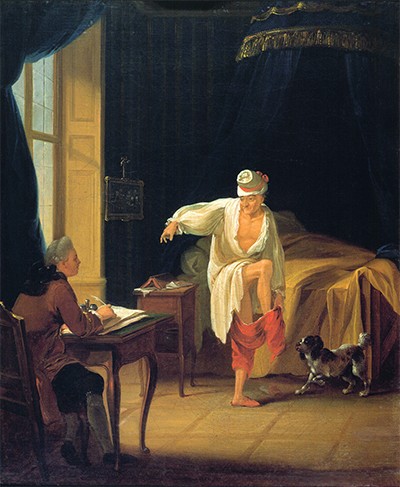
Voltaire has sparkling eyes, tense features, he appears tonic, exuberant, full of energy as soon as he gets out of bed. As he puts on his breeches he immediately begins to dictate to the scribe the thoughts that have flashed through his head upon waking up. A small dog seems to share this rite which is evidently not unusual.
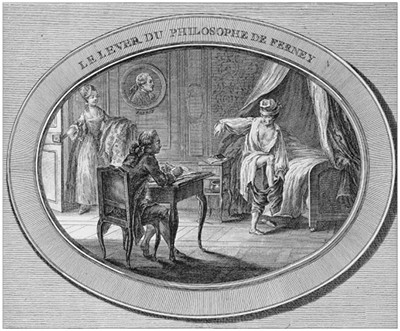
“The philosopher's alarm clock by Ferny", etching preserved in the National Library of Paris. Clearly inspired by Huber's portrait there are important variations.
The jurist and passion painter Jean Huber (1721–1786) portrayed the scene. Huber was one of Voltaire's Geneva friends. The numerous portraits of Voltaire, partly caricatured, earned him fame and the nickname of "Huber-Voltaire". Tsarina Catherine II commissioned him to paint a whole cycle of scenes from the philosopher's domestic life (which were later destroyed in a fire). Even the picture seen by Kafka in the Parisian museum was a commissioned work, executed by Huber in different variations: in some the dog is present, in others not.
Voltaire was not at all happy with this portrait. He complained publicly: he had made a fool of him from one end of Europe to the other. But this was not Kafka's idea. In fact, remember Brod.
Kafka paused in front of an old engraving depicting an episode from the life of Voltaire; he could not tear himself away from that image, and even later he often spoke of it.
I well understood what so fascinated Kafka ... in that engraving: the spiritual fire, the extraordinary vitality of a chosen person, which is infused directly into the spirit.
The pathos in Max Brod's description is a bit misleading: Kafka admired not only the "chosen" people, but anyone who applies himself productively, with concentration and presence of mind, to a work defined in full autonomy, without letting himself be distracted by internal or external disturbances.
A writer who, as soon as he got up, and even before putting on his breeches, already began to dictate something, therefore exerted a particular attraction on Kafka, above all if he compared it with the mornings spent in the office and with his fragile, unstable creative vein, who often abandoned him for whole months.
Da Stach, Reiner, This is Kafka?: 99 finds, Adelphi.