Intesa Sanpaolo rose by 4,22% to 2,41 euro after the 2013 accounts and the presentation of the 2014-2017 business plan (Ftse Mib +1,5%). The strong trading, already above the daily average, pushed the share up to 5% in the morning thanks to the confirmation of the coupon for this year and the expectations of a substantial amount of dividends for the next years of the plan. In fact, the bank is aiming for a net profit in 2017 of 4,5 billion with total dividends of 10 billion euros for the entire period of the plan (1 billion for 2014, 2 billion for 2015, 3 billion for 2016, 4 billion for 2017).
In 2013, however, the institute began a substantial cleanup of its balance sheet, as many other banks are doing in view of the ECB's asset quality review, and closed with a loss of 4,5 billion. In the fourth quarter alone, the loss amounted to 5,19 billion, following value adjustments to goodwill and other intangible assets for 5,79 billion euro.
In 2017, the new plan aims at a return on capital higher than the cost of capital for the group and for each business unit and a business mix "mainly focused on commissions, in order to be able to face even prolonged scenarios of low interest rates". In 2017, the bank expects a Rote of 11,8%, a Roe of 10%, a common equity ratio of 12,2%.
8 BILLION EXCESS CAPITAL
NO EXCHANGE FOR BANK FIDEURAM
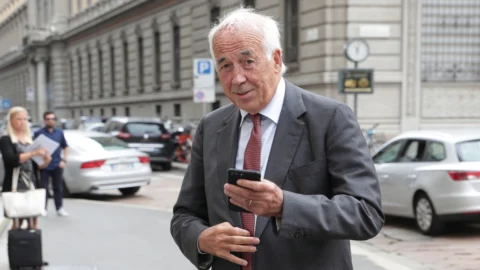
“We are the strongest bank in Europe in terms of capital and liquidity” Messina wanted to underline as he presented the plan this morning at the bank's Milan office. “The level of common equity – he said – is over 12% with an excess capital of 8 billion euros. We are stronger than German and French banks. We are a bank that has never failed to support the real economy.
We took 36 billion from the ECB and disbursed over 50".
Excess capital provides for a Common Equity ratio of 9,5%, which is the requirement required by Basel 3 regulations for systemic banks (4,5% Common Equity + 2,5% conservation buffer + 2,5% maximum buffer Current Global SIFI). In the plan we read that il “excess capital is usable for further distributions from 2016-2017″. But, Messina specified during the presentation to the financial community, that the eight billion in excess capital will be returned to the shareholders “only if it will not be possible to have opportunities for growth”.
The plan does not envisage acquisitions in Italy. “At the moment there are no dossiers on the table for growth opportunities – said managing director Carlo Messina during the presentation to analysts – in any case, growth will not be in Italy”. As far as foreign markets are concerned, "it will depend on objectives, prices and opportunities at a consolidated level - Messina specified - At the moment, however, I don't see any opportunities". Against this capital already available the conversion of savings shares "is not a priority" just as Banca Fideuram is not expected to return to the Stock Exchange.
"To date it is not on the table", commented Messina, answering questions from journalists during the press conference for the presentation of the 2014-2017 business plan. If Intesa were to list Banca Fideuram or other assets would generate additional capital compared to the eight billion euro currently in excess, capital that the bank does not currently need.
“We have a set of business units worth between 10 and 15 billion – Messina explained – if we listed them we would increase excess capital but we would lose profits in the income statement. So we don't need a quote that values these assets. For the future, the options are open given that they are assets that have a value and that could be exploited to the fullest, perhaps with a view to partnership at a European level”.
NON CORE SHAREHOLDINGS SOLD BY 2017
PROJECT WITH KKR AND MARGINAL UNICREDIT
In the meantime, Intesa still intends to sell all the non-core equity investments, which at the end of 2013 were worth a total of 1,9 billion euros. Among these RCS, Alitalia and Telecom Italia. The institute has already disposed of the equity investment in Generali in the last quarter of 2013 (approximately 360 million euro) and those in Pirelli, Sia and Union Life in the first quarter of 2014 (approximately 35, 80 and 145 million euro), for a value total book value of approximately 620 million and a total capital gain of approximately 320 million.
On the Ukrainian side, Intesa is working with the Kiev regulators on the sale of the subsidiary Pravex, since the situation with the buyers is not clear: "They have to tell us if it is possible to sell a bank to a person who has problems with the law - he said again the ad –. There is currently no evidence of a relationship." At the end of January, Intesa reached an agreement for the sale of Pravex-Bank to CentraGas Holding, which belongs to the Df group of billionaire Dmytro Firtash, arrested in Vienna in mid-March as part of an investigation relating to an investment in India in the 2006 and then released on bail.
As for the project with Kkr and Unicredit on restructured credits that have been discussed in the press in recent weeks, Messina wanted to clarify that it concerns "a few practices to be put together, it is a minor matter of our strategy". In other words, whether or not the deal closes is not that important. Messina instead aims at a collaboration with the US operator Kkr which "remains strategic".