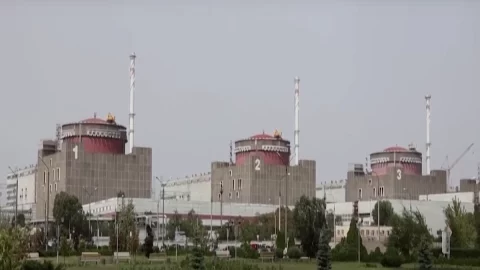
The fire exploded yesterday at the Zaporizhzhia nuclear power plant has reignited tensions between Ukraine and Russia, raising serious concerns about nuclear security in one of the most sensitive areas of the conflict. The plant, located in southern Ukraine and the largest in Europe, has long been at the center of hostilities between the two countries, which accuse each other of using the plant as an instrument of pressure. This recent fire has further aggravated the situation, leading to an intense swap di charges: Pro-Russian authorities point the finger at alleged Ukrainian drones, Ukrainian President Volodymyr Zelensky denounces that the fire was the work of Russian occupiers.
Zaporizhzhia nuclear power plant fire: here's what happened
The fire, which broke out yesterday in one of the cooling towers of the Zaporizhzhia nuclear power plant, has alarmed the entire region. The pro-Russian authorities in the region have confirmed that the flames have been brought under control, and there are currently no immediate impacts on nuclear safety reported. However, the Russian nuclear energy company, Rosatom, warned that the structure involved had suffered significant damage, and the danger of a possible collapse would be assessed by specialists in the coming hours.
Evgenia Yashina, director of communications at the plant, said that “the attack by the Ukrainian Armed Forces violated the physical integrity of the Zaporizhzhia nuclear power plant,” stressing that it was “an unprecedented threat to nuclear security.” She added that this event represents the first time that a nuclear facility has suffered such serious damage, putting at risk the fundamental safety principles established by the International Atomic Energy Agency (IAEA).
The rebound of accusations between Ukraine and Russia
The fire immediately gave rise to a sharp exchange of accusations between Kiev and Moscow, with both sides blaming each other for the incident. The version provided by the Russian authorities claims that the fire was caused by a Ukrainian bombing. They assert that the fire exposes a well-planned strategy by Kiev to compromise the functionality of the power plant and endanger the security of the entire area. Moscow's rhetoric focuses on the assertion that Ukraine is using the nuclear issue as political leverage, seeking to gain diplomatic advantages and increasing pressure on Western powers. The pro-Russian governor of the Zaporizhzhia region, Yevgeny Balitsky, confirmed on Telegram that there had been no changes in radiation levels around the plant and that “all six reactors are undergoing a cold shutdown, so there is no no risk of explosion".
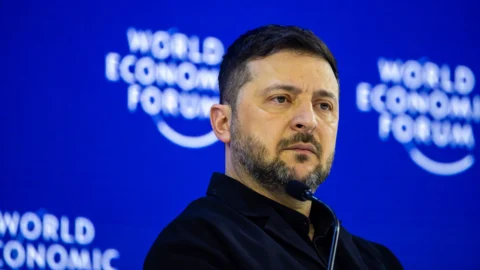
On the other hand, the Ukrainian president Volodymyr Zelensky he promptly rejected the accusations, saying the fire was started by the Russians. Zelensky said: “Currently, radiation levels are normal, but as long as the Russians occupy the nuclear power plant, the situation will never be normal.” He then added that, since the first day of the occupation, Russia has exploited the plant to blackmail Ukraine, Europe and the entire world, demanding an urgent reaction from the nuclear supervisory bodies and the international community so that Moscow be held responsible. Zelensky concluded that “only the return of control of the plant to Ukraine can guarantee full security.”
The fire at the Zaporizhzhia power plant is just the latest in a series of incidents involving the facility since it was occupied by Russian forces in the early days of the invasion, which began in February 2022. Located along the eastern bank of the Dnipro River , the plant has repeatedly been the scene of exchanges of accusations between Ukraine and Russia. The IAEA, with experts on site, repeatedly asked moderation, warning that further reckless military actions could result in a serious nuclear accident.
Ukrainian offensive in the Kursk region
While international attention is focused on the fire, the Ukrainian military is intensifying its own offensive in the Russian Kursk region, close to the border. In recent videos, Ukrainian soldiers are seen hoisting the national flag on Russian territories, a powerful symbol of resistance and determination. These events, which occurred in the village of Guevo, just over three kilometers beyond the border, signal a significant penetration into Russian territory, further increasing tension in a conflict that seems to know no respite.