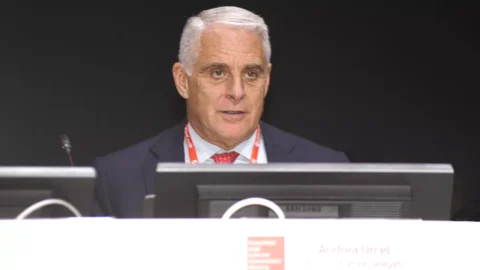
The banking game is back in court. While awaiting the EU Commission's verdict on the April 18 decree, which applied the government's golden power to UniCredit's failed takeover bid for Banco BPM, the bank led by Andrea Orcel has an appeal was filed with the Council of State against the TAR ruling on special powers, which had only partially accepted the objections of Piazza Gae Aulenti, canceling two of the conditions imposed by the government and leaving the other two unchanged. The decision was not intended to rekindle hostilities with the government, but to underscore that UniCredit does not pose a threat to national security, especially in relation to its presence in Russia, “virtually eliminated by the end of 2026”, as Orcel stated at Financial Times.
The TAR ruling
To understand the basis on which Unicredit's possible appeal is based, we need to go back about four months, to July 12th, the day in whichthe Lazio Regional Administrative Court published the sentence on the appeal presented by Piazza Gae Aulenti against the decree of the President of the Council of Ministers of 18 April 2025, with which the executive had imposed four conditions on the operation on Banco Bpm considered fundamental for the protection of the national interest.
At the time, the administrative judges only partially accepted the appeal, annulling two out of four points: the first point concerned the obligation imposed by the government not to reduce the loan-to-deposit ratio in Italy by Unicredit and Banco BPM, with the stated aim of supporting families and SMEs. The administrative judges deemed the five-year duration of the measure disproportionate, holding that a rigid and predefined time limit could not be imposed in the absence of a defined business plan.
The second measure cancelled instead concerned the obligation, imposed sine die, to keep the project finance portfolio level held by Unicredit and Banco BPM. The Regional Administrative Court (TAR) held that this limitation period, without any time limit, constituted direct and unacceptable interference by the public authorities in the bank's credit strategy.
The most indigestible condition for Unicredit, the one that imposed exit from Russia by January 2026, however, remained standing, as did the one that obliged Unicredit to keep the investments in Italian securities of Anima, controlled by Banco BPM. This restriction, according to Piazza Gae Aulenti, would violate MiFID autonomy and EU law.
Government towards counter-appeal?
The deadline to file an appeal to the Council of State expired tomorrow, 60 days after the TAR's ruling. The decision to proceed, in addition to reaffirming that Unicredit is not a threat to national security, would serve, according to the Courier, to protect the institution's stakeholders, but also the directors and the bank itself from any appeals by shareholdersThose who might consider all avenues unexplored during the takeover bid. The Board now has 9-12 months to summon UniCredit to a hearing.
Meanwhile, the government – rather annoyed by the initiative in Piazza Gae Aulenti – is reportedly thinking of presenting a counter-appeal to the administrative appeal judgesAnd it might not end here, considering that the EU Commission's decision on the possible infringement procedure against Italy and the equally possible annulment of the April 18 decree by which the government imposed golden power on UniCredit's takeover bid for Banco BPM. The Italian government could appeal this decision yet again, this time before the European Court of Justice. The takeover bid may have failed, but its aftermath will be felt for some time to come.