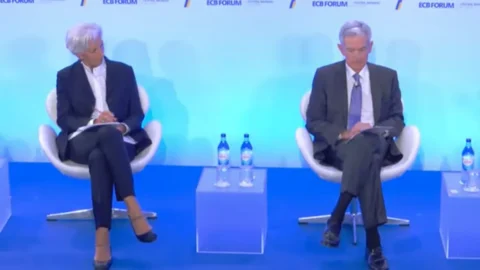
If investors hadn't been engaged in what appears to be one of the biggest stock market turmoils in recent years, they would have focused their attention on two key events di monetary policy this week: the decisions of the Federel Reserve tomorrow and of the European Central Bank Thursday. The first is expected to make no progress on rates, while the second, despite the general silence, is expected to cut rates by a quarter of a point. This could help support the European market. In both cases, in addition to the decision on rates, the two presidents' speeches on future prospects will be particularly important.
ECB expected to cut by 25 basis points on Thursday
In a Eurozone situation that shows a still struggling economy, while inflation has not completely given up, a “light” version of stagflation, an interest rate on deposits currently still at 3% is considered too restrictive by the markets. And therefore expectations are for a further rate cut by a quarter of a point, bringing it to 2,75% when the ECB announces its opinion on Thursday, following the trend of cuts in June, September and December 2024.
In contrast to December, preparations for Thursday’s meeting were relatively quiet, at least in public. “There were no controversial views on the next steps. Instead, there appears to be a growing consensus on the need for further rate cuts,” it wrote in a note. Carsten Brzeski, Global Head of Macro Eng.
The signs of improvement of the German economy arrived from the surveys of theIfo Institute on the business climate, the context should not change, just as the data on the GDP of the fourth quarter of the euro zone should not move. The Ifo index rose in January to 85,1 from 84,7 in December, better than the expectations of 84,9, while for the GDP consensus expects +0,1% quarter-on-quarter, under braking from the robust +0,4% of the previous period and against the +0,2% forecast by the ECB staff in the December update.
Already i minutes of the December meeting had already highlighted a growing orientation to the easing by the Eurotower, based on doubts about growth forecasts and the growing risk of low inflation. “The interest rate on deposits, at3%, it is still restrictive, too much for the current state of weakness of the Eurozone economy” they say at Ing. The recent rise in bond yields in the wake of the Ifo data, but above all of the artificial intelligence news emerged over the weekend in China, are depressing the stock market e strengthening bonds also in Europe.
“Since the last ECB meeting in December, the data situation in the eurozone has not changed significantly,” say experts from dws. “Economic indicators continue to signal a rather weak growth in the coming months. As expected, the inflation rate continued to rise at the end of 2024. At the same time, however, inflation projections show growing confidence that the increase in the cost of living will sustainably approach the inflation target. Unlike the US Federal Reserve, this environment allows the ECB to further reduce the deposit rate by 25 basis points to 2,75%.
Rates, hawks and the need for easing
While some argue that monetary policy can do little to address structural problems, political instability and uncertainty in many countries will force the ECB to continue doing the heavy lifting, they tell Ing.
In the ECB board, "even the hawks seem to be leaning towards more accommodative positions, looking beyond the temporary inflationary push," says the Dutch bank's economist. The main reason for this is that the December forecasts used a terminal inflation rate of below 2%. To hit the estimates, the central bank will have to cut rates by a total of 100bps. If we add to this the increased risks to Eurozone growth arising from the potential economic policy choices of the new US administration, the position of the officials becomes understandable”.
As for the statements surrounding the decision, analysts do not expect any substantial changes in monetary policy communication: “the focus will remain on data dependency, which is logical given the high level of political and trade uncertainty,” say DWS experts. “Further rate cuts are expected. Opinions within the ECB remain divided on how low monetary policy rates can go. However, we see reaching a neutral rate level as an important intermediate goal and expect the deposit rate to fall to 2,0% by June 2025.”
Comments today (January 22) from President Christine Lagarde seem to suggest that a 25bp rate cut is in the cards and that the easing cycle will continue”
Fed on Standby and Watchful for Now. But What Next?
The event will be held tomorrow First Fed meeting of Trump era. The governor Jerome Powell he comes to us with a position prudent on interest rates in a situation that has become even more complicated, amid threats of duties of Trump and the Tech market crisis.
Analysts all seem to agree: at the beginning of this new year, the Fed will remain at the window, leaving rates stable within the 4,25-4,5% range. “Investors, who have long been expecting a pause in the Fed rate-cutting cycle, will be waiting in particular for Governor Jerome Powell's press conference (Wednesday at 20.30:XNUMX p.m. Italian time) to see if any indications will come on the possible duration of this pause,” reads the weekly 'Market Strategy' of MPS.
The officials, starting with the president Jerome Powell They have repeatedly made it clear that, given the current state of the economy, the central bank is in no hurry to lower the cost of money. Inflation is still well above the 2% target (PCE core forecasts due out on Friday indicate a stable value at 2,8%), the job market continues to show itself solid and consumption support growth (fourth quarter GDP, scheduled for Thursday, should be monitored).
In recent days, however, Donald Trump intervened forcefully on the rate issue, announcing that will demand immediate cuts from the Fed and that he expects the same from other central banks in the world. The US president is not new to interfering in the work of Powell, who was the object of criticism already during the election campaign. For his part, the chairman of the Fed has repeatedly reiterated independence of the Washington institution and made it clear that Trump does not have the power to remove him, specifying that he will not resign even if asked to do so.
One of the reasons why the central bank has an interest in delaying rates is linked precisely to Trump, and in particular to his threats of tariffs towards China, Canada, Mexico and other trading partners, including Europe. Just yesterday, the president answered a question on any initial fees of 2,5%, specifying that he has in mind universal duties “much higher.” The Fed is waiting to see if the threats will turn into facts, to evaluate the'impact of policies on the real economy, in terms of inflation and growth.
But the uncertainty is above all for the future of rates, in a twisted situation where on one hand the prospect of Trump's tariffs weighs (a factor that would generate inflation), on the other the crisis in the tech sector after the DeepSeek Chinese Tsunami. According to analysts at ING, another possible stock market crash could have a negative impact on the wealth and consumer spending, which accounts for about 70% of economic growth in the US, but also on the ability of companies to finance through venture capital, on employment and business investment. Therefore, the Fed "will remain vigilant"; in the event of a broader correction, it could be "much more inclined to cut rates and will be under strong pressure from President Trump to do so"
Laurence Fink, CEO of BlackRock, a few days ago, speaking at the World Economic Forum in Davos at a panel on the economic outlook, said about US rates. “The US economy was very strong in the fourth quarter and, from what I hear from business leaders, it is also strong in the first quarter of this year. So the Fed could stop cutting rates for a few months and then maybe lower the cost of money a little further down the line. But it is also possible that at some point, in light of the strength of the economy, it will even end up raising them”.
Regarding the outlook for US rates, Nicholas Never, economist and sovereign credit analyst at Pimco during the event a few days ago on the economic outlook for 2025, explained that the tariff policy promised by Donald Trump risks increasing inflation and consequently "weakening real household incomes and therefore consumption". Consequently, "the Fed could slow down with the cuts "in the short term, but then it will proceed: 4% is too high a rate as an equilibrium rate', the economist continues.
Christian Scherrmann Dws maintains the expectation that the Fed will probably cut rates further in March and perhaps in June, before adopting a wait-and-see stance in light of still resilient inflation. “Needless to say, risks are tilted to the upside at the moment,” the expert concluded.
Today, however, Wall Street seems headed for a little or slightly positive start to the session. As for the rate forecasts, at the moment, Fed Funds Futures They are targeting a 25bp cut by June and assign a 90% probability of a second reduction by the end of the year.