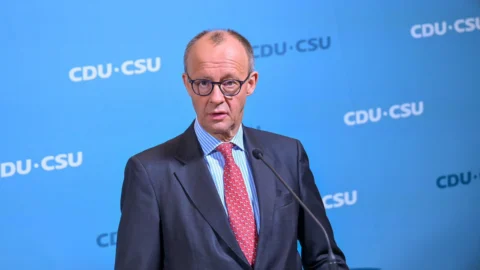
Germany, for the new government second time lucky. Friedrich Merz he was appointed chancellor with 325 votes. Just this morning, among the conservatives, the recurring phrase was: "Even in the conclave, the white smoke often does not arrive at the first vote". Agreement, therefore, in the second vote of the German Parliament on Merz's election to the Federal Chancellery after the resounding rejection that came as a cold shower shortly after 10 in the morning.
"Madam President, I accept the elections“, said Merz, speaking in the chamber immediately after the official announcement of the result. A simple, almost ritualistic sentence, but one that comes after a parliamentary passage never seen before in the history of Federal Germany.
Germany, Merz Chancellor: Second time lucky for new government
It is indeed a second ballot was served, at the end of one long and tense day at the Bundestag, to give the CDU leader the necessary majority. With 325 votes in favour, 289 against, one abstention and three absentees, Merz has passed the threshold of the so-called "chancellor's majority", set at 316 votes. He will therefore be able to officially take up office as early as tomorrow, with the first official visits in France and Poland.
The second vote allowed him to archive the morning incident as an initial stumble. However, it remains evident that his leadership part under close observation, even within its own political area.
For make up for the morning's debacle, they did not want to wait any longer: the strategy was to force the timing, aiming immediately for a new vote today. The group leader of the CDU-CSU Union Jens Spahn, had announced the return to the polls at 15pm, explaining that an agreement had been reached with the parliamentary groups of the Verdi and Lefties. Spahn had reiterated that “all of Europe, perhaps the whole world, is watching this election“, underlining the compactness of the Union and SPD groups in support of Merz. “We are experiencing growing polarization. It is important that there is a stable government,” he had declared in turn Lars Klingbeil, leader of the SPD and indicated as the next vice-chancellor.
Never, from 1949 to today, a the designated chancellor had been rejected in the first round of voting. The German Constitution requires an absolute majority in the first two rounds: 316 votes out of 630. The morning's disappointment has exposed deep cracks in the majority, with 18 snipers (there were 328 numbers at the breakfast) who voted against or abstained, casting no confidence in Merz at a key moment.
The unknowns of a weak majority and the advance of AfD
With the election on the second ballot, Friedrich Merz becomes the tenth chancellor of the Federal Republic of GermanyHe succeeds Olaf Scholz, who will remain in office for ordinary administration until the new government is sworn in.
But if the day ends with a positive outcome, the shadows all remainThe coalition supporting Merz has shown signs of structural fragility. CDU-CSU and SPD will now have to demonstrate not only that they have the numbers, but also lasting political cohesion.
I next steps – from the appointment of ministers to the definition of the program – will be crucial to assess whether the executive will be able to address internal difficulties and economic challenges. Germany is in a period of prolonged stagnation, with a persistent industrial slowdown, while geopolitical tensions are multiplying in Europe.
Over this already complex picture, looms the rise of thefar right of the AfD, which came in second place in the February 23 elections. Although the organization was classified as an extremist by German intelligence, the party claims a central role in the country's political future: "We are ready to take on the responsibility of government. Merz should resign immediately and the way should be opened for new elections", it declared Alice Weidel, co-leader of the training.
Meanwhile, the new Merz government is preparing to take office as early as tomorrow, with the institutional commitments already scheduled. First visit tomorrow by the French President Emmanuel Macron who during the day had reiterated his political support, publicly declaring: "I'll wait for him tomorrow".
Last update 16,45am