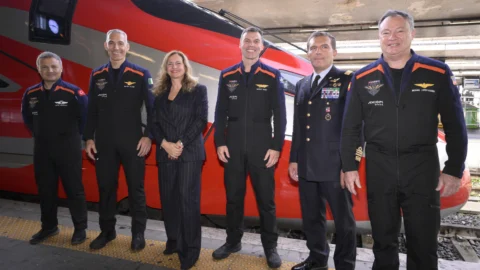
This morning, at Rome Termini Station, the international crew of the Axiom-3 Space Mission è boarded the Frecciarossa, the high-speed train of Trenitalia (FS Group), to kick off their Post Flight Tour. The initiative, which is part of a collaboration between the Italian Air Force and Trenitalia, is a symbol of innovation and sustainability, with common goals that look to the future.
Before the departure, a meeting took place between Maria Luisa Grilletta of Trenitalia, General Giandomenico Taricco and astronaut Colonel Walter Villadei. During the meeting, the shared objectives between Trenitalia and the Air Force were highlighted, summarized in the claim “Together for the future".
Frecciarossa: the symbol of sustainable mobility
The choice of the Frecciarossa by the Axiom-3 crew is not accidental. The train in fact represents asustainability icon, thanks to the use of advanced technologies aimed at minimising environmental impact. The Frecciarossa 1000, the first high-speed train in the world to obtain the environmental impact certification (Epd), is designed with lightweight materials and latest-generation electric motors that allow for a reduction in energy consumption of up to 30% compared to previous models.
Furthermore, continuous technological research has led to the creation of even more sustainable models: the new generation of Frecciarossa will have a recyclability of 97,1%, further improving the 94% of the current version.
The Ax-3 Mission: A Bridge Between Space and Earth
The Colonel Walter Villadei, protagonist of the Axiom-3 mission, spent 21 days on the International Space Station conducting important scientific experiments. The studies have allowed Italy to consolidate its skills in the space sector, strengthening its leadership role in the new global space domain.
The mission represented a innovative collaboration model, with the Ministry of Defense and the Air Force which, together with the Italian Space Agency, have united the forces of different sectors industrial and scientific sectors. This multidisciplinary approach has also involved industries outside the traditional sectors of Defence and Aerospace, opening up new opportunities for the so-called New Space Economy, a rapidly growing sector that represents one of the most promising frontiers for the country's economic and technological future.