
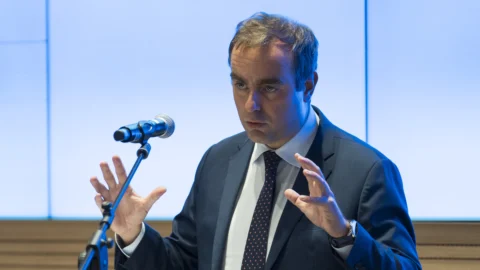
The French Prime Minister, Sebastien Lecornu, presented his resignation a Emmanuel Macron, who accepted them. The Élysée announced this in a statement. Appointed on September 9, Lecornu was supposed to appear before the National Assembly today to make a political statement, but the barrage of criticism from the opposition and the Gaullist right against his government team, presented last night, forced him to step back.
And to think that, after almost a month of feverish negotiations and political tensions, the France finally seemed to have a new government. President Emmanuel Macron appointed yesterday, Sunday 5 October, the eighteen ministers that make up the Prime Minister's team, charged – but now resigned – to take over the reins of the country after the fall of the executive led by François Bayrou.
The new coalition, presented by the Elysée Palace as a balance between "stability and renewal," had nevertheless immediately sparked a wave of criticism from both the right and the left. The first Council of Ministers was scheduled for today at 4:00 PM at the Elysée Palace, while the prime minister was scheduled to deliver his general policy address to the National Assembly tomorrow.
Lecornu: "Be negotiators; the budget is your primary objective."
“Finding compromises with all parliamentarians”, to be “negotiators”: this was the instruction that Lecornu had given to his ministers. An inevitable request, given his lack of majority in the Assembly , threat of a motion of censure already announced by the opposition.
According to the prime minister's entourage, the new government "resembled the common ground of the right and the center" of the previous coalition, combining "stability, because certain actors and administrations need continuity," and "renewal, since a third of the ministers did not belong to the previous government."
Before taking a step back, Lecornu aimed to make approve the budget law by the end of the year and to “lead some major projects of national interest for our fellow citizens”.
Who are the ministers of the Lecornu government?
The new team was composed of 18 ministers, with numerous confirmations and some surprises, defined by many observers as "a correct re-edition" of the previous Bayrou government. The economist Roland lescureA lifelong Macron supporter, he would take over the reins of the Ministry of Economy and Finance, with the daunting task of drafting an acceptable budget for a country crushed by public debt exceeding 115% of GDP. He would face the challenge of convincing a hostile parliament and an increasingly wary public.
The most sensational return, however, was that of Bruno Le Maire, who after seven years at the Ministry of Economy and Finance was moving to the Armed Forces, taking over from Lecornu himself. "In the exceptional circumstances France is experiencing, there's no holding back," the former minister declared, a sign of a bond of political and personal loyalty that has endured with Lecornu for years.
Justice was left with Gérald Darmanin, while the leader of the Républicains Bruno Retailleau He retained the leadership of the Interior Ministry, despite the discontent within his party. The former prime ministers Elisabeth Borne e Manuel Valls remained respectively to Education and the Overseas Territories, in a sign of continuity that many, on both the left and the right, had interpreted as a lack of renewal.
Foreign Affairs remained Jean-Noel Barrot, while Catherine Vautrin would have dealt with Health and Work and Rachida Dati, despite his candidacy for mayor of Paris and a corruption trial set for 2026, kept Culture. Amelie de Montchalin remained in the Public Accounts, while in the field of Ecological Transition it returned to Agnès Pannier-Runacher.
They completed the team Naima Moutchou (Public and digital function), Philippe Tabarot (Transportation), marina ferrari (Sports) and Aurore Bergé, which in addition to Gender Equality assumed the role of government spokesperson. Finally Mathieu Lefèvre he would have dealt with relations with Parliament.
The watchword seemed to be only one: keep the government afloat. But it lasted only a moment.