
Here is the recipe new frontier of the CGIL"Between 2022 and 2024, workers and pensioners paid 24 billion more in IRPEF, because brackets and deductions were not revalued for inflation", he thundered Maurizio Landini in an interview with Republic: "For an income of 30 euros, that means about a thousand euros lost. Those sums must be repaid immediately." In technical terms, this is the so-called restitution of the fiscal drag that was the obsession of union demands in the 80s. And there were many reasons for it. tax drag It operates on the principle of progressive tax rates on wages inflated by inflation. In the 80s, inflation was quite high (double digits, if not even two dozen), and workers and pensioners suffered a higher tax burden on an income that had increased only nominally.
Then, let them know, the beast of theinflation It was tamed, and the issue of fiscal drag faded into the background, until the surge between 2022 and 2023 following the events that precipitated that phase. Inflation in the two-year period 2022-2023 had a dual effect: on the one hand, it eroded the real value of salaries and pensions, and on the other, it increased the burden of taxes on fixed incomes through the progressivity of personal income tax, which automatically triggers an increase in the tax burden. In terms of numbers, Landini, however, is pushing his own agenda. The economist Marco Leonardi, Already Director of the Department of Economics and Finance of the Presidency of the Council at the time of Draghi government, in an article on The paper It has put its accounts in order. It's true: in recent years, the government has benefited from approximately €25 billion in additional revenue generated by the fiscal drag. But €17 billion has been returned with the tax reform, which favored employees with an annual income of less than €35.
The result is that a significant portion of those levies remains seized and used to finance a reform whose purpose was certainly not to reinstate fiscal drag, but rather to increase the real value of wages or, secondarily, to offset the impact inflation has had on them. Inflation has reduced the real value of public debt; fiscal drag has kept the tax burden higher than before. And public finances have remained balanced, but at the expense of earned income, albeit with significant differences. Indeed, according to INPS data, the lowest incomes are still 3% short of returning to 2019 real levels, while those in the decile with an average income of 32 are 5,5%.
For years now, it has been legally established that those earning more than €35 are wealthy, so much so that in recent years—despite being the largest taxpayers—they have been excluded from all benefits available under various circumstances, from bonuses to tax breaks to social security contributions. According to Leonardi, it would be necessary to: sterilize fiscal drag at least for the future, by indexing brackets and deductions to inflation and admit transparently, that the reform for the lower-middle classes was largely a refund of fiscal drag, i.e. revenue not due by taxpayersIt is, however, strange—in the writer's opinion—that the Corso Italia union has for years pursued a policy of income protection based on public policies, namely fiscal measures (such as tax exemptions on contractual increases) and contributions, the establishment of a minimum wage, and other measures related to the welfare sector.
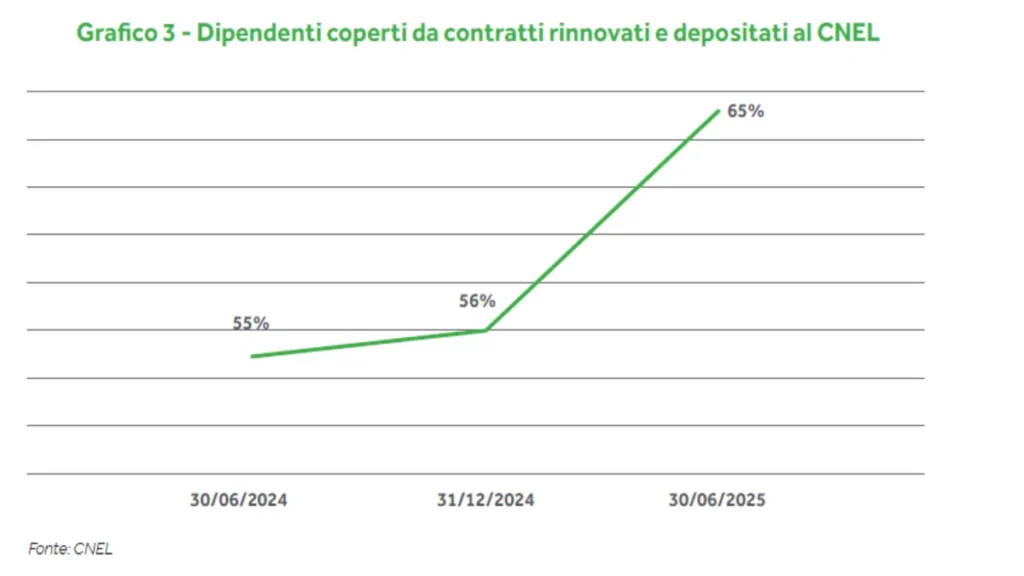
We are now inside a logic of "nationalization" of wages The union believes it bears no particular responsibility for its inadequacy, so much so that it uses the issue in its polemics against the government, at the same time that the CGIL—as a political opposition—is boycotting the very conclusion of public contracts wherever possible. Landini rarely speaks about collective bargaining and the role it can play in improving wages. This is done in an attempt to portray a social reality in which "all cows are bad." The CGIL ends up not taking credit for having contributed to reversing a serious situation of delay during 2024 and the first half of 2025, if not a freeze, in the renewal of contracts, exposing the wages, agreed upon at the time, to the attack of an unexpected surge in inflation. In recent days, the CISL has undertaken this survey, based on CNEL data. The data Cnel half-yearly report They note a significant situation regarding the increase in the percentage of private sector workers covered by renewed national collective bargaining agreements, which went from 56% at 31 December 2024 to 65% at 30 June
- According to the Confederazione di Via Po, this nine percentage point increase in just six months represents considerable progress in the coverage of renewed contracts. The ISTAT data differ in quantity due to the different sample structure used, but they match in trend lines.
Il CISL half-yearly report , in line with Cnel data, denies the litany of pirate contracts To counteract the spread of these agreements, the CGIL (Italian General Confederation of Labour) is calling for the passage of a law on representation. The reality is that 14.055.107 workers in the private sector are covered by one of the 214 national collective bargaining agreements signed by trade federations belonging to the CGIL, CISL, and UIL, representing 96% of workers.
The 60 national collective labor agreements signed by UGL (of which 28 for membership to those of Cgil, Cisl and Uil) apply to 4% of the workers traced by the Uniemens flows, while the 150 national collective labor agreements signed and recognized by Confsal (of which 3 for membership to those of Cgil, Cisl and Uil) they concern 5% of workers. 632 other national collective labor agreements signed by various representative organizations not represented at the CNEL, 62% of the total national collective agreements on file, have a very marginal overall coverage equal to 367.645 workers.
The first half of 2025 recorded a average growth in contractual wages of 3,5%, characterized by a progressive deceleration: from 4,0% in the first quarter to 2,7% in the second. This trend – according to the CISL – reflects the reduction of inflationary pressures and a normalization of bargaining dynamics after the strong post-pandemic recovery. The bargaining activity – claims the CISL – also in the first half of 2025 has demonstrated the ability of the industrial relations system to adapt to the new economic conditions. Providing responses consistent with the recovery of wage purchasing power, while maintaining the sectoral specificities that characterize the Italian labor market. The table highlights the residual discrepancies between income lost due to inflation and income recovered due to the contractual and fiscal measures adopted.
Sheet
The average figures for the wage emergency are known, but these averages conceal a complex and diversified reality across income brackets regarding net wages.
- Inflation-wage gap: 9 percentage points (inflation +17,4% vs. contractual wages +8,3%)
- Real lossReal wages in March 2025 (since ISTAT has not published second-half data) remain 8% lower than in 2021. The most striking finding emerging from the INPS analysis concerns the trend and substantial recovery in inflation for low- and middle-income earners through the effects of contractual and fiscal policies. Analyzing net wages against a cumulative inflation rate of 17,4%, the data are as follows:
- Low incomes: +14,5% – Residual gap: only 2,9 points
- Median (average income): +16,9% – Almost complete recovery, remaining gap: 0,5 points
- High incomes : +12,0% – Residual gap: 5,4 points.
The difference between gross and net wages shows the redistributive effectiveness: - Low incomes: Fiscal policies added 7,4 percentage points of growth
- Average income (median): Fiscal policies added 9,5 percentage points of growth
- High incomes: fiscal policies added only 0,8 percentage points of growth
Translating the data into annual euros for a median full-time worker: - 2019: €21.969 net (€30.755 gross)
- 2024: €25.687 net (€33.027 gross)
- Nominal increase: +€3.718 per year (+€285 per month)
- Real increase: substantially in line with inflation
For the low incomes, the recovery was particularly effective: - 2019: €17.217 net (€21.571 gross)
- 2024: €19.720 net (€23.103 gross)
- Nominal increase: +€2.503 per year (+€192 per month)
- Residual inflation gap: less than €500 per year
For Istat During the period under review, the most significant improvement was the trend in contract coverage, which involved 7,4 million workers. This result stems from intensified negotiation activity, which resulted in a significant reduction in the number of employees awaiting renewal, from 47,3% to 43,7%, with average waiting times for expired contracts reduced from 29,0 to 24,9 months.
The season of numerous renewals of the major national collective bargaining agreements and the tax wedge and tax deduction measures have not only supported millions of families in difficulty but have also achieved effective progressive redistribution. This confirms, according to the CISL, that the key to increasing wages is the integration of strong collective bargaining and targeted tax policies.