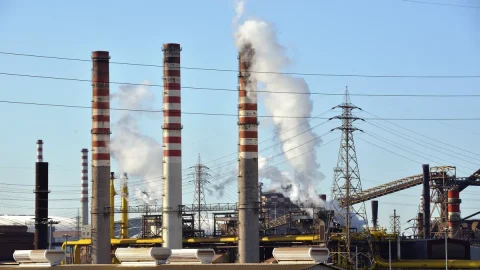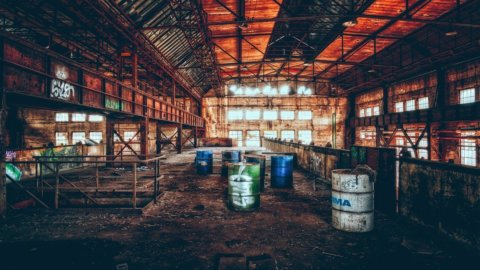
5 thousand cubic meters of special waste of various types seized by the Ecological Operations Unit of the Carabinieri of Venice. They had been abandoned for years and came from industries in the area. We are looking for those responsible.
It is only the latest major seizure to occur in Italy after the crackdown decided by the Council and the European Parliament in the fight against environmental crimes.
In Italy, Legambiente counted 2022 per day in 84 and for this it received the Medal of the President of the Republic.
Le eco-mafia they are not giving up and the proposal for a directive drawn up in Brussels which increases the number of crimes from 9 to 18 must be supported. Furthermore, the distinction is introduced between a natural person and a legal person as the perpetrator of the crime. In addition, the scope of crimes becomes broader, covering the trafficking of timber or the recycling of chemical substances.
Although this is a proposal for a directive intended to replace the 2088 legislation, governments were urged to equip themselves. A point that marks the turning point, in fact, concerns the training of the personnel who must act: judges, police officers, public prosecutors. A gap that needs to be filled quickly because, especially in Italian courts, environmental crimes are often declassified without sending anyone behind bars, without affecting assets or having the damage repaired, in the most cheerful (bad) Italian justice system.
Polluters pay. Or not ?
Sanctions are now being tightened for everyone. If the crime is committed by a physical person, in a negligent manner, ranging from a minimum sentence of 5 years up to 10 years for malicious crimes which also cause the death of people.
For serious crimes attributable to legal entities, especially companies, there is a financial penalty equal to 5% of the turnover or a sum of 40 million euros. For the other categories of crimes the maximum fine is equal to 3% of the turnover or 24 million euros are paid and everything can end there.
However, the directive also provides for additional sanctioning measures against company managers, joint-stock companies, consortia or contracting entities. For example, to restore the damaged environment or compensate the costs for the damage caused. Likewise, the judge can order the withdrawal of permits, authorizations, concessions, up to and including exclusion from access to public funding.
In this additional setback, the European legislator has, however, set aside the sacrosanct principle " the polluter pays ” included in another European directive from 2004. An oversight? It is not clear.
By collective memory, we remember that that directive cost millions of euros to companies across Europe to impact as little as possible on the external environment, redesign production cycles, obtain special certifications to be truly (or just appear) sustainable.
It's a shame that a principle, once respected by thousands of companies, has now become an additional measure to be applied at the judge's discretion. There's time to fix it.