The “hopefully I get away with it” from auspice is turning into finding. Economies that were predicted to go into recession, sandwiched between the anvil of the worst energy crisis in half a century and the fastest rate turnaround in analyst memory, and war-distressed Ukraine, are scurrying out dented but lively and ready to resume the growth path. The 2023, like the devil, will reveal less ugly of how we imagined and painted it. How come? To whom or what the credit? And at what stage are the economic systems in recovering “normal” post-pandemic conditions?
The fulcrum on which the economic systems are recovering is the employment growth. Usually, in the vicissitudes of the business cycle, employment is a delayed indicator, because the flow of hiring continues partly due to inertia and partly due to the unawareness of many companies of the upcoming economic storm. Those hires are reminiscent of the light of dead stars, which continues to reach us because it is light years away, in fact. But at some point comes what some economists now call «Willy the Coyote moment»: when the unfortunate cartoon character created by Jones and Maltese remains suspended in the air for a few moments before realizing he is finished over the edge of the ravine, and that awareness seems to prevent him from continuing to fly and plunges him into a dive to crash.
But this it is not a normal cyclical turn. Because companies, while seeing orders fall and inventories accumulate and cutting production, they continue to take. They do this because they have been burned by the experience of having no staff to expand supply to meet the demand for goods and services. They had fired massively as soon as the pandemic broke out and have been surprises from the rebound quick and supported by government policies and by the desire to live from the demand for consumption of goods first and then of services. They don't want to find themselves in the same conditions when the cycle restarts and they expand their ranks.
Secondly, the cyclical turn is not normal because the pandemic has reduced the job offer, causing many people to exit the market as a result of the rethinking the hierarchy of values, as well as leaving a long trail of those who lost their lives (approximately 3 million between the two sides of the Atlantic and over 6 million worldwide). In addition to reducing to a trickle for over a year i migratory movements. So the search for personnel has become a kind of treasure hunt, and employers who have successfully made it to the end of the journey are not missing out on valuable resources.
Finally, too many commentators, prey to a ultraneoliberalism (perhaps as a knee-jerk reaction to the mounting return of the public role), they neglect the crucial and powerful government action, in injecting resources into the budgets of households and businesses, thanks to the financing at the foot of the list of central banks. Multiple points of GDP, not motes.
The aid policies continuein other ways and for other purposes. And this is the third significant difference with similar cyclical phases of the past: governments have sent the theories of expansive austerity to the attic (never have economists deemed valuable done so much damage to the social body!), and they threw themselves into emulating the nations that invest in infrastructure, research, new sectors. Thanks to the geopolitical changes, the reindustrialization policies, which had timidly appeared in the post-trauma of the financial crisis of 2008-9, are now becoming full-bodied and targeted. Not only higher spending on infrastructure, but also heavy subsidies to install machinery and manufacture microchips and biopharmaceuticals (the list would be longer…) – of course, all this raises accusations of protectionism and veiled autarky, but the benefits are greater than the evil.
Alongside and together with these factors there are the massive business investment, made forced by the green, digital and biopharm revolutions. That is a typical wave driven by innovations. Among these is the space economy, small in itself but vast for its repercussions in all areas of human activity. And we want to talk about the rearminduced by that unhealthy enterprise called war? In short, we will have more butter and more guns to keep up demand for goods and work.
However, since every rose has its thorns, the better economic situation than feared risks being stung by the tenacious stubbornness of Central banks who declare that they are not very convinced of the fall in inflation and, waiting to be convinced, will continue to raise rates. We therefore have on the one hand a positive momentum of the economy, and on the other hand – one armed against the other – the negative effect of the increase in the cost of money on the real economy. This 'negative effect' seems to be stronger in America than in Europe: in the United States the prime rate is 7,75%, and rates on 30-year mortgages are above 6%: in both cases well above the inflation expectations. The rates for households and businesses in Europe (see below) are less restrictive.
In this tug of war between headway and restriction, it makes sense to point out the influence of China. In this year and next the latest estimates of the Monetary Fund give a China which resumes the role of locomotive, after having lost it for the first time in decades in 2022: Chinese GDP is seen to grow significantly more than world GDP for 2023 and 2024. Which is good, if it weren't due to the fact that the recovery of China – the world's leading absorber of raw materials – is likely to revive the quotations of these materials, keeping inflation high.
In last month's Lancette we had the opinion that "to strangle the price-wage spiral in its cradle" we must hope that the latter do not keep pace with the former. In short, the Fed and the ECB hope that workers will lose purchasing power, which would slow down the economy”. In Japan – puts account to point out – this dilemma does not arise: the Prime Minister has openly called on businesses to raise wages more than the inflation rate (which is at 4%), and the wish has been fulfilled: in December salaries increased by 4,9%, even if spurred on by that particular 'Japanese-style thirteenth' which are the end-of-year bonuses year. We can see that, after decades of deflationary anguish, a bit of a price-wage spiral is like cheese on macaroni for the Japanese.
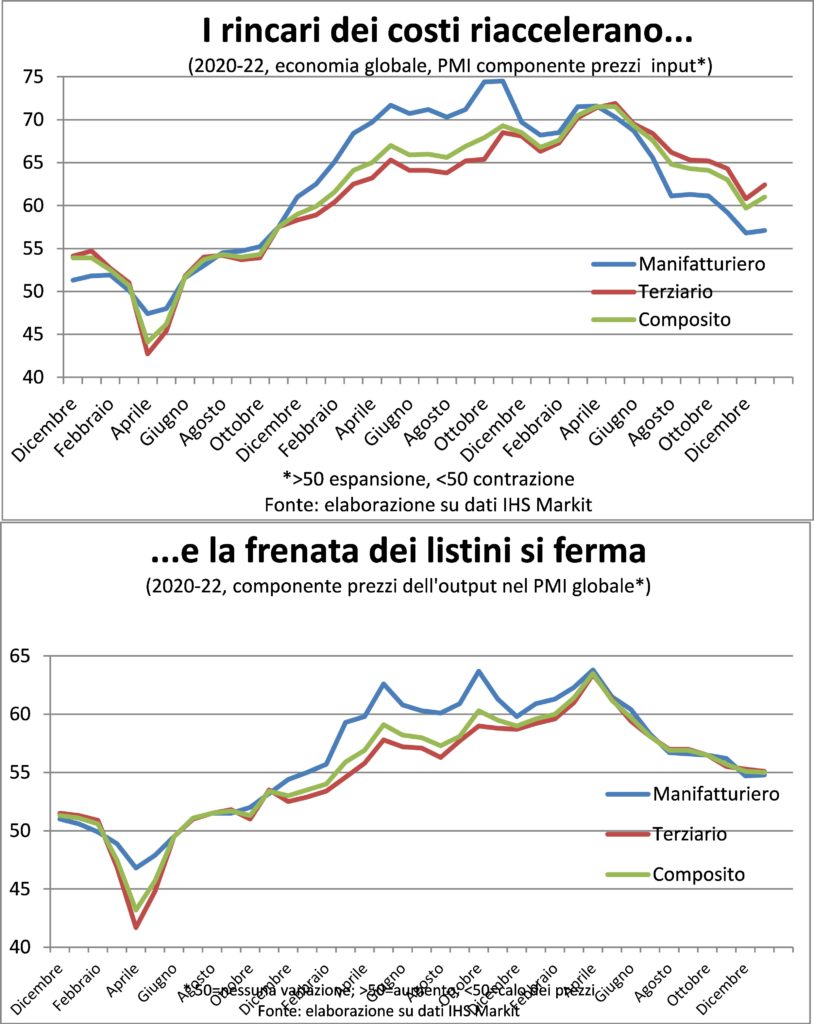
Going through a few data released in the last month, on the basis of which we have recalibrated the assessment of the economic prospects more positively, here is the opinion on orders, obtained from the PMI survey: the fall almost abruptly stopped at the beginning of 2023.
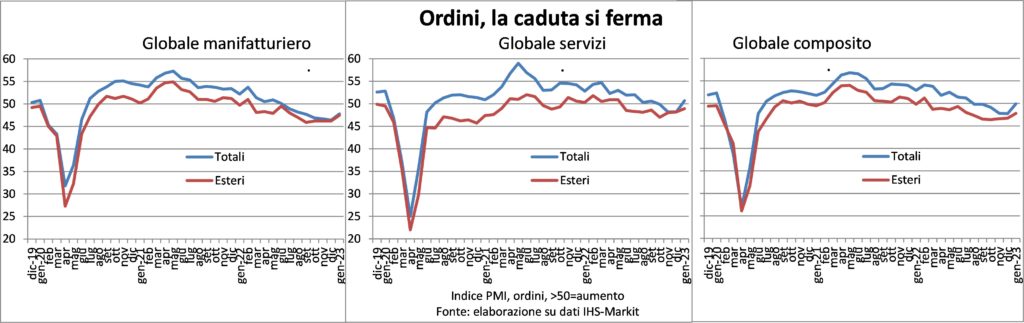
It is the best encouragement for the overall performance of the private sector. And, in fact, theoverall PMI index he says that in manufacturing the decline has stopped, and in services the expansion has already started again.
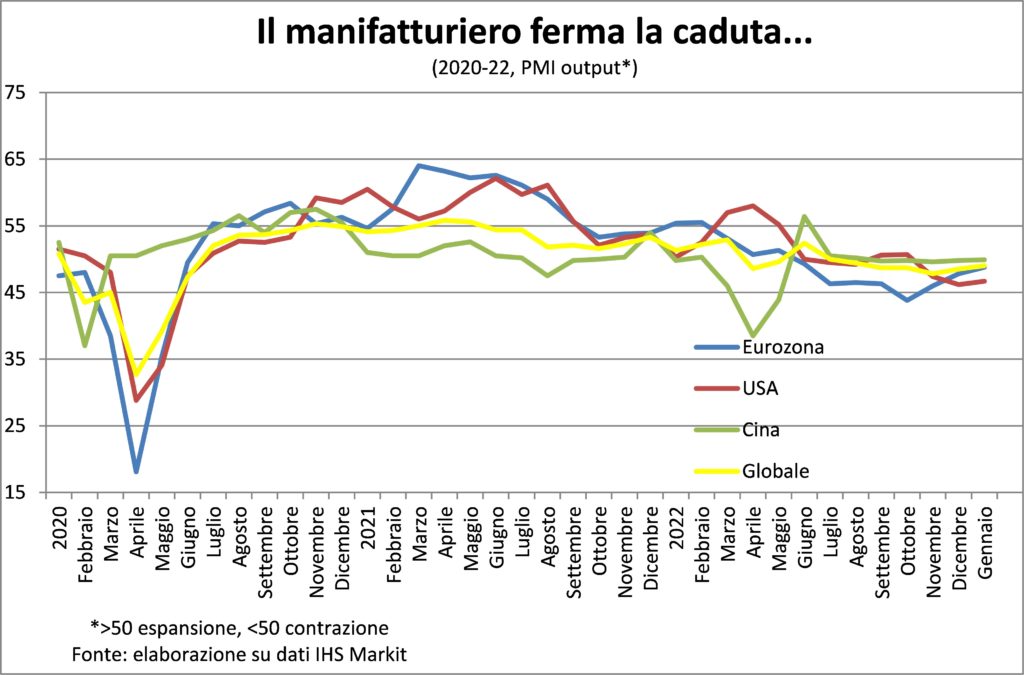
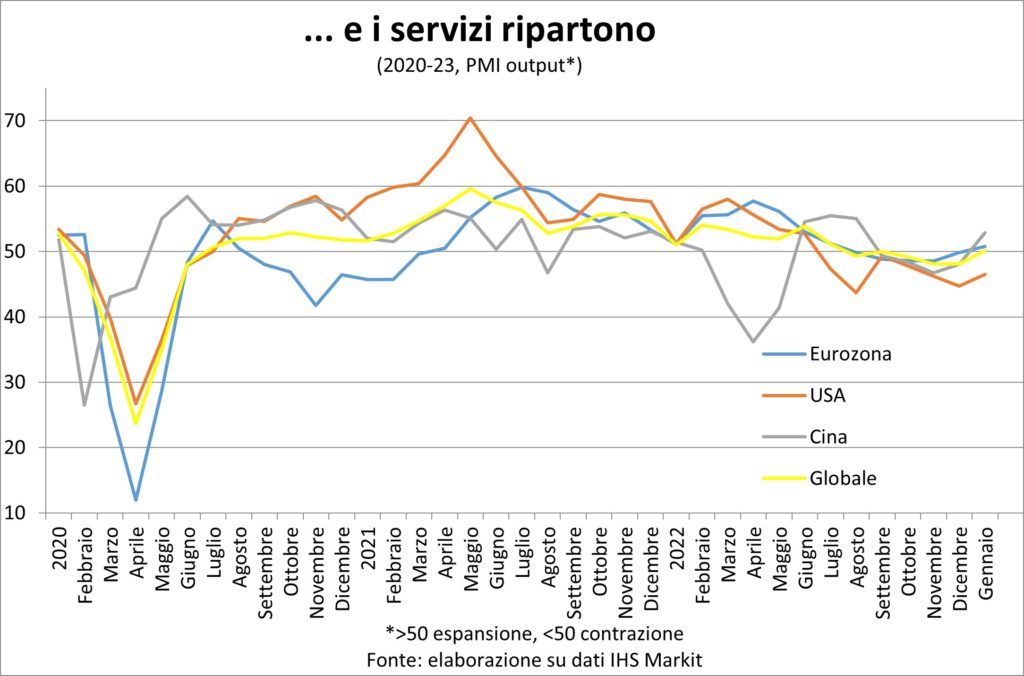
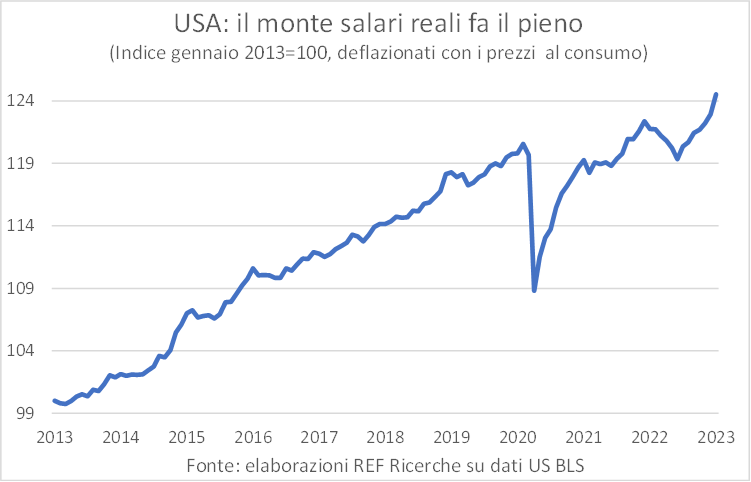
Finally, the key chart for understanding what is happening in the labor market: the monthly trend of real payroll in the USA. Which is growing very rapidly, combining a stratospheric increase in jobs, an increase in hours worked, an improvement in payrolls and a decrease in the cost of living over the previous period. So that mountain reached the altitudes it would have had if the pre-pandemic trend had continued. AND the most powerful fuel to support the confidence and spending power of American consumers. If indicators existed, we would see the same performance in Europe.
INFLATION
La price rush, measured on the annual change, continues to decelerate, even quite rapidly. This means that "there is no more inflation!»? Phrase to repeat with that joy that comes from relief, like someone who woke up with a start after having the nightmare of being very overweight and hums «and the belly is gone!». Calm and chalk (the one used to prepare the cue for the next billiard shot).
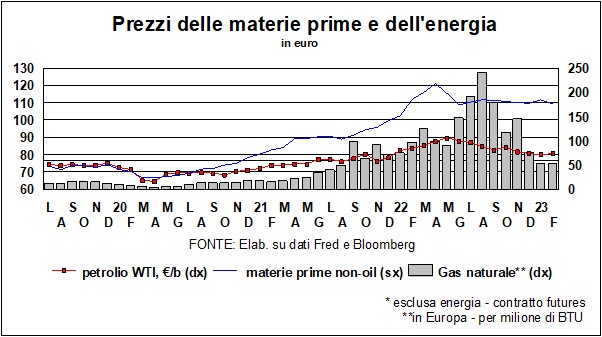
Indeed, if the raw material energy and food are much cheaper than before the crisis linked to the war, however they remain a multiple of previous levels that crisis, the shortage of workers it stays there, as we told above. And if a resource is scarce, it tends to go up in price. And in determining the price lists the labor cost is even more important and pervasive than energy, being also present in all activities and being two thirds (more or less) of the added value, i.e. of the wealth produced by a nation.
Also, that cost is by far the largest part of the household income, then its increase feeds that income and the expenditure towards which it is directed. Thus the higher cost of labor affects inflation both on the cost side, in fact, and on the demand side.
Some signs of this can be read in the price component of interviews with purchasing managers (PMI), which illustrates the setback at the beginning of 2023 of the disinflationary process undertaken in the second half of 2022. If we look at the picture as a whole, the hypothesis that pandemic and war have dissolved deflationary thrusts (ie of price reduction) that had taken possession (like Mephisto of Faust's soul) of the body and spirit of the economies from the Financial Crisis onwards. In a sort of crisis chases away crisis.
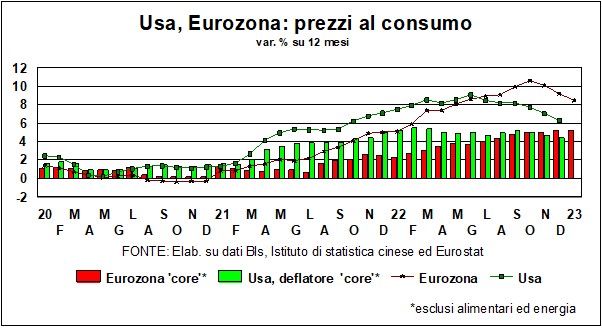
In other words, we will still observe the reduction in the annual change in consumer prices for a while, but at some point this reduction will give way to an invariance (zero second derivative of the price index). Getting down from there will be longer and more painful, unless firms do not sacrifice margins, with what follows for the profitability of investments, including equity investments. That is, we would fall from the frying pan into the fire of an earnings recession.
RATES AND CURRENCIES
A few intimations were enough the economy is doing better than expected to shoot new arrows: the archers of Central banks they fired the darts and put more into the quiver. For once, the ECB (perhaps because she left later) did more than Fed (+0,50% against +0,25%). But perhaps if the Fed had known that the data would soon show more than half a million new jobs created in January, it would have also increased by 0,50%?
This precise question was asked to President Powell, who modestly refused to answer. Be that as it may, since the data showed that the economy is running faster than previously thought, rates are going up, in America, in Europe and in Italy (where it spread has risen a bit, as always happens when the trend is upwards, but it remains at non-worrisome levels, well below the 200 level).
- actors on the badger scene there are at least five: the real economy, inflation, monetary policies, 'financial conditions' (apart from rates) and geopolitics (from Ukraine to the Chinese 'balloons'). With so many factors pulling from one side to the other, it is understandable how the path of interest rates is difficult to decipher. Even the central banks, which also keep their finger on the trigger, admit that the next moves will be even more than before influenced by economic data.
I real rates are little changed (if deflated, as we usually do, by inflation core) and are held comfortably below zero.
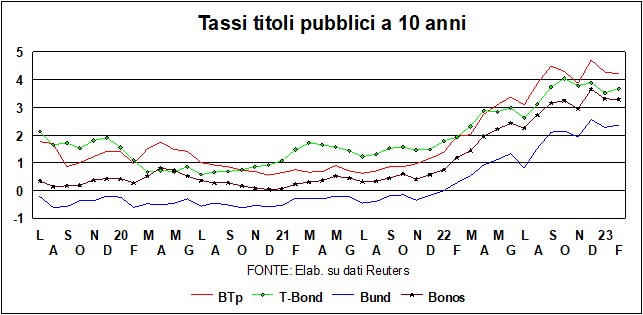
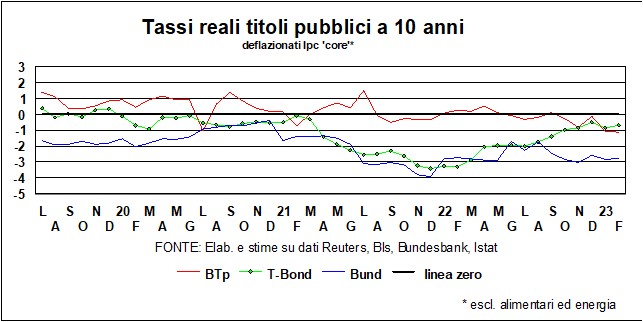
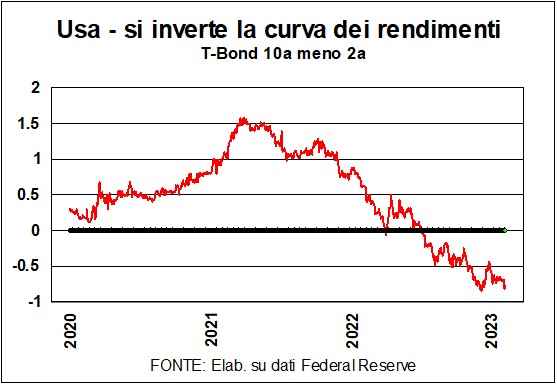
The Fed should be pleased it pushed the yield curve (10-year T-Bond minus two-year T-Bond), negative, to levels not seen for a quarter of a century: this reversal it is usually a sign of a recession. But in this anomalous cycle, crowded with black swans, these signals no longer have the value they once had.
Especially since the impact of monetary policies on the real economy must be judged according to how the other factors influencing the financial conditions, from cultural, (a currency that depreciates loosens monetary conditions) alle Bags (share prices determine the cost of equity), ai spread between risky and risk-free stocks…
The good stability of the Stock Exchanges (as long as it lasts) partly compensates for the restriction on interest rates and the Central banks they may want to insist on increases to compensate for other variables that row in the opposite direction. A dilemma, this, which, to a greater or lesser extent, manifests itself not only in America but also elsewhere, from Europe to Australia. Much will depend on how the real economy evolves. The presidents of the Fed and the ECB, Powell and Lagarde, as well as us, poor mere mortals, are all at the window.
It has been said above that the cost of money 'bites' particularly in America, with a first installmentsto 7,75% e mortgage rates at 30 years above 6%, well beyond the inflation expectations, whether these are targeted with household surveys or derived from the difference in yields between 'normal' bonds and inflation-protected bonds. In Europe such a comparison suggests that the cost of money is lighter: data from the ECB say that (as of December 2022) rates on mortgages over 10 years in the Eurozone are at 2,7%, and loans to businesses (up to 1 million euros and for terms of up to 5 years) they cost 4,5%. The data for theItaly they are slightly higher, but fortunately much less than the sovereign spread, which is influenced by political factors.
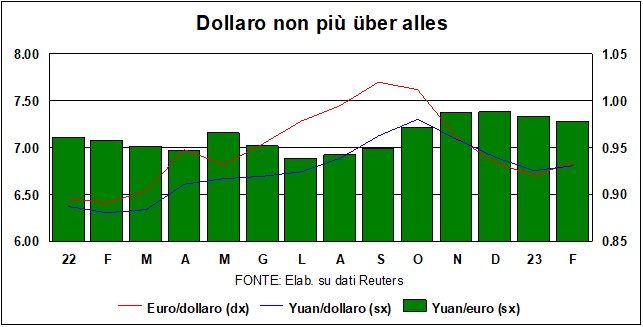
The change of dollar, after having lost in recent months, has regained some ground (both against theeuro that towards the chinese coin), for the same reasons that drove the yield of T-Bonds: the stability of the economy, which is growing despite the weakness of construction, the sector most affected by high rates. We have mentioned the five players on the badger scene a little above. On that of currencies the actors are even more, not to mention the extras. Anyway, the currency scene seems to be stabilizing around current levels.
Sui stock markets quotes, shaped by collective wisdom (or madness) (here there are millions of actors…), have resolutely embraced the hope for a break in monetary tightening (but now this granite certainty is wavering…: it is called volatility). Wall Street, which had gained about 17% since its lows in October, is giving up something, but the trends remains bold. The problem is that quotations are not only influenced by rates, but also by earnings; and here the hopes are less bold: the labor market is in favor of supply e if labor costs rise, margins shrink. There is no other choice, if we are to assume lower inflation and higher wages. As usual, time will tell, but for those who live long enough an investment in the stock remains the best use of savings.