Its excellent nutritional properties are unquestionable, as are the countless cooking and pairing possibilities, not to mention the incredible variety of species found in our country which boasts a very rich maritime gastronomic tradition with its 7.500 km of coastline. Nonetheless, fish intimidates many because it is considered too laborious to cook. The difficulties already begin at the fish counter with the uncertainty of what to buy, how to clean and finally how to cook. A useful guide which is an invitation to familiarize yourself with seafood gastronomic cuisine and to enrich our tables with wholesome and wholesome food comes from Slow Food which has published Easy Fish techniques and recipes for cooking fish, molluscs and crustaceans, a useful guide to dealing with an ingredient that is only apparently complicated like the fish world with essential advice for buying, cleaning and preparation techniques, the most suitable cooking methods and many traditional Italian recipes.
Each marine species is described with a card that provides information on the main characteristics, on what you need to know to bring them to the table in the best way. on the seasonality and sustainability of fishing, a topic not to be overlooked because many fish stocks are at risk of collapse, inviting consumers to make informed choices on the seas of origin,
Informed buying guide
It starts from the moment of purchase. When the consumer enters a fishmonger's often, he is limited to the usual species that are easy to clean and cook. Meanwhile, the first factor to take into consideration in order to have a product not only of good organoleptic quality but also safe from a hygienic-sanitary point of view is to read the label. Then the invitation is to rely on your senses: there are several signs, in fact, that do not escape the trained eye that can provide important information on the freshness or otherwise of the products.
In addition to sight and touch, smell comes into play: fresh fish is almost odourless, if smelled up close or near the gills it has a slight scent of the sea. Should you feel ammonia scents, choose something else. Moving on to molluscs: those with two-valve shells must be sold in sealed packages, with a label to guarantee the traceability of the product which shows the origin, the expiry date, and the details of the purification plant. At the time of purchase, one-valved gastropods must be alive and have a clear, shiny valve, an internal body adhering to the shell, a pleasant smell. On the other hand, to evaluate the freshness of cephalopods (squid, octopus, squid) the characteristics to look for are: bright eyes, firm flesh, intense color with shiny white parts, attention: if it tends to yellowish, firm consistency of the flesh, non-soft tentacles and delicate scent of saltiness. As for crustaceans, it is good to know that those that have a blackish green abdomen, dull eyes, relaxed muscles and a pungent odor are not fresh. Current legislation allows the use of sulphites to avoid the appearance of black spots on the outside of the animal. But sellers are required to declare the presence of these substances to consumers.
Respect seasonality: purchases based on the season ensure fresh and healthy products and protect the environment. The recommended choices
Even fish, like vegetables, have a seasonality given by their passages and their reproductive rhythms which must be respected in order not to harm the species and safeguard the eco-environment. Seasonality that varies according to the latitudes, the climatic trend, the overall conditions of the sea and the fishing stops established by law which are variable. Here's the advice:
In spring focus on anchovies, mullet, gurnard, leerfish, murmur, glance, bonito, sea bream, scampi, cuttlefish, mackerel, sea bass, horse mackerel, long wing tuna, squid.
In summer choose: garfish anchovy, barracuda, mullet, sea bream, glance, sea bream, bonito, pomfret, amberjack, white bream, sardine, scampi, cuttlefish, mackerel, sole, horse mackerel.
In autumn it's time for silverfish, squid, gray mullet, gurnard, dolphinfish, bream, glance, turbot, bream, sardine, cuttlefish, mackerel, sea bass, longline tuna, red mullet, tuna.
Finally, in winter: argentina, anchovy, squid, mantis shrimp, mullet, dolphinfish, murmur, glance, bream, bonito, monkfish, octopus, amberjack, turbot, sarago, sardine, redfish, mackerel, tuna, red mullet.
Obviously the volume contains a series of indications for cooking fish based on the variety. And finally complete with a rich series of easy-to-make recipes that will enrich your table by bringing flavors, scents of the sea and a lot of health in consideration of the enormous nutraceutical properties of fish, a real panacea for the body.
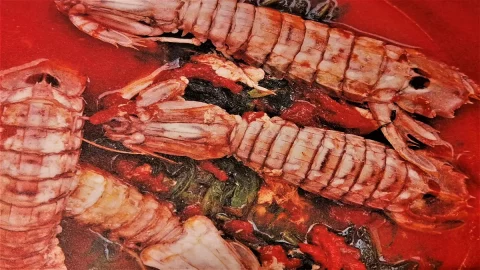
The recipe for the mantis shrimp and country chicory soup
Ingredients for four people
a dozen half-medium sized mantis shrimps
some fish heads and bones
1 kg of wild chicory
4 hg of cherry tomatoes
half a green pepper
two cloves of garlic
a sprig of parsley
stale bread
extra virgin olive oil
salt
Method
when you go to buy cicadas, in addition to asking the fishmonger to clean them for you, get some fish bones and heads, then prepare a broth by boiling the fish scraps in water with a spoonful of oil, salt, parsley and a peeled garlic clove .
Peel and wash the vegetables, blanch the chicory, drain it, cut it into strips and put it aside. Fry the garlic clove in two tablespoons of oil which, once golden, must be removed, add the cherry tomatoes and the pepper which you will have cut into small pieces, dilute with two ladles of broth and cook over moderate heat for about ten minutes.
Add the cicadas, cover with a lid and continue cooking for another 5 minutes, complete with the chicory and cook for a few more minutes. You can enrich the soup with croutons