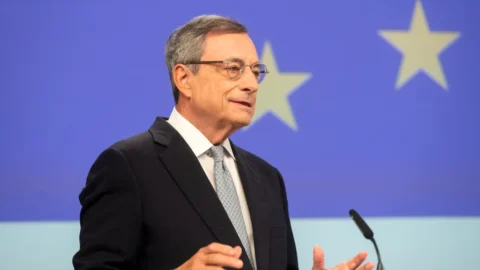
"Europe must act as one stateThe alarm was raised by the former president of the ECB and former prime minister, Mario Draghi, In its speech to the European Parliament during the 2025 parliamentary week. His speech, focused on the economy and the Competitiveness Report, highlighted the need for a common European approach: “The complexity of the policy responses, covering research, industry, trade and finance, will require an unprecedented level of coordination between all actors: national governments and parliaments, the Commission and the European Parliament”. This is not the time for half measures: according to the former president of the ECB “if recent statements outline our future, we can expect to be left largely alone to ensuring security in Ukraine and in the same Europe".
Translated: Europe must get moving, and fast. Draghi's speech put the issue of economic competitiveness and continental security on the table without mincing words.
Draghi: “EU response must be rapid and large-scale”
Draghi pressed European leaders, putting them face to face with the urgency of the moment: “The response must be quick, because time is not on our side, with the European economy stagnating while much of the world grows”. Not just speed, but also ambition: “It must be commensurate with the scale of the challenges. And it must be focused on the sectors that will drive further growth. Speed, scale and intensity will be essential”.
And for those who still haven't grasped the extent of the commitment required, Draghi reeled off the numbers: according to his Competitiveness Report, "they are 800 billion in investments per year needed to relaunch the European Union. We need to break down internal barriers, standardize, harmonize and simplify national regulations, and promote a more equity-oriented capital market”.
Draghi: “With US duties there is a risk of invasion of Chinese products”
Draghi also addressed the issue of new geopolitical challenges linked to the duties Usa. “When the report was written, the main geopolitical theme was the rise of China. Now, in the coming months the EU will have to deal with the tariffs imposed by the new US administration, hindering access to our main export market”. The risk, he warned, is that “the increase in US tariffs on China will redirect Chinese excess production capacity to Europe, further hitting European companies”. In short, there is not only American competition to fear, but also ainvasion of Chinese products in surplus.
As if that were not enough, Draghi added: “We could also be faced with policies designed to attract European companies to produce more in the United States, based on lower taxes, cheaper energy, and deregulation. Expanding industrial capacity in the United States is a key part of the government’s plan to ensure that tariffs are not inflationary.”
Draghi: “Support traditional industries”
In addition to modernising the European economy, Draghi stressed the importance of accompanying the transition of traditional industries, which remain key for Europe. “Since 2012, the sectors with the fastest growing productivity are predominantly mid-tech, such asautomotive and machinery. The sector too manufacturing employs about 30 million people, compared to 13 million in the United States. In a changing geopolitical context and with growing protectionism, maintaining strategic industries such assteel and products processes it is essential”.
But beware of false dilemmas: “Support for traditional industries is often portrayed as a binary choice: either let them go to favor new sectors, or sacrifice the development of new technologies and accept permanently low growth. But the choice does not have to be so clear-cut. If we implement reforms to make Europe more innovative, we can reduce the trade-offs between these objectives.”
Draghi on energy: “Reduce prices, anticipate the benefits of the transition”
Draghi stressed the need to urgently address the issue of energy prices. “We need to reduce energy prices, this has become imperative not only for traditional industries, but also for advanced technologies,” the former prime minister said. He added that “the decarbonization can only be sustainable if its benefits are anticipated”, suggesting an energy market reform that includes greater transparency, long-term contracts and massive investments in networks and interconnections.
Furthermore, he reiterated the importance of ensuring level playing field for clean technologies: “Decarbonization cannot mean the loss of green jobs, because companies from countries with greater state support can gain market share.”
European Defence: “Too many weaknesses”
And then there is the sore point of the defense: “The report addresses several vulnerabilities of the European economy, including our defence system. The fragmentation industrial capacity on a national basis limits the scale needed to respond effectively to defense needs”. The former ECB president highlighted how, despite the EU being “collectively third in the world in defense spending, production capacity is insufficient to meet increased demand”.
The conclusion is bitter: "national defense systems are not always interoperable nor standardized in some key parts of the supply chain. This is one of the many examples where the EU fails to reach the potential of the sum of its parts", Draghi explained.
Draghi: “United, we can overcome the challenges”
Draghi concluded his speech with an appeal to the European Parliament and other decision-making bodies: “We are counting on the Parliament to act as a protagonist: to build political unity, to create momentum for change, to hold politicians to account for their hesitations and to deliver an ambitious agenda for action. We can revive the innovative spirit of our continent. We can recover the capacity to defend our interests. And we can give hope to our peoples”. He added: “The governments and national parliaments of our continent, the Commission and the European Parliament are called to be the guardians of this hope at a turning point in the history of Europe. If united, we will rise to the challenge and succeed.".