Yesterday's "monster" council was one that intertwined the themes of war in endless hours of discussion Ukraine, climate regulations, competitiveness, and simplification. There is almost no unanimity on any of the issues. The green light for the 19th package of sanctions against Moscow the agreement was (as other times in the past) to 26 with the ploy of Hungarian Prime Minister Orbán which was brought to the Council after the decision had already been made.
European Council: €140 billion from Russian assets to Kiev
The Ukrainian president is now a regular guest in Brussels, Volodymyr Zelensky coming from Sweden where he received the promise of obtaining fighter planes for their own air defenseIn Brussels, Zelensky welcomed with satisfaction the commitment (for now only political) to have 140 billion euros for budget support and defense needs for 2026 and 2027. The “big decision” to use frozen Russian assets as a “reparation loan” to support Ukraine is “near”, Zelensky said. A good part of the frozen assets (overall 180 billion) deposited at Euroclear in Brussels.
Russian assets frozen, Belgium resists
The use of these funds, however, raises legal questions that are far from secondary and which see the strong resistance from Belgian Prime Minister De Wever and partly from the ECB"I want full risk mutualization, because the risk is great. We will face enormous compensation claims. So, if you want to do it, we will all have to do it together," declared Belgian Prime Minister Bart De Wever, laying out his conditions for approving the loan, which also include the use of other Russian funds frozen in other European countries, including non-EU countries such as the United Kingdom and Switzerland. The Council has instructed the Commission to study a technical solution that involves a loan rather than confiscation.
How to use Russian liquidity
The idea is that of use Russian liquidity to finance zero-interest loans to Ukraine, which will return the funds only after Russia has paid war reparations. Only then will Moscow be able to regain its credit on Euroclear while retaining ownership of the assets. In practice, Europe would only use the income. This is to avoid undermining the global confidence in European financial marketsWithout altering its financial position, Russia would essentially remain a creditor of Euroclear, which in turn would have a claim on the EU.
European Council: New sanctions package against Moscow approved
The Council has launched the 19th package of sanctions to hit the “shadow fleet” which evades sanctions on Russian liquefied gas, the cryptofinance andKremlin military inducedA gradual ban on LNG imports has been imposed—within six months for short-term contracts, by 2027 for long-term contracts—and a crackdown has been launched on five Russian banks, electronic payment systems, special economic zones, and cryptocurrency operators. Russian diplomats are also under scrutiny: their movement within the EU will be restricted by a new notification procedure. Both Costa and Zelensky welcomed the broadening of sanctions after the United States announced new sanctions against Russia's two largest oil companies, Rosneft and Lukoil.
European Council: What has been decided on defense?
The European Council also took stock of the work to decisively strengthen Europe's readiness for defense by 2030Italy has expressed its willingness to participate in all nine planned programmes but has not yet resolved the issues relating to the initiative. NATO purges over US arms purchases for Ukraine after Spain also declared its participation in the program.
European Council: Meloni's demands
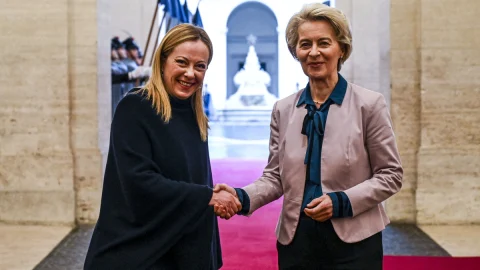
Sul climate The Commission will have to work further after the Parliament effectively rejected the latest proposal of the omnibus law which provides for various forms of flexibility before reaching the final objective of neutrality in 2050. Italian Prime Minister Giorgia Meloni he spoke extensively in a bilateral meeting with the President of the European Commission Ursula von der LeyenIn particular, Meloni would like forms of flexibility (essentially state aid) to obtain discounts in the Stability Pact to reduce energy bills given the narrow margins for maneuver with excise duties. And he also asked to count the work carried out by Italian companies (such asEni) in non-European countries.