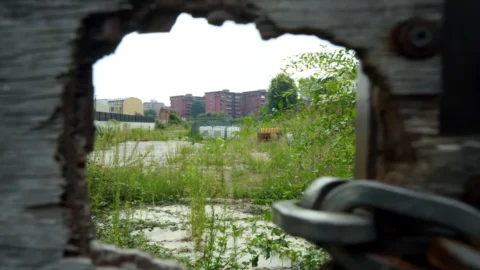
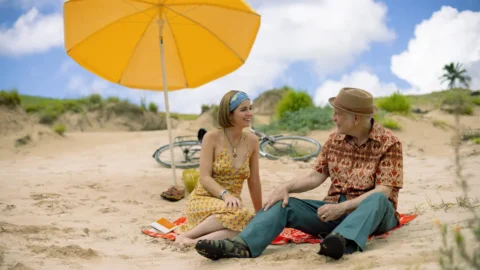
For a good part of this valuable film by Kleber Mendonça Filho, played by Wagner Moura (Narcos, and alongside Parker Posey in the series Mr. and Mrs. Smith), the plot remains hidden. Brazil 1977, we read in a superimposed blurb, while the film opens with a shot of what appear to be the feet of a dead man covered by two cardboard boxes held in place with rocks. Cut to a close-up of a foot pressing the brake inside a car. It's a yellow Beetle, stopping at a gas station. A police car also arrives: the officers aren't interested in the body but in the driver, who is searched for a check and then let go in exchange for a pack of cigarettes and perhaps some money. So the man—Marcelo, we'll soon learn (Moura, exceptional)—continues his long journey north: Recife, we'll learn later.
So far the prologue, cinematographically dazzling, the latest work of a director who was already a journalist, critic, producer, documentary maker and passionate archive connoisseur.
Ne The Secret Agent – which won the Palme d'Or at Cannes for Best Director and Best Actor, has just won two Golden Globes and is nominated for four Oscars including Best Film and Best Actor – Mendonça Filho crafts an effective narrative of the atmosphere of corruption and violence of the years during which the dictatorship was established in Brazil, using and staging the tools of memory. Photos, audio cassettes, documents, contemporary films.
To quote the director, the best documentaries are fictional films, capable, with their stories, of representing entire eras. And so: if the opening credits scroll over a series of black and white photographs to the tune of If you leave me now (Chicago), the reason why the film proceeds through chapters that are not entirely sequential is that it is told through the recordings of the protagonists' voices recorded on audio cassettes and collected by a woman, Elza, real name and profession who knows. In order not to forget one of the many stories of persecution during the regime of the generals and to avert the echoes felt in the recent past.
A little less than halfway through the film, the narrative device is revealed: they are two modern-day students who listen to the tapes, becoming witnesses to history and memory. Marcelo, whose real name is Armando, is a university researcher opposed by a corrupt businessman with ties to the regime. He returns to Recife to see his young son after the mysterious and premature death of his partner and finds refuge in the home of Dona Sebastiana, a resistance fighter who welcomes refugees, awaiting expatriation and salvation.
The child lives with his mother's parents. Alexandre, his grandfather, is a poignant figure, the true moral center of the film: a tireless worker, upholding values with simplicity and tenacity, he is an unwavering point of reference for the entire family. Alexandre's profession—he manages a movie theater in Recife—is linked to Mendonça Filho's previous work. ghost portraits, a documentary in which he showed the past and present of Recife's cinemas.
A powerful reference to cinema that the director uses as a tool of social analysis – the scenes in Dona Sebastiana's house convey the atmosphere of a captivated yet resilient Brazil – but also as a play of references and ways of weaving other stories. Alexandre's theater is currently showing Lo squalo by Spielberg, which provides the impetus for an imaginative plot twist: a shark is found on the city beach with a severed leg held in its jaws. That same leg becomes the subject of a homophobic raid, literally kicking the unfortunate night owls of a city park.
The surrealist quota – but based on an urban legend that was circulating in Recife in the 1970s – of a film that proceeds by juxtaposing different genres and time periods. Not everything fits, and the length doesn't help, but the unconventional narrative reveals itself as pure cinema, and Mendonça Filho chooses bright colors, the sun, and the carnival to represent his Recife, while maintaining the urgency of the story. There's no point in looking for the secret agent of the title. Perhaps Elza, perhaps him, or, more likely, the eponym of the many secret identities that resist the dictatorship. The past never returns, but we must know it.
At Cinema
Original title: O agent secreto, Production: Brazil, France, Holland, Germany 2025, Director: Kleber Mendonça Filho, Screenplay: Kleber Mendonça Filho, Editing: Matheus Farias, Eduardo Serrano, Photography: Evgenia Alexandrova, Main cast: Wagner Moura, Maria Fernanda Candido, Carlos Francisco, Tânia Maria, Alice Carvalho, Duration: 161'. Distribution: Filmclub Distribuzione by Minerva Pictures.