

Author's judgement:

How many can remember where they were and what they did that day in July 1969 when the first man set foot on the moon? It was a very special day, which profoundly marked the history of human civilization as well as a milestone in the conquest of space. This is the theme proposed with the film of the week: First man, directed by Damien Chazelle with Ryan Gosling and Claire Foy.
The story is taken from the biography of Neil Armstrong who was the first to descend the ladder of the Columbia spacecraft and takes us back to all the phases that preceded the launch and descent onto the terrestrial satellite. The director, former author of the lucky La La Land, draws a picture of the enormous human, as well as technological, difficulties that are faced to achieve that result. Before Apollo 11, in fact, there were countless experimental flights, some that ended in tragedy, which made the moon landing possible. Armstrong, along with his colleagues Buzz Aldrin and Michaele Collins, completed a mission to the limits of technological and scientific capabilities possible at the time. Just think of the dimensions of the computers that have been used: today they could be contained in a normal desktop while back then they were the size of a room. Armstrong's figure is the one that has entered history the most as his foot was the first to touch the lunar surface, but it is legitimate to assume that the same privilege could also have fallen to one of the other members of the crew .
His personality, as reported to us in the film, does not appear of such depth as to be remembered for particular merits. The character, somewhat shy and of few words, appears entirely concentrated on the technical and aeronautical aspects rather than on the human and symbolic ones. It almost seems that, had it been for him, the moon landing could have had the same meaning as any flight mission which he had been trained (he was a test pilot). We owe him the phrase that indelibly marked the meaning of the moon landing: "one small step for man, one giant leap for humanity". Even this sentence, considered spontaneous for a long time, was later learned through his brother that it had already been thought of before departure. All this to say that the film outlines the story, the human story of Armstrong in a way that is probably faithful to his true nature which, however, to us who have experienced it as spectators (it was the most important television event of the century, followed by almost half a billion people), takes away a part of the fascination, of the emotions that were experienced on that distant day in July of '69.
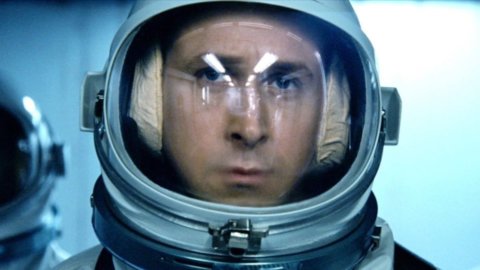
The film, presented at the opening of the recent Venice Film Festival, appeared in many respects on the verge of boring, insufficient in the dialogues, in the narrative timing, to convey the pathos of the story. The protagonist, Ryan Gosling, has a single expression that was perhaps sufficient to represent the character in his complexity and concentration of the moment. For the scientific part, nothing new or more interesting than what is already known and seen countless times is added. At the end of the long vision, over 2 hours, one remains somewhat disappointed. The expectation of being able to relive even only a small part, those hours of that distant day in our history, in our memory, was high and was largely disappointed. Likewise, all that part of humanity who had seen in that adventure the beginning of a new era in space and on the Moon, which instead was then drastically interrupted, was probably disappointed.
For the record, it is right to recall, also from a cinematographic point of view, the controversies still in progress, on the possibility that the landing on the satellite really took place. There are even those who claim that Stanley Kubrick himself was involved in the filming of some scenes filmed on the Moon. A film has also been proposed, Capricorn One, which tells precisely of the alleged false trip made by the USA to the lunar soil.





“Michael Collins”
“…Capricorn One, which tells of the alleged false trip made by the USA to the lunar soil. ”
Precisely. This article has been here for over a year and no one has fixed the glaring error. It is clear that Rossano Capricorn One has never seen it.
I won't even comment on the presumed "duty to report" which makes no sense. Hm.
How silly to mention Capricorn One which concerns the hypothesis of landing on Mars made in a film studio, among other things, even in this imaginative hypothesis the epilogue is predictable: the attempt at artifacting is unmasked. Forcing as a conspiracy theorist rather than reporting duty
Quote John. In my opinion, the Director of this newspaper, who up until now had seemed reliable and serious to me, shouldn't allow such nonsense bordering on conspiracy to be written. The credibility acquired so far depends on it.
The duty of reporting does not require the public to be reminded of baseless nonsense such as the one that concludes his review, which is otherwise very valid.